Pay a few sincere compliments

Today I told a friend and mentor that he is a jerk. Does that count as a compliment?

For years I have always defined myself as an outsider. I was always different, not in a bad way, but always in a “I have to prove myself” kind of way. I have to run further, run faster, swim longer and come out dryer then everyone else around me; a classic over achiever.

I was never part of the inner circle anywhere. Always struggling to prove my worth, and I lacked self worth. Mothers of girls I would date would ask their daughters if they really wanted to have that type of life, a blue collar life. I would be told that I was just a grease monkey and my opinion wasn’t as really valuable or I didn’t know what I was talking about.

It has been a struggle for years for me to really feel confident. But recently I have been changing. Seeking validation and proving myself have become less important. I have been successful at church, and things in churchland are going in the right direction. In many ways I feel at peace with myself and know I am growing, changing and evolving into someone new.

My friend and mentor has been instrumental in helping get here. So today I told him he was a jerk. You see, because of his help I am happier. I also no longer know who I am though. This changing, growing and developing is rewarding, but it is also terrifying because for the first time in my life I do not know who I am anymore.

It is the undiscovered country.

Read Psalm 139

What does it mean to have someone know you? And I mean really know you; to know everything about you?

A comforting thought I am sure, but also terrifying. So while it means that God knows me; my thoughts, my heart and soul, and this can give great comfort it also means I can never hide. Everything I think and do God sees. Every nasty thought about the driver in front of me, or each time I covet my neighbours ass, or in this case car, God hears and sees.

There is not place to hide, but to be completely naked and exposed before God. While some find this comforting, I would prefer to have a fig leaf or two to hide behind.

Pray the paper, Pray for the news events of the day

Is it wrong that I was praying that Rob Ford was NOT in the news today? Maybe. But I did pray the news today and with earnestness.

A Ukrainian soldier was shot and killed in Crimea. The Ukrainian President called this action the first move into the military phase of the occupation of Crimea.

I’m scared. I’m scared we have learned nothing of war and we are on the pathway to another massive war involving super powers and European powers colliding.

So I prayed for the soldiers soul, and for peace. I will continue to pray for peace and for calm in my frightened heart.

Call an Old Friend

Does IM on Facebook count? Did I cheat? I am not sure, but I did reconnect with an old friend I had not spoken to in a very long time through Facebook. That is why it is there right? To touch base with people from years ago you don’t speak to anymore and share cat pictures?

The thing is while it was good to reconnect, I also realized I am no longer the person I was or they knew. I have changed so much over the past number of years I scarcely know who I am anymore. This has just reinforced for me some thoughts I have been having for a while now.

If I am no longer the person I used to define myself as, then who am I? Am I clay, continually being folded into something new? Will I never be able to point to something, a generalization as to who I am?

There is something freeing about not being the person you thought you were and something completely terrifying about not knowing who you are.

$5 gift cards

Stopped at Timmies this morning. Grab my coffee and breakfast sandwich and picked up 2 gift cards load with $5 on them.

I am not planning to be downtown today so I will just keep them on me and that way I will be ready when I meet a brother or sister that is in need of some food and a little help.

Tis proactive planning to help a random stranger is great.

Do Someone Else’s Chore

As I do most of the cooking and cleaning at home, this challenge left me one messy option. Cleaning the kitty litter.

How do two little cats make such a mess I will never know. But I scoped, bagged and tossed out the litter and the challenge was completed.

Did I learn anything? Not sure. Have I grown as a person? Don’t think so. Have I banked good will? I think so. Maybe I can cash it in the next time the drains need to be cleaned out??

No Bitching Day

As a lenten discipline this is really a hard one. I had no idea how much negativity came from me each day. Whether it was to get annoyed at someone knocking on the door looking for the Consistory next door (just read the sign) or someone who frankly drives way to slowly, I do bitch a lot. A little too much in fact.

Many times throughout the day I had to stop myself and say no bitching and force myself to look at the positive side of the situation. The guy coming to the door looking for the Consistory was looking to pick up equipment for a parent, what a kind and loving act. The slow driver may have been looking for an address or simply being cautious.

Far too often we focus on the negative. We complain a lot. We rarely compliment or say positives. This was a good learning experience and one I hope to put into practice more often and not just on no Bitching Day.

The Other End of Switching

I switched up my lenten devotions from last friday, turn off the car radio. Friday’s are my day off so I wasn’t likely to be driving. Yesterday was the day I switched to. And of course it was snowing so travel was longer and the silence in the car was deafening.

The first thing that happened is my mind kept wondering. Thoughts would bubble up and then I would see something and a new thought would just pop into my head. It was a total ADHD squirrel moment. I couldn’t seem to focus.

Now one would hope that solutions to problems would pop into my head. But nope. Just a continual stream that kept jumping tracks to the next topic.

So Challenge accepted, challenge finished…learnings, I need something to focus me and silence sucks.

Oh, and I think I have a bad wheel bearing in my car.

Something of Beauty

Today’s Lenten Challenge from St Andrew Memorial was to stare out the window until you see something of beauty you have never noticed before.

Okay I cheated. This morning was clericus, the monthly meeting of all the clerics in the Deanery of London. It was held at St Aiden’s here in London. St Aiden’s sits right on the edge of the sifton bog.

As we were praying this morning I glanced out the window and watch a deer move through the bog. Right in the middle of London is chaos, cars, people, traffic and this still moment of nature slowly passing through like a ghost. It was beautiful.

So no I didn’t stare out my window, but I did see something of beauty out of a window today. I think it counts.

5 minutes of silence

Today’s Lenten challenge from St Andrew Memorial was to take 5 minutes of silence at noon.

This could have been easy for me since I work alone in the church most days. I am often in silence. But today I decided to really have 5 minutes of silence. I left my computer and phone, went into the sanctuary and sat there breathing for 5 minutes.

Know what I learned? 5 minutes is a long time!! Especially for an extrovert like myself. I am not sure this challenge helped me. Other then to practice my counting skills. Maybe if I try the 5 minutes of silence next time in a park or something…but then again that is me distracting myself with things around me. Which probably defeats the purpose.

Needless to say. Challenge completed. Not sure I learned anything.

Give $20 to a non profit of your choice

Saturday’s Lenten challenge from St Andrew Memorial Anglican Church is to give $20 to a non profit of my choosing. Sure it could be easy to slip another $20 in my envelope on Sunday, but I think that will defeat the purpose of this challenge.

A couple of months ago I reached out to a friend, Megan Walker, for help in preparing a report for the bishops on human sexuality, the over sexualization in our culture, gender stereotypes and the pervasiveness of porn. What I learned while writing that report is that I am privileged, or I should say how privileged I am.

While I cannot deny my privilege as a white man, I can choose to use it, even if only in a small way to make a difference. I do not want to give a hand up to people, rather I want to get under them, to give them shoulders to stand on. The difference in approach is about getting into muck with others, walking in solidarity and accompanying others in their journey.

So I will continue to look for ways to walk in solidarity, but in the context of the Lenten Challenge I decided that the best place I could donate my $20 was to the London Abused Women’s Centre.

Switching Days, 5 Items to the Goodwill

Friday’s Lenten challenge from St Andrew Memorial Anglican Church was to turn the car radio off. Since Friday is my day off and I wasn’t driving it seemed fair that I switch days with another challenge.

Next Wednesday is donate 5 Items to the Goodwill. So on my day off I went through my closet and bagged up about 10 items I no longer wear or will wear again. I have set them in my car, and will take them to Mission Services rather then the Goodwill on Monday.

Who knew de-cluttering could be so helpful. I need to stay on top of keeping my life de-cluttered.

Walk, bus, car pool or bike

Thursday’s lenten observation from St Andrew Memorial Anglican Church was to walk, bike, car pool or bus. This was a hard one for me. Mostly cause I am a commuter. I live in one city and work in another. So to help accomplish the lenten challenge I drove to work, but bussed and walked to all my appointments.

What I experienced was people. I talked to a few random strangers at the bus stop, nodded hello to dozens of people on the street and had genuine human contact. I should do this more often…get out of the car and meet my neighbours.

Pray for your enemies

Yesterday’s Lenten challenge from St Andrew Memorial Anglican Church was to pray for an enemy. You would think priest don’t have enemies, but unfortunately that isn’t true. Priest are human, and we hold grudges. So yesterday I prayed for one of my “Newmans” (Senfeild reference).

Do I think I have overcome my bitterness? No. But swallowing my pride and praying for the “other” is a good experience and especially helps me know that even if I disagree with others, I can still love them…if only at a distance for now.

And in case you are curious, no I didn’t pray for the Leafs…baby steps.

A Lenten Journey

Over the course of the next forty days I will be reflecting on my lenten journey. In case you are not aware, lent is the time between Ash Wednesday (March 5th this year) and Easter (April 20th). And it does not include Sundays. Sundays are always a day of celebration when we celebrate the Eucharist (communion).

Some of the challenges from St Andrew Memorial are reflective, while others are about giving and still others are about seeing things for the first time. I hope you enjoy some of my reflections and engage in your own time of reflection as we prepare for Easter.

If you are interested in the Lenten Challenge or what to know the daily challenges you can follow St Andrew Memorial on Facebook.

Genesis 16

Now Sarai, Abram’s wife, bore him no children. She had an Egyptian slave-girl whose name was Hagar, and Sarai said to Abram, ‘You see that the Lord has prevented me from bearing children; go in to my slave-girl; it may be that I shall obtain children by her.’ And Abram listened to the voice of Sarai. So, after Abram had lived for ten years in the land of Canaan, Sarai, Abram’s wife, took Hagar the Egyptian, her slave-girl, and gave her to her husband Abram as a wife. He went in to Hagar, and she conceived; and when she saw that she had conceived, she looked with contempt on her mistress. Then Sarai said to Abram, ‘May the wrong done to me be on you! I gave my slave-girl to your embrace, and when she saw that she had conceived, she looked on me with contempt. May the Lord judge between you and me!’ But Abram said to Sarai, ‘Your slave-girl is in your power; do to her as you please.’ Then Sarai dealt harshly with her, and she ran away from her.

The angel of the Lord found her by a spring of water in the wilderness, the spring on the way to Shur. And he said, ‘Hagar, slave-girl of Sarai, where have you come from and where are you going?’ She said, ‘I am running away from my mistress Sarai.’ The angel of the Lord said to her, ‘Return to your mistress, and submit to her.’ The angel of the Lord also said to her, ‘I will so greatly multiply your offspring that they cannot be counted for multitude.’ And the angel of the Lord said to her,
‘Now you have conceived and shall bear a son;
you shall call him Ishmael,*
for the Lord has given heed to your affliction.
He shall be a wild ass of a man,
with his hand against everyone,
and everyone’s hand against him;
and he shall live at odds with all his kin.’
So she named the Lord who spoke to her, ‘You are El-roi’;* for she said, ‘Have I really seen God and remained alive after seeing him?’* Therefore the well was called Beer-lahai-roi;* it lies between Kadesh and Bered.

Hagar bore Abram a son; and Abram named his son, whom Hagar bore, Ishmael. Abram was eighty-six years old when Hagar bore him* Ishmael.

Abram and Sarai have no children, even though God has promised that his descendants will be like the stars of the heaven. Rather then trusting in God they decide they will fix the situation. They will assert their power in the situation and mold and shape the situation to their desires.

Sarai convinces Abram to take her slave girl, Haggai, as a wife. Of course this was in the time when men did have multiple wives so this really shouldn’t shock us that Abram has more then one wife. Monogamy is a rather modern invention and the sacrament of marriage did come into institution until the 12th century.

What is more shocking about this passage is the desire for humanity to control all situations, impose their will upon it and upon others in an attempt to get their desires, their greed fulfilled.

Abram then “goes into” Haggai, she does conceive and Sarai becomes jealous. She sees the way that Haggai looks at her and no doubt looks at Abram. This creates a division between Abram and Sarai. In an attempt to mend fences and control the situation Abram tells Sarai that Haggai is her slave girl, treat her as you will. And not surprisingly she treats her badly, oppresses her and drives her away.

It is in the desert, by a spring, that faith in God’s providence is restored. And Abram, God’s chosen, his wife Sarai, does not restore it or any of is kin. It is restored by a slave girl, a concubine, abused and cast off, alone in the desert and pregnant.

God’s preference for the poor, the oppressed and the marginalized is clearly displayed in this chapter of Genesis. It is to the oppressed that the angel of the Lord appears. It is the oppressed that God seeks to deliver. Not the leader of the household, Abram, not his wife Sarai, but God goes to be with a scared, lonely, hurt and abused pregnant slave girl.

SALVADORAN ARCHBISHOP OSCAR ROMEROI am preparing to leave again in a few days for El Salvador. I will once again walk in the steps of Monsenor Oscar Romero. I will once again experience one of the birthplaces of Liberation Theology. And I will once again be molded and shaped, have my expectations turned upon their heads and constantly be surprised by God’s preference for the poor. It will be in El Salvador that I will once again experience the presence of God.

“There are many things that can only be seen through eyes that have cried.”
-Oscar Romero

Genesis 15

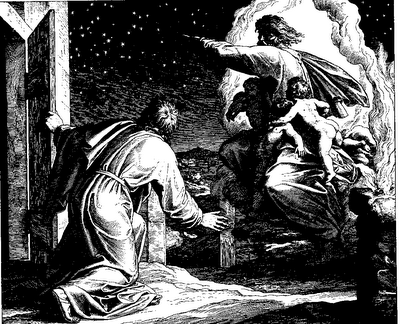
After these things the word of the Lord came to Abram in a vision, ‘Do not be afraid, Abram, I am your shield; your reward shall be very great.’ But Abram said, ‘O Lord God, what will you give me, for I continue childless, and the heir of my house is Eliezer of Damascus?’* And Abram said, ‘You have given me no offspring, and so a slave born in my house is to be my heir.’ But the word of the Lord came to him, ‘This man shall not be your heir; no one but your very own issue shall be your heir.’ He brought him outside and said, ‘Look towards heaven and count the stars, if you are able to count them.’ Then he said to him, ‘So shall your descendants be.’ And he believed the Lord; and the Lord * reckoned it to him as righteousness.

Then he said to him, ‘I am the Lord who brought you from Ur of the Chaldeans, to give you this land to possess.’ But he said, ‘O Lord God, how am I to know that I shall possess it?’ He said to him, ‘Bring me a heifer three years old, a female goat three years old, a ram three years old, a turtle-dove, and a young pigeon.’ He brought him all these and cut them in two, laying each half over against the other; but he did not cut the birds in two. And when birds of prey came down on the carcasses, Abram drove them away.

As the sun was going down, a deep sleep fell upon Abram, and a deep and terrifying darkness descended upon him. Then the Lord * said to Abram, ‘Know this for certain, that your offspring shall be aliens in a land that is not theirs, and shall be slaves there, and they shall be oppressed for four hundred years; but I will bring judgement on the nation that they serve, and afterwards they shall come out with great possessions. As for yourself, you shall go to your ancestors in peace; you shall be buried in a good old age. And they shall come back here in the fourth generation; for the iniquity of the Amorites is not yet complete.’

When the sun had gone down and it was dark, a smoking fire-pot and a flaming torch passed between these pieces. On that day the Lord made a covenant with Abram, saying, ‘To your descendants I give this land, from the river of Egypt to the great river, the river Euphrates, the land of the Kenites, the Kenizzites, the Kadmonites, the Hittites, the Perizzites, the Rephaim, the Amorites, the Canaanites, the Girgashites, and the Jebusites.’

Making a deal with God can often be a tricky endeavor and truth be told it doesn’t often go well. There will be many more examples of this later on in scripture, but for now let us stay within the confines of Genesis only.

Abram here in Chapter 15 makes a covenant with God surrounding the land, but more importantly surrounding who will rule that land; namely offspring. To this point in Genesis Abram has not had a child. Abram has had no offspring. No descendants to carry on his name. No descendants who will rule over the land to which he is being promised.

Yet God promises Abram that his descendants will be as plentiful as the stars and they will have the land, but first they will suffer in slavery before being brought to the land. In other words, God hears the pleas and prayers of Abram and God answers them, just not in the time and the way that Abram would prefer.

GenieThis is often the case with prayer. We assume that because we have not gotten exactly what we wanted immediately that God has not heard our prayer. We have somehow tricked ourselves into believing if we pray hard enough and believe long enough that God will grant us whatever wish we want.

But what this passage highlights for us is that God is not a Genie in a Bottle who if rubbed the right way will grant us wishes.

Instead, we learn that God does indeed answer prayer, just sometimes the answer may be: not yet, maybe later or worse, no. God hears our pleas and God sends to us who and what we need for situations and life, but not necessarily what we want.

This is a hard lesson for us to learn and a hard lesson for Abram. He gets his many descendants, as plentiful as the stars. Yet first they must become slaves and suffer horrible hardships. Lesson, be careful what you pray for.

Making the Dollars make sense

http://www.dreamstime.com/royalty-free-stock-image-new-religion-image5258556The pay structure in the Diocese of Huron, of which I am a member, is based upon years of service. Simply put, the more years of service as an ordained clergy, the higher the stipend. A new or relative new clergy will make between 32 300 and 34 800 a year. Meanwhile, for example, a senior clergy with 30 or 35 years experience will make 47 800 and 50 800 respectively.

This cost is born by the individual congregation. Couple this with housing cost, either through a rectory (the house beside the church where the priest lives) or an housing allowance at a rate of 40% of the clergy’s stipend, in conjunction with things like EI, CPP and all other deductions, the cost of a clergy person can rise dramatically.

Smaller congregations, whether rural or city, often have a difficult time keeping senior clergy due to high salary cost. As a result the practice in the diocese is to go to a starter parish, which can afford a 0-3 year level clergy and then the clergy moves on. The trajectory is for senior clergy to end up in larger city parishes while junior clergy are in small parishes, often rural.

This communicates two things to me. One, rural parish are seen to be not as important as the city parishes and two, this is not in line with the strategic plan of the Diocese of Huron to place the right clergy in the right place to encourage growth and renewal.

Financial constraints will:

  • Take the right person out of the location they need to be to effectively serve God and help build up the Kingdom of God.
  • It presupposes that senior clergy ought to be in cities and that junior clergy, who may have dynamic vision and energy, are not let loose in the environment most conducive to their and the church’s success.
  • And finally, for senior clergy who are winding down their careers the demands of an active city parish may be not what they are in need and capable of giving, yet that is the only parish that can afford their stipend.
  • Of course there are many other criticism to be leveled at this system, or any system for that matter. It is easy to say you are doing it wrong, without offering a new way of doing things. So to that end, I have a modest proposal, which I am sure others will criticize, and in the end I hope they do for that would mean we are having an honest conversation about the needs of the church.

    In times of crisis management must centralize. It is safe to say, the church is in crisis. Let us say there are 88 parishes in Huron with approximately 100 employed clergy. Years of service will vary, but it would be safe to assume that medium years of service would be in the range 10-13 years.

    If the total cost of clergy was pooled and then equally apportioned out to each parish, then each parish would be paying the same for their clergy. This would put clergy cost for each parish at the same amount, roughly between 37 500 to 38 900. This would have the net effect of being able to send the right clergy to the right location, which could include a clergy with 30 years experience to a rural multi point parish.

    To make this system fair, the total cost of clergy would have to be calculated upon minimum stipend only. If a parishes wishes to pay a clergy more, then that is to be negotiated between the individual clergy and the parish and the additional cost born by that parish alone.

    It is true that this would put a burden on smaller parishes that may not be able to carry this additional cost on the short term. But with the right person in the right place, growth and renewal will come. It also demonstrates that the rural and small city parishes are not starter parishes who live in constant fear of their clergy leaving, but rather can build strong, vibrant relationships with their clergy, participate in missional activities and get back to growing the Kingdom of God.

    Closing the doors

    Church DoorsThere is no denying it. Churches are going to close. Christendom is no more and there is a shift happening in society. And while closing churches will become a necessity in the coming years as the size of congregations continues to dwindle, or the very cost to keep the building open and in good repair just no longer is reasonable or a good use of the resources that we have been entrusted with, I would like to offer something for us to think on.

    The church long before it was associated with a building was simply a gathering of the people. The church always was and still is the people. Our understanding of what it means to be “church” ought to have grown out of our understanding of what the word truly means.

    Church, or Ekklesia, is God’s call out to the world, literally. Ekklesia parsed out gives us:

    Ekk- out or out of
    Kaleo- I/you/we call

    Literally Ekklesia is God’s call out to the world. The assembly that Ekklesia came to be known as, the church, represents all those joined in baptism to God, participating in the Missio Dei, the mission of God, by taking up a baptismal life and following the teachings of Jesus Christ.

    That life in Jesus Christ does not stop when the church’s doors are closed on Sunday or permanently. Rather that life propels us forth from the font to the world. The people still gather, in person, in homes, virtually and where needed. Prayers are still offered and God is still worshipped and glorified. The poor are served and the kingdom of God is realized a little more each and everyday. Church has not ended because the doors are closed because church is more than bricks and mortar.

    We cannot close the church, because we cannot close people. Buildings close, churches don’t.

    The Song of the Summer (NSFW)

    Driving into work today I was flipping channels on the radio and came across Tom Cochrane’s Life is a Highway and I was transported back to 1991 and the end of high school, or at least what would have been the end had I ever bothered to finish high school.

    Life is Highway is a great driving song, catchy and easy to listen to. It is no wonder that it was the song of the summer way back in 1991.

    The song of the summer for 2013 seems to be Robin Thicke’s Blurred Lines. It has been featured on The Colbert Report and even had a special feature on the VMA with Miley Cirus. (Which we will try to avoid talking about)

    It too is catchy, musically speaking. The lyrics leave a little to be desired though. It is troubling to me (queue old man rant about music back in my day and how it has changed) that music today must be so denigrating to women, hyper sexualizing them in order to sell singles and video counts on Youtube.

    I know sex sells. It always has. But things seem to have shifted somewhere along the way and not for the better. The hyper-sexualization of women and debasing them down to their body parts seems extreme these days, or at least more honest and up front.

    For instance, instead of releasing a music video for the song Blurred Lines, Robin Thicke released two, both readily available on Youtube. Notice the difference in the second one?

    We have become a culture that requires more and more that our women be chaste and pure just so that we can sacrifice them upon the altar of our fantasies. This is a disturbing trend.

    Interesting that life’s highway has brought us yet again to the off ramp of needing a resurgence of feminism.

    Genesis 14:17-24

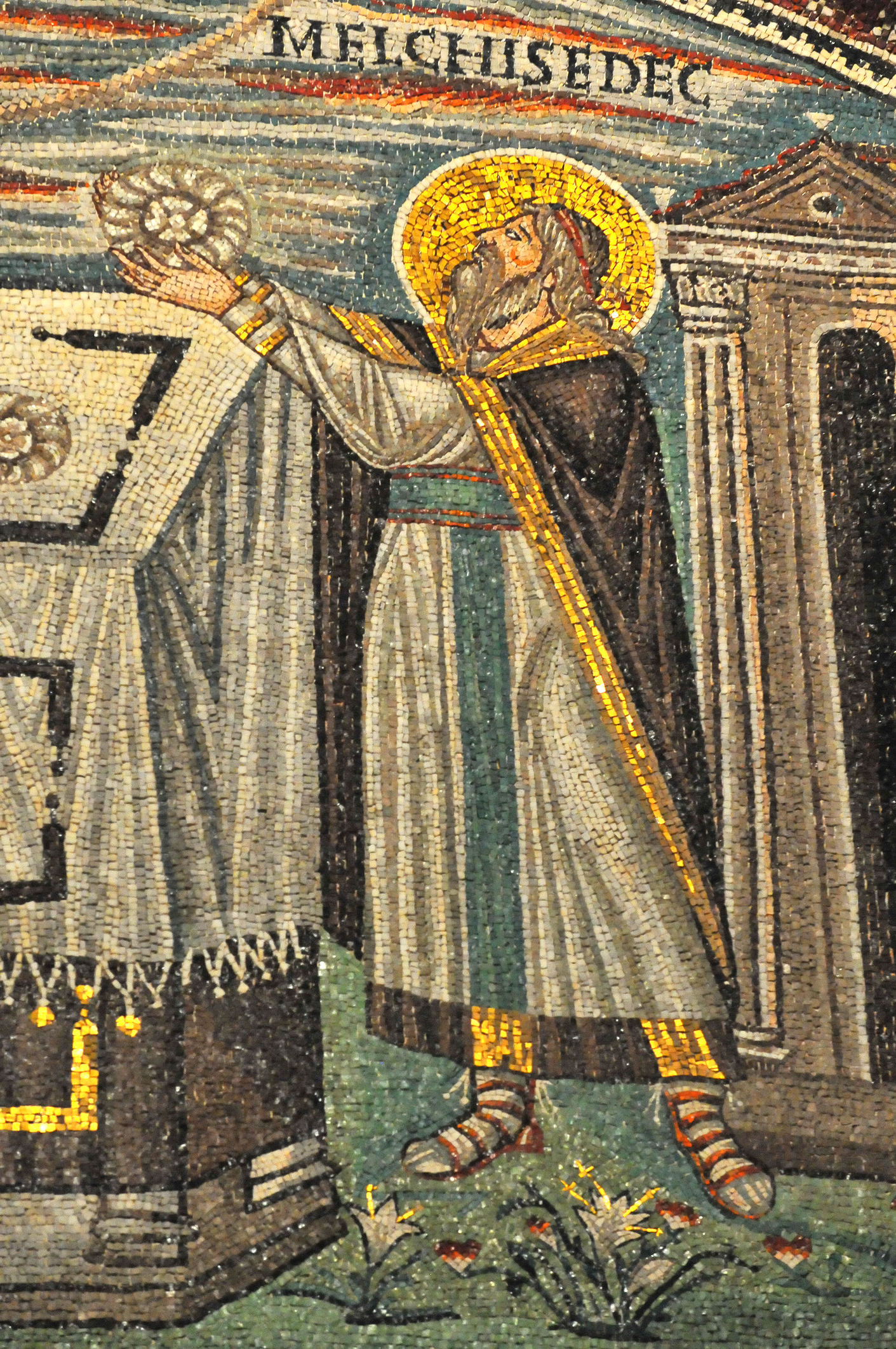
    After his return from the defeat of Chedorlaomer and the kings who were with him, the king of Sodom went out to meet him at the Valley of Shaveh (that is, the King’s Valley). And King Melchizedek of Salem brought out bread and wine; he was priest of God Most High. He blessed him and said,
    ‘Blessed be Abram by God Most High,
    maker of heaven and earth;
    and blessed be God Most High,
    who has delivered your enemies into your hand!’
    And Abram gave him one-tenth of everything. Then the king of Sodom said to Abram, ‘Give me the people, but take the goods for yourself.’ But Abram said to the king of Sodom, ‘I have sworn to the Lord, God Most High, maker of heaven and earth, that I would not take a thread or a sandal-thong or anything that is yours, so that you might not say, “I have made Abram rich.” I will take nothing but what the young men have eaten, and the share of the men who went with me—Aner, Eshcol, and Mamre. Let them take their share.’

    http://www.dreamstime.com/stock-photography-king-jerusalem-image21873522This is a very dense yet interestingly revealing passage about the nature of God and our relationship to Him. We are still very early in the Old Testament and the covenant has yet to be made with Abraham and the chosen people have yet to come into the Promised Land and Jerusalem has yet to become the Holy City.

    While I have been avoiding cross-referencing passages, we must look at this one though through Hebrews 7:1-3 in hopes of parsing out a translation that will help us glean some insight into this passage from Genesis. My reasoning for allowing cross-referencing on this passage is slowly a language issue, to help us better understand who Melchizedek is, and what importance can be placed upon this High Priest of God.

    In Hebrews 7:1-3 the name of this “Melchizedek, King of Salem, which is, King of peace; without father, without mother, without descent, having neither beginning of days, nor end of life.” And from Melchizedek Abram accepts blessing.

    The significance of this was that Salem meant and would become Jerusalem, and so Abram is linked already with what is to become the Holy City and the center of his peoples’ lives. But furthermore the High Priest and Priests of this city would later in history adapt themselves to the conquering people that would come into their land, the Israelites, and adapt to their faith.

    Interesting that long before Christianity adapted cultural and religious norms in mission countries, the Jewish people would also partake of the same practice. Cultural assimilation and cultural blending goes far back into the recess of time and the bible it seems.

    But what does it mean that the chosen people will accept as their priest, priest of the order of Melchizedek instead of Levites, or in conjunction with Levites? For Christians today fighting to maintain traditions exactly that have been handed down to us and creating museums of our churches instead of places of worship this passage can utterly undermine those initiatives.

    Long ago, in both our common Jewish and Christian distant past there was cultural adaptation and assimilation of new ideas, new traditions and new forms of worship. For us in the Anglican Church this should be a wake up call that it is okay to do worship without the BCP or the BAS, and that God can be found in Fresh Expression of worship.

    In fact, one could say it is scripturally based to try new things in hopes of turning the local area we find ourselves in, our Salem, into a Holy City, a Jerusalem; a city and place where we can come to meet and be with God here on earth.

    The church and contest

    Attention all clergy!!

    Your work hereMy partner and I are excited to announce an exciting opportunity for you. In a few months we will be getting married and would like a custom marriage service designed for us. We want it to be special and unique, so nothing out of the box. (Or book)

    So we decided that we would hold a CONTEST!! That’s right. Simply submit your marriage service that you designed for us to the email address below and we will review them. We look forward to announcing the winner on our wedding website. (What great recognition for you and your work!!)

    Wait!! There is more. Not only will you be acknowledged for your hard work on our website and at our wedding too when the officiant we hire to perform your service gives you a shoot out!! But you will also receive a new Ipad for all your efforts.

    We look forward to reviewing your submissions soon.

    Okay maybe the above contest is tongue in cheek. But that is how the church comes across to graphic designers, web developers and artist when we hold a “contest” so we can get a free poster for an event or a new logo for our church.

    I know it is well intentioned. But it is also insulting to highly trained professionals.

    It says:

    We do not value your work

    We want something for free

    We don’t understand the industry and therefor look amateurish.

    I hope in the future we, clergy and church leaders, who want to have our own work valued and respected would afford the same respect to other industries. And we would always look to fairly compensate people for their hard work in their trained field of expertise and be grateful when those we have contracted for work offer it at a reduced rate or free as a gift to God.

    Content vs Relationships

    Luke 24:13-25

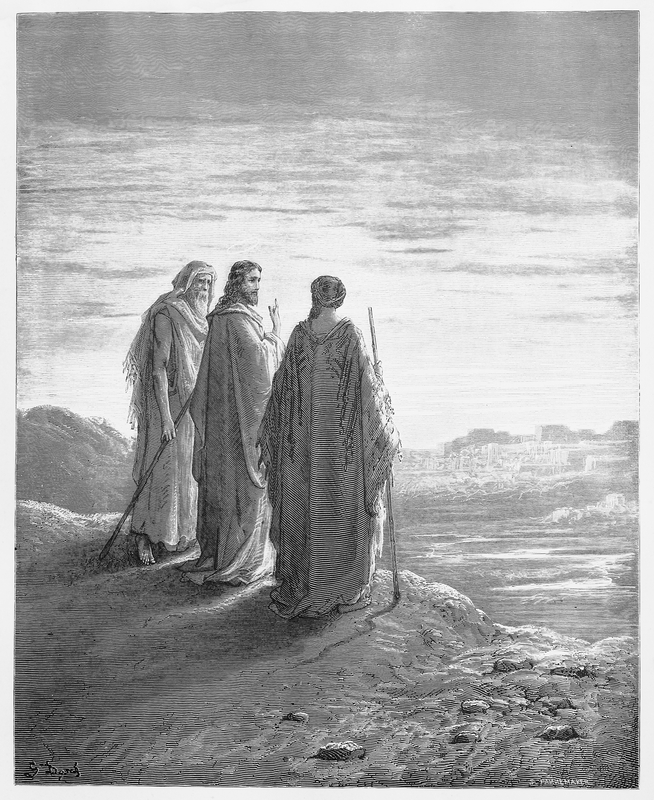
    http://www.dreamstime.com/stock-photos-disciples-encounter-jesus-road-to-emmaus-picture-holy-scriptures-old-new-testaments-books-collection-image30190343The road to Emmaus is one of the best biblical accounts of how social media works. And I find it striking that in this 2000-year-old account of a resurrection appearance of Jesus Christ we have the very fundamentals of social media. But then again should I be surprised? The Gospel is, after all, always astonishing.

    In this passage Jesus appears to the disciples, although they do not yet know who he is. He walks with them along the long and dusty road. He comes into relationship with them. Jesus dialogues with them and lets them open up to him about themselves and what has just transpired in Jerusalem. Jesus does not force the conversation or push content upon them instead he builds a relationship.

    After a time, once a relationship has been established, Jesus continues to dialogue with them, but he also begins to offer content. He opens their minds to scripture. This is tricky of course, because this is the moment when we would want to push content upon people, but instead Jesus demonstrates for us that the time is not yet right. Instead, He focuses on building the relationship, understanding a subject (namely the scriptures) and how we must first come to walk together before being bombarded with content, the finale is when he appears to the disciples in the breaking of the bread.

    Jesus on the road to Emmaus knows something fundamentally important about relationship building that we lose at times in social media. We push content, new post, new blogs, new sermons posted to the web. We push content in the hopes of gaining new followers and new “likes”. We purchase ads to further our reach and further the reach of our content. And by doing so we forget what Jesus talked about so long ago, and that is to come into relationship with people.

    Pushing content seems natural to us. Having something new up on our Facebook pages and websites seems critically important in an ever-increasing world based on consumption. Yet, I think, Jesus is demonstrating for us on that long and dusty road that instead of consuming, we ought to be coming into relationship with one another.

    So always remember, that while content is important, so also is it important to stop, engage and interact with those that like, comment or share our posts. Take time in your day to read what others put forward on their social networks and work on building relationships. Enter into dialogue and discuss, get to know one another.

    In today’s media savvy world, it does not take long to develop a reputation as a spammer, content pusher and a social media version of an ads pusher. And remember we count success not in number of likes, multiple points of entry into our churches or growth, but we count success always in the spreading of the Gospel message and coming into real relationship with our brothers and sisters.

    Holy Week Sermon Series

    The follow sermon series was inspired from my recent mission trip to El Salvador with Foundation Cristosal. Walking through Holy Week is something I had the privilege to do this past year, not just during Holy Week itself, but also in the lives, memory and people of El Salvador. I have included for you pictures that inspired my thoughts. I hope and pray that my words and thoughts have honoured the people we met and the stories we were entrusted with.

    Palm Sunday

    Readings:
    Isaiah 50:4-9b
    Psalm 31:9-16
    Philippians 2:5-11
    Luke 22:14-23:56

    When you step off the plane in El Salvador and you enter into the city of San Salvador, without realizing it you are stepping into the biblical narrative. That isn’t to say that El Salvador is some backwards third world country that has you stepping backwards 2000 years into the past, for San Salvador is much like any North American city complete with gas stations, shopping malls and of course ice cream shops, just ask the Dean of the Cathedral. Every time we past one there was a Kevin shaped cloud in the place where Kevin recently stood, right out of Loony Tune cartoons fame.

    No what I mean is that the biblical story has been lived out in El Salvador in our generation. This becomes abundant clear as you drive around the city and you steep yourself in its people and its history. This is the place that suffered its people in slavery, suppressed by Pharaoh, an oligarchy. This is the place where they journeyed for years in exile during the civil war, searching for their promise land, to share all that God had promised them. And this is the place that gave birth to some of the most profound people in the Liberation Theology, messiahs of sorts.

    Let me explain. You see before Oscar Romero was Oscar Romero, he was a dutiful priest in El Salvador. He was, in many ways, ill prepared for his ascension to the role of Archbishop of the Roman Catholic Church in El Salvador. He was a quiet man, who more often then not shrank from confrontation. He was prayerful of course and he lived a pious and meager life, serving the people that God sent to him.

    But much like the Catholic Church as a whole, he focused on the salvation of the person’s soul. The scripture that informed the church’s position was, “blessed are the poor for theirs shall be the kingdom of heaven”. He taught, much like the rest of the church, that you ought to be happy with your lot in this life for in the kingdom of heaven they would receive their reward. And the church was a tool of the right wing government, the military and the oligarchy that helped to maintain the status quo and oppress the poor. Hardly the principles of a legend, like Romero.
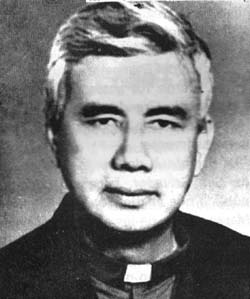
    Rutilio_grandeThat was, of course, till Romero met a friend and mentor, Padre Grande. Padre Grande was a revolutionary, a rogue and a radical. And he was a mentor to Romero. Padre Grande preached a radical message. He preached that God loved all, equally in this world and in the next. But more so he preached that God went to the poor, to those that suffers. That God goes to the poor of El Salvador and that God wants the wealth of the world, and especially of El Salvador, to be redistributed so that all share in God’s abundance.

    This revolutionary and a counter cultural message of the times rubbed the oligarchy the wrong way. Romero hadn’t adopted this position when he ascended to be archbishop of El Salvador. In fact, he was chosen because to be archbishop because he was quiet and a moderate. The government and the oligarchy figured he would be a useful tool in using religion as the opiate of the masses in an effort to maintain the status quo.

    Two events changed the course of Romero’s life and therefor changed the destiny of the people of El Salvador. He was asked to be present by the army at a student protest, for the army feared violence would break out and the archbishop’s presence with the military could help keep the peace. Three times the generals asked Romero, and three times Romero quietly and simply said he would pray for them.

    When Romero woke the next day and opened the paper, he read of the violence that had occurred. Romero had an epiphany that day. A moment when the heavens are tore open and God descends. That doing nothing was, in fact, a choice, and therefore he was complicit with the murders and the violence that had just occurred.

    And while Romero was wrestle with this knowledge, during a period of fasting and prayer, Padre Grande his mentor and friend and leader in the liberation theology movement in the Roman Catholic Church in El Salvador, was assassinated by the government.

    These two events, the gift from God of knowledge and the death of a mentor spurred Romero into a new direction, a new ministry; a ministry to be with the poor and speak on behalf the poor. A ministry that focused on the life of Christ, the life that Christ lead; of feeding the poor, healing the sick and caring for the most vulnerable of society.

    If this reminds you of the baptism of Christ and Jesus’s relationship with John the Baptist, it should, for it is mirror of the Gospel story. And for the next three years, three years, Romero would champion the cause of the poor. For three years, much like Christ himself, Romero worked at healing a nation and a people divided. The oligarchy, the Pharisees though, fought him every step of the way.

    Until after three years they could take no more. The Pharisees, the oligarchy, conspired after one of the most controversial sermons Romero preached in which he ordered the soldiers of the military to disobey orders when ordered to kill their brother or sister, their fellow Salvadorian. That God’s law of thou shall not kill trumps any order from officers in the military, or from the oligarchy, the Pharisees.
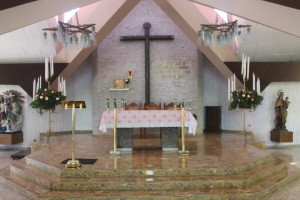
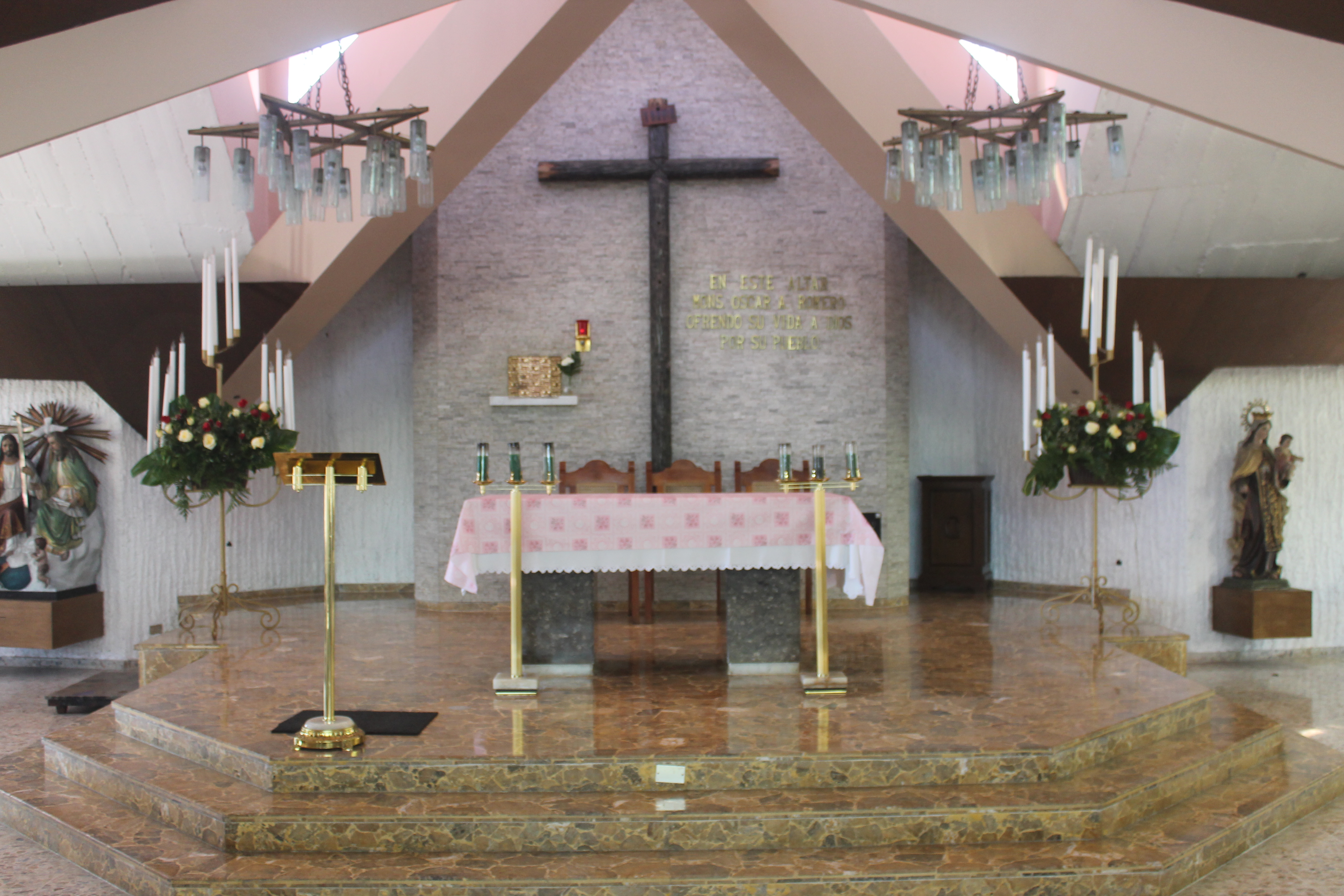
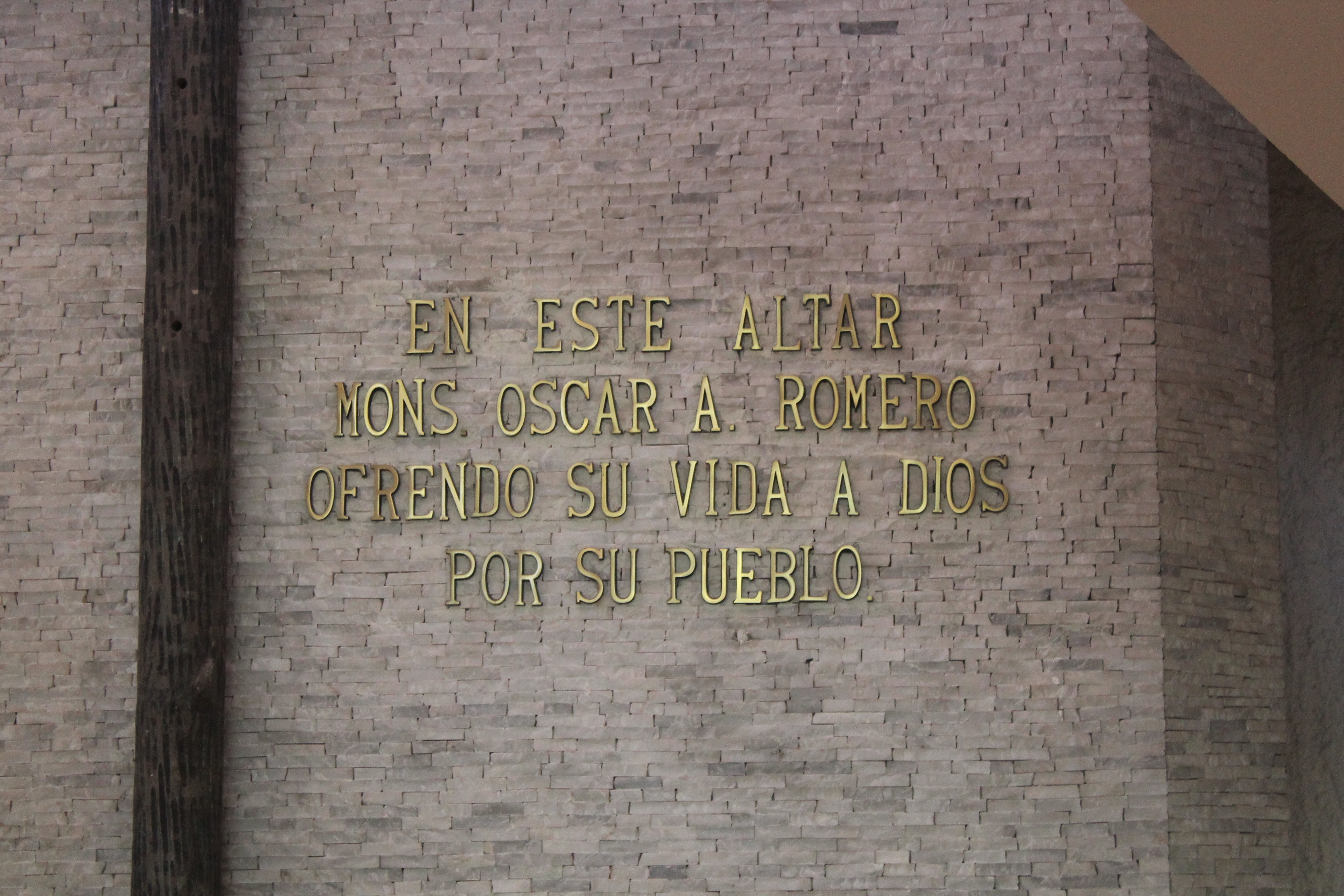
    IMG_5112And while preparing to celebrate the last supper, the Eucharist, the greatest the offering to God of the church, Romero was assassinated. Gunned down in cold blood has he stood behind the altar of our Lord.

    As I reflected upon Palm Sunday and Christ triumphant entrance into Jerusalem after three years of preaching, healing and caring for the poor in the outskirts of the Holy Land, I remembered the story I had just walked in El Salvador. I remembered Christ own journey from baptism and his light rising as John light faded, till John was eventually killed. And I remembered how Christ actions of siding with the poor and fighting systems of oppressions would lead to his eventual crucifixion.

    Of course Christ is resurrected, while Romero lies dead still. Except that in his final sermon Romero boldly predicted that even if he was killed he would live on in the people of El Salvador. And as we past mural after mural, the image of Oscar Romero is literally everywhere in El Salvador.

    So I invite you my friends, as we prepare ourselves for Holy Week, and to walk the path from the triumphant entrance into Jerusalem to the cross; and from the cross to the tomb. And from the tomb to the resurrection; I invite you to remember that this is not just a story from a long time ago, but it is a story that God continues to enact in our world today. It is the story of the people of El Salvador and if we have ears to listen and eyes to see, it is our story also, the story of St Andrew Memorial and the people of London.

    This week, look around you, read the paper, watch the news and be vigilant in prayer. For if you look around you, you will see the heavens split apart and God’s spirit descend. You will see wild men and women preaching the gospel and offering their lives. You will see people offering service, healing others and caring for the poor and you will see death, like death upon the cross. But if you look, if you really really look, pray and see with spirit filled eyes, you will have the privilege of also seeing resurrection.

    Amen.

    Maundy Thursday

    Readings
    Exodus 12:1-14
    Psalm 16:1-2, 12-19
    1 Corinthians 11:23-26
    John 13:1-7, 31b-35

    What does it mean to be a servant? And what does it mean to choose to serve the poor? These are the questions that pre-occupies a preacher during Holy Week, and most especially as we begin the Triduum; the great three days of Easter; Maundy Thursday and the institution of the last supper; Good Friday when our Lord and Saviour is crucified and the Great Easter Vigil with the kindling of the new fire and the celebration of the empty tomb and the resurrection of Christ.

    What does it mean to be a servant, a servant like Christ? Is it that once a year I kneel before you, my congregation, and humble myself and wash your feet as Christ washed the disciples feet? Perhaps. But this symbolic act is meant to remind and re-enforce the servant ministry that we have all taken up in our common baptism.

    What does it mean to be a servant?

    Our world, I think, is not so different then the world in which Christ found himself. He championed the poor and spoke on behalf of those that had so little. He cared for the sick and the outcast, ate and lived with sinners. And in the process violated many religious laws, whether biblical or institutional, that had been in place and used to oppress the poor and maintain the structures of society that benefitted the elite, an oligarchy.

    Jesus message was a dangerous message for the powers of Jerusalem. Not because they would insight a revolt against Rome, but because they would insight a revolt against the religious oligarchy that had formed over many centuries and clung to its power. It was Jesus who stepped into the temple and drove the moneychangers out of the temple.

    The scam was actually quite intricate. To have your sins forgiving you must offer sacrifice at the temple. You would journey to the temple and in the outer court purchase a dove from the priest to sacrifice. But because you couldn’t purchase a sacrifice with money that had a graven image upon it, like the image of Caesar, you had to change your money in for temple currency, at a fee of course.

    The sacrifice would then be taken to the priest, and the penitent sinner would hope the priest did not find a blemish on the dove, for the process would start over and each time it did the temple authorities would glean a little more off the top because a dove with a blemish would not be worth the original price paid for it.

    This religious oligarchy would do whatever they had to do to maintain their control and power over the people. What was at stake for them was their power, wealth and earthly possessions. And like most of history, oligarchies use deadly force to silence movements before a revolt could occur and their power eroded.

    History is replete with example after example of this same story being lived out time and time again. It happened in ancient Palestine with Jesus, it happened in South Africa under Apartheid, and it happened in El Salvador.

    When the power and wealth of oligarchies, the social elites, is threatened, they use whatever resources are at their disposal to silence the ones that are speaking on behalf of the poor and serving the most marginalized in society. For when the poor are cared for, they have something very very dangerous, hope. And with hope, they aspire for something better.

    In the case of South Africa this was the imprisonment of Nelson Mandela, the execution of Stephen Biko and the forced oppression of millions of people. In El Salvador this comprised of the assassination of prominent church figures like Oscar Romero, Padre Grande, the Jesuits instructors at the University of the Americas and many others.

    In El Salvador this went so far as to ban the owning and carrying of a bible. For the bible and the biblical message of caring for the poor and the sick, that God always sides with the poor and calls government to the fire for not caring for the poor, was seen as a communist message, a revolutionary message and a message that threatened the power of the ruling elites. And it is this message, preached and lived by Oscar Romero, that lead to his assassination by the government.

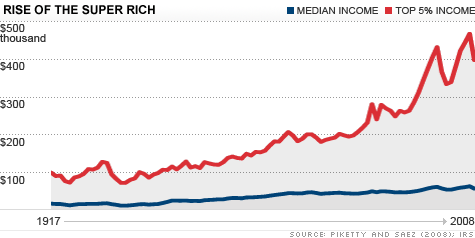
    An example closer to home for us is the way in which the rich used the state and the police to disperse and eliminate a growing movement is the occupy movement, which was casting a light upon the income discrepancy between the 1% and the 99%.

    In each case the powerful and rich of society continue, as they did 2000 years ago, to bully, silence and many times resort to coercive and deadly force to eliminate those that would speak on behalf of the poor and marginalized; to point out the various structural injustices in society.

    What does it mean to be a servant?

    The servant is often cast in a horrible light in the media, as stories are fabricated or embellished. Servants are forced to live through attack after attack upon their character, their morality and often their very physical being as well.

    IMG_5113To be a servant, is to suffer and walk in the shadow of the cross. It is to be vilified in society and cast out because the oligarchies, filled with greed for wealth and power, will do whatever they have to do to keep their wealth, even if that means oppressing the poor, destroying the lives of thousands and eliminating servants, by whatever means necessary.

    Tonight as we reflect upon what it means to be a servant like Christ, to bend low and wash the feet of the disciples, we come face to face with the cost of a servant ministry, the cost that many saints before us have born. And we struggle with our willingness to bare these costs and to speak on behalf of the poor and to serve those in needs. But as we struggle to with the true cost of servant-hood we know as Christians, we do not bare these costs alone.

    Even in the darkest of nights in prison on Robbin Island, Mandela knew he was not alone. Standing at the altar, preparing to celebrate the Eucharist, Romero knew he was not alone. And as we, servants of our fellow person, we know when we go forward to do the work of God, the Missio Dei, we are not alone either.

    We are joined to Christ and the saints throughout the ages through our common baptism. And we gain insight and courage from their example. But most notably and most importantly, we gain strength and courage to continue to serve the poor by being nourished in the meal that Jesus inaugurated this night, in the bread and the wine, the Eucharist.

    In it we find hope, peace and most especially love. And armed with these virtues we go forward into the world to serve the poor and meet all those that would stop us with hate, anger and violence to save for themselves a few more dollars. And while at times it may seem bleak and hopeless, we return to the table to be nourished and find what will be waiting for us on Easter Sunday, in the empty tomb and God’s promise. Peace, love, hope and Resurrection. All the things we need to be servants.

    Amen.

    Good Friday

    Readings:
    Isaiah 52:13-53:12
    Psalm 22
    Hebrews 10:16-25
    John 18:1-19:42

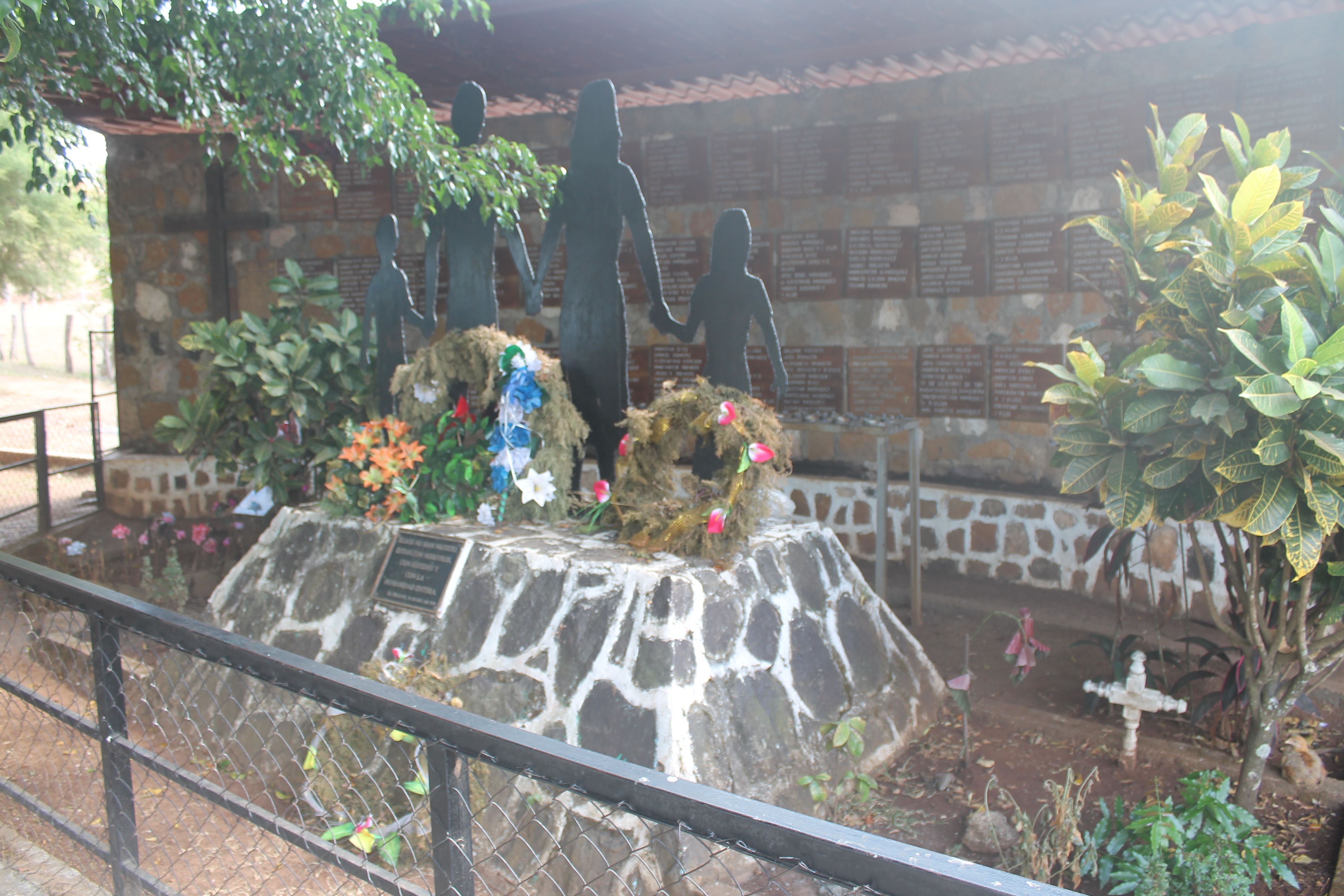
    Rufina Amaya was one of the only survivor of the El Mozote massacre on December 11 and December 12, 1981, in the Salvadoran department of Morazán during the Salvadoran Civil War.
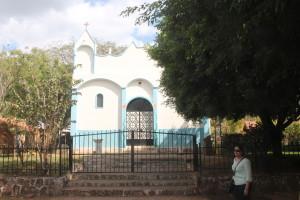
    IMG_5163Early in the morning, the soldiers assembled the entire village in the square. They separated the men from the women and children and locked them in separate groups in the church, the convent, and various houses.
    During the morning, they proceeded to interrogate, torture, and execute the men in several locations. Around noon, they began taking the women and older girls in groups, separating them from their children and gunning them down after raping them.

    Finally, they killed the children at first by slitting their throats then by hanging them from trees, with one child as young as two years old. After killing the entire population, the soldiers set fire to the buildings and burned the village and all the corpses to the ground.

    The soldiers remained in El Mozote that night but the next day went to the village of Los Toriles, some 2 km away and carried out a further massacre. Men, women and children were taken from their homes, lined up, robbed and shot and their homes then set ablaze.

    Hidden in a tree to which she had run to while soldiers were distracted, Amaya watched and listened as government soldiers raped women, then killed men, women. She watched them then burn the bodies.
    Amaya lost not only her neighbors, but also her husband whose decapitation she saw; her 9-year-old son, who cried out to her, “Mama, they’re killing me. They’ve killed my sister. They’re going to kill me.”; and her daughters ages 5 years, 3 years, and 8 months old were also killed. The only one of her children who was not killed in the massacre was her daughter Fidelia, who was not in the village at the time.

    Following the massacre, Amaya became a refugee for a time in the neighboring country of Honduras. She returned to El Salvador in 1990. Her testimony of the attacks, reported shortly afterward by two American reporters, but the reports were called into question by the U.S. journalism community as well as by the U.S. and Salvadoran governments, was instrumental in the eventual investigation by the United Nations Commission on the Truth for El Salvador after the end of the war.

    The investigation led to the November 1992 exhumation of bodies buried at the site and the commission’s conclusion that Amaya’s testimony and experiences had accurately represented the events has they occurred.
    I cannot imagine what Amaya had gone through that night or any other night afterwards when she closed her eyes and went to slept. What visions and dreams would haunt her? I cannot imagine what she endured as a wife, a friend and a mother. Or how she continued on and even moved back to the site of such a horrific event.
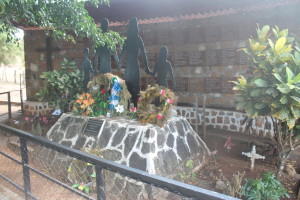
    IMG_5154And as I cried at the mass burial site, knowing my tears were mixing in the dirt with the tears of so many others who had come there since so much blood had been spilled, and I looked at the grave of Rufina Amaya, buried with her kin after her death in 2007 from a stroke, I was confronted with the ugliness of the cross, and the love of a mother, of Mary.

    The brutal power of the state, of the right wing government and the oligarchy bent on crushing a rebellion is not very different then the oligarchy of religious Jewish figures and the Roman Empire some 2000 years ago.
    The desire for earthly power and money and the lengths that people go to cling to that power is disturbing. And standing at the crossroads of the cross of El Mozete I was forced to confront that our world is not so much different or evolved.

    In that village, Christ suffered. In that village Christ was crucified. And in that village Christ died. Soldiers carried out the orders of the ruling elites and crucified the Lord. Power and wealth was protected. A movement crushed and the people beat down by a power thirsty oligarchy. And this all happened while Mary or Rufina, the mother watched.

    Today, as we come forward to venerate the cross, stop and read the articles and look at the pictures crucified on the wood. Christ suffered long ago, in the mists of time. But Christ continues to suffer, in the people of El Salvador, the men, women and children of El Mozote and in the many tragedies that continue in the world.
    Today we have walked with Christ as far as we can go. We can walk no further. Now, like Mary and like Rufina Amaya, we must watch, we must see, and we must listen. We must tell the story so it is not forgotten, how one man speaking to the face of power risked everything for the poor of the world. We must tell the story of how Christ continues to pour out his blood in the people of the world, in the people of El Salvador and El Mozote and we must be vigilant in prayer, looking for hope and trusting that God will provide.

    Amen.

    Easter Sunday

    Readings:
    Isaiah 65:17-25
    Paslm:118:1-2, 14-24
    1 Corinthians 15:19-26
    John 20:1-18

    Over this past Holy Week we have travelled from the triumphant entrance into Jerusalem of Jesus to great fanfare and him being welcomed as a king, the messiah. We sat at the Last Supper and experienced the betrayal of Judas, one of the disciples. We prayed in the garden with Jesus before his arrest. And we stood and watch his trial before Pilate and his eventual execution by crucifixion.

    As a spiritual exercise, each year, we commemorate these events in our worship. We re-create the triumphant entrance with a procession on Palm Sunday. We sit for the last super, wash the feet of others and await the betrayal we know that is coming. And we come on Good Friday to hear the passion, and to experience the crucifixion. And then on Easter Sunday, we great the empty tomb and celebrate with our Lord and Saviour the victory over death.

    This year I framed the experience of Holy Week in the life of the people of El Salvador from my recent mission trip. And in that framing, I think, we came to realize that the biblical story is not something from long ago, but is something that continues to be lived out in people’s lives. That God continues to act in the world to restore his people back to right relationship when things go so terribly wrong.

    We learned how Oscar Romero served the poor for three years as archbishop before his own crucifixion, when he assassinated behind the altar has he prepared to celebrate communion. We heard how his mentor, Padre Grande, a radical and a bit of a rogue influenced the life and ministry of Oscar Romero, much like John the Baptist influenced the life and ministry of Jesus Christ and how the story of these two men mirrored the biblical story of John the Baptist and Jesus himself.

    We heard about how when individuals side with the poor, speak on behalf of the poor and seek to help the poor attain the basics in life, food, clothing and shelter and basic human rights and a fair wage, the social elites, the oligarchies, will use whatever force is required to suppress or eliminate those that would rise against their earthly power and wealth, even if that means resorting to murder to keep 30 pieces of silver whist other beg for food.

    Padre Grande assassinated, Oscar Romero assassinated, the Jesuit martyrs, all betrayed and killed by a government that they peacefully protested against, when they were only asking for fair treatment of the poor, and that all of God’s children share in God’s abundance. Some of the most basics that we take for granted here at home on Canada like being able to turn on your tap and have water that will not kill you.

    And we walked the long road to the crucifixion through the massacre at El Mozote, where we heard the horrific tale of Rufina Amaya, the lone survivor of the massacre where the entire village was systematically eliminated. Men murdered, women raped and killed and children horribly murdered. And like Rufina Amaya we came before the cross to look at the ugliness of the cross and the results of human action and greed.

    We have journeyed to the end of Holy Week and it is Easter Sunday. But we haven’t yet heard all the tales of El Salvador. We haven’t heard the last. There is still more stories to tell. And in many ways as I prepared to tell this story, I must admit I was very tempted to swap out the gospel reading for today, and instead to read the story of the road to Emmaus from the Gospel of Luke. And the reason for that is that I want to tell you the story of Maria.

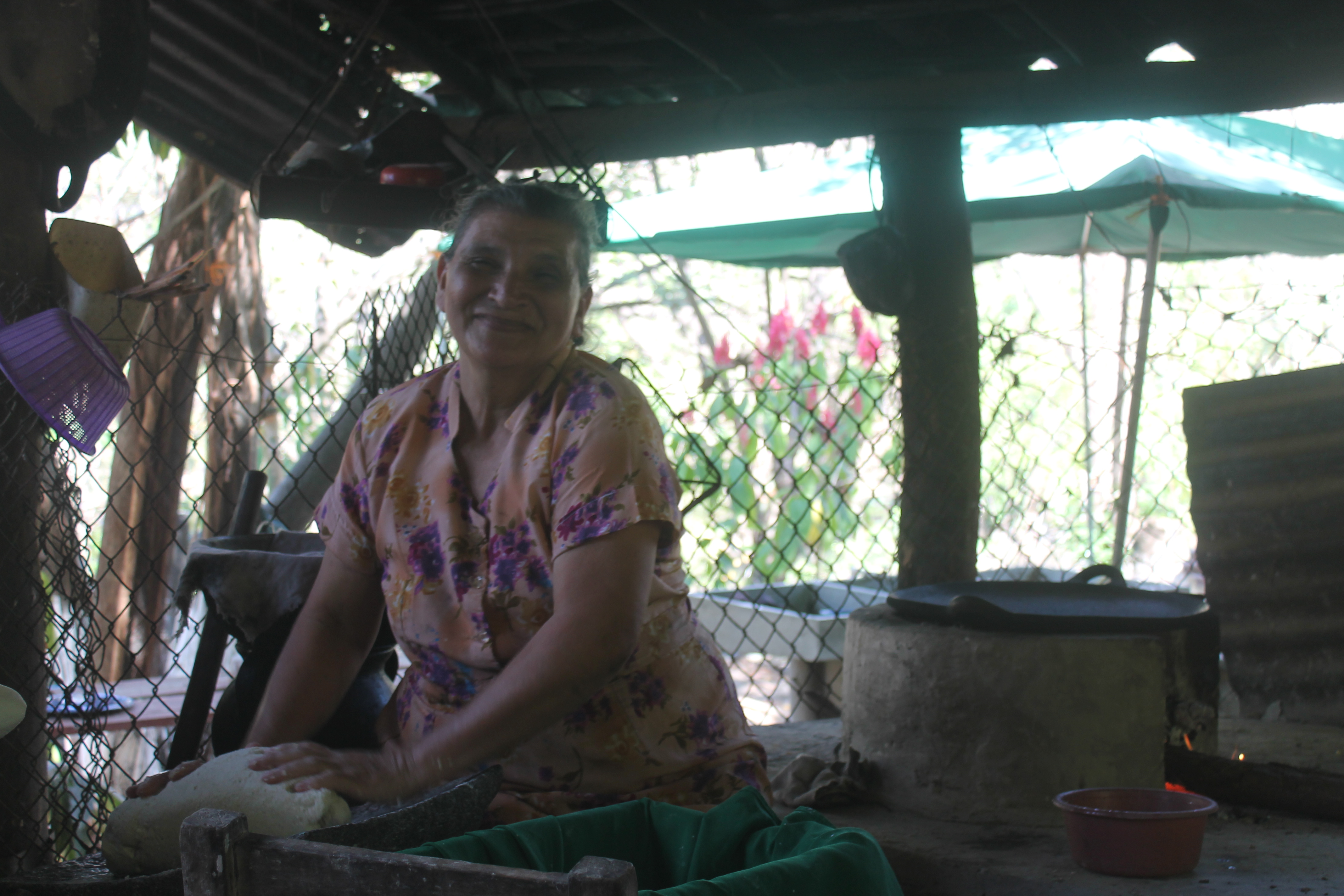
    IMG_5241Maria is a farmer who lives by Perquin, in the Morazan department in El Salvador. The Morazan Department and especially around Perquin was guerilla controlled territory during the Salvadorian civil war. As such, most of, if not all, the local population was eventually driven out. If you continued to live in the area you would be considered a guerilla and killed by the state for simply eeking out a living on the land.

    In the war Maria lost her husband and her son. Her farm was burnt and the buildings destroyed. All that she had was gone. She lived as a refugee for a time in Honduras until the end of the war. She returned to her farm, found “this old man” she would say as she pointed to a man standing by her, her new husband and telling us he would do just fine with a wink.

    Her daughter lived with her, her son in law and now grandchildren. The little children ran around the farm and chased after the dog and laughed. In all it had the makings of a beautiful life, a life filled with love and grace.

    We happened there quite by accident really. After walking through the El Mozote massacre site and tracing the escape path of Rufina Amaya, we had journeyed to Perquin to see the revolutionary museum and the old Guerilla camp. Having gotten ourselves ahead of schedule (a miracle in of itself), we found we had the morning free in Perquin, and having sat at the foot of cross, so to speak, the day before as we experienced El Mozote, we took advantage of the free time and our local guide knew a river where we could go swimming for the morning and decompress.

    That is when we drove onto the farm, or rolled back the stone and looked inside the tomb. Maria invited us into her home. A modest building where the kitchen attached to it was open with only a roof over top. The morning breeze brought the smell of cooking to meet us as we approached. The fire was going, the metal skillet sat atop and Maria was making tortillas. She invited us into her home and we sat in her kitchen has she cooked. She told us her story, the story of losing her husband, her son and her farm. We heard about lose and betrayal. We heard about greed and death.

    But she kept talking, smiling and laughing. She told us about her new husband, her grandchildren and how she re-claimed her farm. Her snow-white cat was begging for food and once it got its food the dog kept trying to steal the cats food. It was peaceful, loving and warm. It seemed so distant from the tales of war, massacres, pain, suffering and loss. Here was a place of peace and love.

    Maria offered us fresh cheese she had just made and tortillas right off the grill and we graciously accepted. As we waited for the tortillas to cool so we could eat them, Maria began to make fun of us (Silly Gringos) for having such soft hands, just like her son in law. She reached over and broke our bread for us, she broke bread for us. “When he was at the table with them, he took bread, blessed and broke it, and gave it to them. Then their eyes were opened, and they recognized him”

    Maria opened her home to us and shared with us her story of renewal and new life. We broke bread together and in that moment after all the pain and suffering we had experienced, we came to know and experience resurrection. Maria ceased to be Maria, but Christ was made known to us.

    It would be easy to pass over and not recognize Christ as Mary in the garden fails to recognize him immediately. We are always left looking for that perfect image or that perfect moment. We are looking for the heavens to be tore open and Jesus descend on a cloud in majesty. And as such we forget to look for the way that God subtle works in the world, the subtle and small little ways that God recreates, renews and creates that Easter moment of resurrection.

    As I sat eating my Tortilla and cheese, the sounds of the world slowly vanished. The mowing of the cow and belting of the goats drifted away and this Salvadorian woman captivated me. For in the breaking of the bread, Christ promised that we would know him. And in the breaking of the tortillas the image of Christ appeared to us that day and that was the image of an old, weathered, partially toothless Salvadorian women. Christ was alive. Alleluia, Christ is risen. Praise be to God.

    Amen.

    The Problem with Adjectives

    http://www.dreamstime.com/stock-photo-goggle-chihuahua-image27930960The adjective is a great descriptor. It provides nuance to the otherwise banal. Things stop being so plain and take on visions in our minds. The dog is just a dog. But a large black dog, with short coarse hair and a large head may bring to mind the image of a Rottweiler, rather then a cute Chihuahua.

    Of course to call an adjective a descriptor is also rather redundant. The very purpose of an adjective is to provide nuance and description to a noun. A car becomes more than a simple car when we refer to it as a sports car or an SUV.

    Adjectives provide colour, depth and texture to our language. They open a creative world to us and allow us to communicate specific images and specific ideas. The adjective is a powerful tool in communication.

    The adjective can also be dangerous, it can oppress and it can most definitely be used to maintain systems of oppression. I can think of many examples, but I would like to bring to your attention three examples that I believe can help open up this dialogue to us so we can see the problems that can arise at times when we use a descriptor on a noun.

    First is Gay Marriage. The implication by putting the descriptor on this noun, marriage, is to somehow quantify the marriage as different then the average or regular marriage. While it is true the couple is homogenous, I fail to see how a gay marriage is any different then a heterosexual marriage. In the morning the gay couple does not get out of their gay bed, have gay breakfast; drive their gay car to their gay job, while living their gay life.

    By using the descriptor to describe the marriage of a homosexual couple it can lead to a second-class status. There is marriage and then there is gay marriage. And somehow that doesn’t seem equal to me.

    This problem also applies with gender in the work force. My wife is a computer programmer. This is the work she does. By referring to her, as a girl programmer, is to somehow say that she is different then a regular programmer and what she does is not the same. It separates her from her colleagues and others her. It is to say she is different. Maybe that different is special, but it still separates her from her colleagues and implies, in a sense, that she programs differently or writes girl code.

    I believe this is also the case for women clergy. Whether male or female is irrelevant, the same vocation is being fulfilled. The same sacraments are being celebrated. To call a priest a woman priest, is to somehow separate her from what her male counterparts do. She is after all simply a priest. No better or no worse then a male priest.

    The adjective, while it can add so much to our language and communication can also help maintain systems of oppression and separation between us as a people, a society and in gender relations.

    And I believe this is also theologically dangerous and counter-intuitive to Holy Scripture. It was after all St Paul who said in Galatians (3:28) “There is no longer Jew or Greek, there is no longer slave or free, there is no longer male and female; for all of you are one in Christ Jesus.”

    Genesis 14:1-16

    In the days of King Amraphel of Shinar, King Arioch of Ellasar, King Chedorlaomer of Elam, and King Tidal of Goiim, these kings made war with King Bera of Sodom, King Birsha of Gomorrah, King Shinab of Admah, King Shemeber of Zeboiim, and the king of Bela (that is, Zoar). All these joined forces in the Valley of Siddim (that is, the Dead Sea). For twelve years they had served Chedorlaomer, but in the thirteenth year they rebelled. In the fourteenth year Chedorlaomer and the kings who were with him came and subdued the Rephaim in Ashteroth-karnaim, the Zuzim in Ham, the Emim in Shaveh-kiriathaim, and the Horites in the hill country of Seir as far as El-paran on the edge of the wilderness; then they turned back and came to En-mishpat (that is, Kadesh), and subdued all the country of the Amalekites, and also the Amorites who lived in Hazazon-tamar. Then the king of Sodom, the king of Gomorrah, the king of Admah, the king of Zeboiim, and the king of Bela (that is, Zoar) went out, and they joined battle in the Valley of Siddim with King Chedorlaomer of Elam, King Tidal of Goiim, King Amraphel of Shinar, and King Arioch of Ellasar, four kings against five. Now the Valley of Siddim was full of bitumen pits; and as the kings of Sodom and Gomorrah fled, some fell into them, and the rest fled to the hill country. So the enemy took all the goods of Sodom and Gomorrah, and all their provisions, and went their way; they also took Lot, the son of Abram’s brother, who lived in Sodom, and his goods, and departed.

    Then one who had escaped came and told Abram the Hebrew, who was living by the oaks of Mamre the Amorite, brother of Eshcol and of Aner; these were allies of Abram. When Abram heard that his nephew had been taken captive, he led forth his trained men, born in his house, three hundred and eighteen of them, and went in pursuit as far as Dan. He divided his forces against them by night, he and his servants, and routed them and pursued them to Hobah, north of Damascus. Then he brought back all the goods, and also brought back his nephew Lot with his goods, and the women and the people.

    This is a difficult text. One this text is the only place in all of the tradition that has Abram (later Abraham) portrayed in such a role, as a military commander. As we will see later on in Genesis (we haven’t quite read that far yet) Abraham is often the lone stranger among the Hittite inhabitants of Kiriatharba.

    Secondly the historicity of the 5 petty Palestinian kings being subdued by 4 mighty kings from the east is questionable at best. There simply is no extra biblical evidence to support such an invasion and/or battle.

    And thirdly, we must confront the thought that such a small band of 318 men, lead by Abram will defeat the 4 mighty kings who had just crushed a rebellion by 5 kings in Palestine. This seems dubious at best.

    So what are we to make of a text that seems completely out of place, that glorifies military victories and battles and whose history seems more likely many pieces of stories redacted into one giant meta-story, much in the same manner that the combination of folk stories go into the creation of urban legend.

    This primeval history of the chosen people is of course not meant to be about historicity, as it is meant to be about the founding mythology of the Jewish people. And the founding mythological piece in this story is Abram’s ability to best the 4 mighty kings is a testimony to his status as Shem’s heir and therefore the recipient of Shem’s blessing, received from Noah.

    Lineage is very important in biblical literature. Lineage allows the blessings of God to be traced back to the beginning, when the covenant was first formed. In this case, that is the covenant between Noah and God. No longer will God destroy the peoples of the earth and the bow in the sky (the rainbow) will be a sign of that covenant.

    This also continues the lineage of the chosen people from Adam, to Noah, to Abram. It helps identify a certain people with a certain God. In this case the chosen people, the Hebrews, with Yahweh, the God of the Jews. The military victory depicted also lends support to a primeval culture asserting the dominance of its God over other gods.

    So what is the take away then? What truth does God want us to glim from this passage?

    http://www.dreamstime.com/-image2418821God’s blessing, which has travelled through generations from Noah, to Shem, to Abram. The blessing that will travel through time through the prophets, the judges, the martyrs and through Jesus Christ is the same blessing that we receive in the sacraments of the church.

    The covenant is a sign that God will always come for us, much like Abram comes for Lot. That doesn’t mean nothing bad will happen to us. It simply means that through our covenant, in baptism, God journeys with us, remembers us and gives us strength. And I know standing in the vast emptiness of the world and starring up at the sky and looking at a rainbow I am comforted by the knowledge that God is with me. And sometimes that is enough.

    Why Going to Church Matters

    I firmly believe that there are three main aspects to human life, and each of these aspects needs to be cared for and nurtured. And together when they are cared for, human beings live healthy and happy lives. These three aspects are:

    1) The Physical

    2) The Mental

    3) The Spiritual

    Now there are two ways that these aspects may be treated in life. We can choose to treat them acutely, as in when something goes wrong, or we can treat them in a preventive manner.

    Case in point is the physical. Preventive care would encompass things like exercise, going to the gym and eating a healthy and balanced diet. By doing so our bodies develop stronger immune systems capable of fighting of various sicknesses and helps to prevent diseases, like heart disease and strokes.

    Now many chose instead to treat their physical selves acutely. They have a bad diet, little to no exercise rendering them winded from climbing stairs and a sedentary lifestyle. When they become ill, they go to the doctor and receive medication. Or poor diet can develop diabetes in the individual, at which time medication is required. Just a couple of examples of acute care.

    A healthy active lifestyle prolongs life and quality of life. Simply put caring for ones physical self is important. We feel better when healthy, happier and have a better quality of life, both now and in the long run.

    The same is true for the mental. There are many aspects to the mental. There is mental illness, but there is also exercise of the mind. I will treat each of these separately, for they are truly distinct, even though one may dovetail into the other.

    Accumulation of stress and not having a release for that stress can often cause depression or a tendency to lash out at people and see in them projections of stress not yet dealt with. We can read into situations things that do not exist, or even see innocent comments as personal attacks.

    Having the means for coping with high level of stress and decompressing after high levels of stress is a must for a healthy and happy mental life. The high levels of Post Traumatic Stress Disorder being reported by returning soldiers from active theater is an indication that proper and timely decompression from stressful events is not taking place.

    Yet caring for our mental wellness is not just a matter of treating mental illness. It is preventive also. Like the physical we can either treat the symptoms acutely when they arise or we can engage in a regiment of preventive care. Here education is key.

    Stretching past ones assumptions and beliefs and having those beliefs and assumptions challenged so that we can see our prejudices is key to helping us have a happy healthy life. This allows us to come beside our neighbor and to understand their perspective.

    It should be noted that understanding does not mean agree, simply put, it means if we can see another’s point of view, we have opened our mind to new possibilities of understanding and friendship.

    Caring for our mental well being, exercising our minds and allowing sufficient downtime after stressful encounters is key to a happy and healthy life.

    Finally the one aspect of our lives that in our western post modernist secular world that is often over looked is the spiritual.

    I often run into people during the course of my duties as a priest who tell me they are not religious, but spiritual. When I press them on this, in what do they do to exercise their spirituality I am often met by blank stares and stumbling answers like, “I try to be a good person”.

    By not caring for our spiritual selves, we open up ourselves to the need to have this aspect of our lives treated acutely when crisis happens. And if there is one guarantee in life, we will encounter crises. A regular regiment of spiritual development needs to be engaged if we are to care for this third aspect of our lives.

    Which is of course is one of the many reasons I believe in the value of church. Church may seem antiquated and out of touch with today’s world, but I firmly believe church will give you the exercise your spiritual selves needs to be strong and healthy. It provides preventive care in the same manner as preventive care surrounding our physical and mental lives, which helps us to be happy and healthy.

    It is hard in the moment to see how hitting the treadmill or de-briefing an incredibly stressful event will help you years down the road. And it is equally hard to see how attending church will help you years down the road as we confront our own mortality, aging process and growing through our many encounters and crisis in life.

    But exercising our spiritual lives is key. It is the third leg of the stool upon which sits a healthy and happy life. And when lacking a regiment of exercise for our spiritual lives church in many senses becomes for us our gym.

    So grab a Bible, a Torah, a Koran or other sacred text. Join a church and let the spiritual sweating and exercise begin.

    Advent 3, Year C (The first Sunday after the Newtown Massacre)

    May the words of my mouth and the meditations of all our hearts always be acceptable in your sight, oh Lord, our strength and our redeemer. Amen.

    As I preparing for this morning’s sermon this past week, I was struggling with the text. It is a difficult text to preach upon in many ways. John the Baptist, who is well known as the herald and harbinger of the coming of the messiah, is dressing down the Jews, his congregation in a real sense, and calling them all a brood of vipers. And he openly wonders as to who it was that warned them of the forthcoming messiah and why they are repenting now as he says,

    “John said to the crowds that came out to be baptized by him, ‘You brood of vipers! Who warned you to flee from the wrath to come? Bear fruits worthy of repentance. Do not begin to say to yourselves, “We have Abraham as our ancestor”; for I tell you, God is able from these stones to raise up children to Abraham. Even now the axe is lying at the root of the trees; every tree therefore that does not bear good fruit is cut down and thrown into the fire.”

    A scathing retort against any congregation and one I am sure I would never be able to get away with. And I was reading commentaries and essays on this passage on where I could focus my sermon, especially taking into considerations on our Advent theme of “Spend Less, Give More, Love All”. I could focus this homily on our desire as a people of God to leave behind the business as usual, for something new is about to arrive. A great message and focus for us as we re-discover what it is to live missionally again here in Old South.

    I could look at the angle of those that rise to a new challenge because of a friend and mentor, as the disciples rose to new challenges through following Christ. And we have so many pop cultures examples of this too that I could draw upon for a laugh or two, like Karate Kid and Good Will Hunting. And imagine the unbelievable heights we will reach because we follow Christ? We could even share some stories of how we have risen to new challenges because of our faith, have a kind of revival and have old fashion testimonials.

    And as I sat constructing a sermon that spoke of God’s grace and mercy, the hope we find in Jesus Christ, the expectant messiah, and how we can as community rise to any challenge if we follow our friend and mentor, Jesus Christ, that I should confess my struggles with the text had me writing my sermon on Friday. I was here in the sanctuary on Friday, preparing my sermon, preparing for last rites with one of our beloved, when my twitter account began to get a lot more active. That is when I tuned into CBC and then I heard about the tragedy in Newtown.

    20 children gunned down and 6 adults. I was shacking by the news. I was numb at first, then angry, then completely sad. And as I fell to my knees in the sanctuary to pray at that moment for the victims, their families, and all those affected by this horrible, senseless event, and my mind was drawn to a different passage of scripture as I realized that the sermon I was working on could wait till another day.

    All I could think about was the Gospel of Matthew, in chapter 2, after the wise men visit the infant Jesus and depart by another route so Herod does not find out where the Christ child is. I was drawn to the massacre of the Holy Infants as it is known.

    “When Herod saw that he had been tricked by the wise men, he was infuriated, and he sent and killed all the children in and around Bethlehem who were two years old or under, according to the time that he had learned from the wise men. Then was fulfilled what had been spoken through the prophet Jeremiah:
    ‘A voice was heard in Ramah,
    wailing and loud lamentation,
    Rachel weeping for her children;
    she refused to be consoled, because they are no more.’”

    I knew then that my original sermon could wait. And this Sunday as we light the candle of Love, we would need to, as a community here, as neighbours to those that have lost so many precious little children, need to stop and talk about the events. We would need to ask why? How? And it would be a challenge to our faith. We would need to weep and yes to wail with those that have lost so much.

    In the coming days and weeks as more information becomes known, you may find yourself in conversations with people who will ask you where was God in this? Or you may find yourself talking to someone who believes they are speaking on behalf of God and interpreting the massacre. I would like to, first, offer you 5 things not to say. 5 bad theological answers to peoples’ questions. Then I want to offer you 5 things to say when asked or confronted with people who are seeking answers. And then lastly I would like to humbly offer a thought about where God is in the massacre of Holy Infants.

    1. “God just needed another angel.”

    Portraying God as someone who arbitrarily kills children to fill celestial openings is neither helpful nor faithful to God.

    2. This happened because prayer was taking out of school.

    I have seen a T-Shirt floating around Facebook that says, “A concerned students asks God, ‘why do you allow so much violence in schools. And the t-shirt portrays God as answering ‘Dear concerned student, I am not allowed in schools.”

    This implies that God somehow not only let this event transpire, but also suggest that perhaps it is punishment and if we only had been good, more devout, our Jealous and vengeful God would not have allowed this to happen.

    3. He/she was just on loan from God and God has now called them home.

    The message here is that God is so frivolous that God will break parents’ hearts at will just because God can. It also communicates to parents and loved ones that they are not really entitled to their grief.

    4. God doesn’t give you more than you can handle.

    Bullsh*t! Actually, some people do get a lot more than any one person should ever have to handle. And it doesn’t come from God. Don’t trivialize someone’s grief with a “what doesn’t kill you makes you stronger” mentality.

    5. This was God’s will or judgment.

    Unless you are God, don’t use this line. Proclaiming that God seeks revenge or somehow willed that parents would lose 20 children does not speak of the incredible love that God has shown for us by giving his only Son to die. Knowing the pain He suffered while Christ died on the cross, I do not believe God would will 20 children to die in judgment of a society.

    Many of these things will get said in the coming days, and they are pad answers that I don’t think speaks of the love we have known in Jesus Christ, the actions of Christ in the world and the continuing outpouring of love that we will experience at Christmas as the messiah comes among us. So when confronted or talking to your friends about this tragedy, here are 5 things or answers that speaks of who we are as a people of God.

    1. I don’t believe God wanted this or willed it.

    God creates and recreated everything new. In the Easter moment God renews all creation. Our God, the God that died upon the cross, never, ever willed pain, suffering or death upon any. This simply is not the message of Jesus Christ.

    2. It’s okay to be angry, even if that is to be angry with God.

    This often never gets said. That this is a time or mourning and we must keep our composer. I don’t believe that to be true. There are times when screaming, wailing and weeping is the only way. Be mad about this, please. And if you want to yell at God, do it. I am sure he can take it.

    3. It’s not okay.

    It seems so obvious, but sometimes this doesn’t get said enough. Sometimes the pieces don’t fit. Sometimes nothing works out right. And sometimes there is no way to fix it. And there is nothing okay about this. And it is not okay with God.

    4. I don’t know why this happened.

    People are looking for answers, but giving them pad answers can deny them their grief, their anger and their sorrow. We don’t know why this happened yet, and we may never know. Don’t trivialize it with stock answers. Say what we all feel, we don’t know why this happened.

    5. I can’t imagine what you are going through.

    Often there is nothing we can do in our support of others. There is nothing to do but hug one another and cry, weep and wail. There are times when the world makes so little sense. And the events that surround us shock us and can de-humanize us and they become far to commonplace. Allowing ourselves the opportunity to cry and be angry helps us keep our humanity in the face of such senseless violence.

    So as we contemplate this tragedy and how the lives of so many are affected I want to simply remind you that God takes no joy in this, or is it any part of his plan or judgment upon us, his people. But that God’s actions in the world rather is this, God goes to those who have suffered and God choses to be with those that have lost so many beautiful children and loved ones, and God joins with them, with us and with the world, as he did with Rachel and God “weeps for his children;
    he refuses to be consoled, because they are no more.’

    Let us pray,

    God of grace and mercy, to all who have suffered in this tragedy be with them in their suffering, in their weeping and their wailing; be with us and the millions trying to make sense of this event and we pray for those who that lost their lives, grant to them eternal rest and perpetual light shine upon them, may their souls and all the souls of the dearly departed rest forever in your peace, now and forever.

    Amen

    25th Sunday After Pentecost, Daniel 12:1-3, Hebrews 10:11-25, Mark 13:1-8

    May the words of my mouth and the meditations of all of our hearts always be acceptable in your sight, oh Lord, our strength and our redeemer. Amen.

    I have spent far too much time watching and reading the news of late and I have been a little startled by the news coverage to be honest. There is the looming financial crisis in the form of the fiscal cliff in the United States of America that is threatening to drag them, Canada, and the rest of the world back into a crippling recession.

    While the financial crisis of 2008 is still being felt not only here in Canada, but throughout all of Europe, as country after country comes to the edge of bankruptcy. Greece, Ireland, Spain tittering on the very precipice of financial collapse.

    This past week workers throughout Europe walked off the job in a continent wide protest over austerity measures, spending cuts, loss of pensions and benefits as nation after nation seeks to get a grip on spending that is, quite frankly, out of control. Workers are clashing violently with governments and companies over the ever increasing income gap, as tough economic measures are being bourn on the back of the once prosperous middle class and low income earners while the rich and ultra rich seem free from such measures and their wealth continues to grow.

    Meanwhile in Syria the violence is escalating. The civil war that has gripped that country for months now, continues to claim the lives of innocents. Civilians, women and children, are increasingly killed and the number of refuges has climbed to a quarter of million people spilling into neighboring countries.

    The civil war itself and the violence it breeds has even spilled into other countries and territories. Rocket fire was exchanged from Syria and Israel in the Golan Heights for the first time since the 6 day war back in 1967.

    And Israel and the Palestinian people in the Gaza strip are once again at war as violence there escalates. Rockets being fired at Jerusalem for the first time since the mid 70’s, the night pierced by air raid sirens in Tel Aviv and Israel responding with naval bombardment and air strikes in Gaza. The Israeli government is preparing for a ground invasion, has thousands of troops have been called into active service in an attempt to eliminate Hamas once and for all.

    The Middle East from one corner to the next is embroiled in conflict and war, from Iraq, Iran, Afghanistan, Libya, Egypt, Syria, Israel, and many more. And Western powers and politicians seem ready and almost eager to jump into the conflict and continue to wage war throughout the world if you are to listen o the Hawks in Washington.

    And then there are the earthquakes, hurricanes and floods that dominate the news, as the US eastern seaboard seeks to still recover from Hurricane Sandy and the west coast was recently rocked by earthquake and warnings were dispatched, as fears of Tsunamis would devastate the area. Global warming, increasingly sever weather patterns and destructive storms rage throughout the world and their effects are being felt in the economy, the food supply and the global markets.

    And then we read this morning’s gospel and we stop, we pause and we shiver.

    “As he came out of the temple, one of his disciples said to him, “Look, Teacher, what large stones and what large buildings!” Then Jesus asked him, “Do you see these great buildings? Not one stone will be left here upon another; all will be thrown down.”

    “When he was sitting on the Mount of Olives opposite the temple, Peter, James, John, and Andrew asked him privately, “Tell us, when will this be, and what will be the sign that all these things are about to be accomplished?”

    Then Jesus began to say to them, “Beware that no one leads you astray. Many will come in my name and say, ‘I am he!’ and they will lead many astray. When you hear of wars and rumors of wars, do not be alarmed; this must take place, but the end is still to come. For nation will rise against nation, and kingdom against kingdom; there will be earthquakes in various places; there will be famines. This is but the beginning of the birthpangs.”

    Mark’s “little apocalyptic message” here is meant to frighten the disciples and us but also to prepare them. Jesus here is talking about what is necessary to help bring about the kingdom of God. And it seems all so very terrifying, with war, famine, natural disasters and nation rising against nation. A world gone completely mad to be sure.

    But this has always been the world that we live in, fallen and broken. Each generation throughout history has been able to point to these impeding “signs” of doom and say that Christ will return soon, repent and believe. And how many prophets have come among us, seeking to sell us salvation. They preach about when the world was good, before we, as a society, had lost our way and gone down such a morally dubious pathway. They point to these “signs” and say that Christ is coming, and judgment is on its way, repent and believe for the end is near.

    Yet, they are partially right, for the kingdom of God is indeed on its way, my brothers and sisters, its is coming, it is immanent. Because it is into this world that Jesus sends you, the baptized. You see, this passage from Mark, is not about the end that is coming, but about the beginning, the beginning of something new, the beginning of God renewing his creation and his covenant with his people. It is about the beginning of what we are to do as followers of Jesus Christ. These are indeed the problems of the world and these are the problems that we will face and are sent to help make right. We are to be the peacemakers, the healers, the stewards of creation and the friends, companions and advocates to all those that are broken and suffering.

    We are to build something new, a new kingdom, a new temple to Christ, not one of rough stone hewn from the earth. But we are to build a new temple, a new kingdom, comprised of living stones. And we are to do it not alone, but through the grace and mercy of God, for we have been joined to God through Jesus Christ by the power of the Holy Spirit in baptism. We are to be the new temple, the body of Christ. We are to be living stones.

    Listen to the words of Peter in his 1 letter the church.

    “Come to him, a living stone, though rejected by mortals yet chosen and precious in God’s sight, and like living stones, let yourselves be built into a spiritual house, to be a holy priesthood, to offer spiritual sacrifices acceptable to God through Jesus Christ. For it stands in scripture:
    ‘See, I am laying in Zion a stone,
    a cornerstone chosen and precious;
    and whoever believes in him will not be put to shame.”

    Living stones, a new temple in the form of the body of Christ we are. My friends, the end is indeed coming and instead of lamenting the loss of a world that is broken, we should be glad indeed. For the end of the old world and the beginning of something new, the kingdom of God, is upon us.

    From us, living stones, joined together with Christ in baptism, we will go forward into this broken and fallen world, not to judge it or condemn it; not to hide or shrink from the work that needs to be done; nor to sit idly by and wait for the coming of our Lord again. We are to participate in the building of the kingdom of God, not as creators ourselves, but the resurrected body of Christ, the church. Christ as the head, but each of us as the body.

    And we are to go forward, into the world, the living stones and we are to become a living temple were the kingdom of God is realized, through us and in us.
    The apocalypse is upon us.

    Alleluia and amen.

    Social Media Campaigns and the Church

    Churches often wish to jump on bandwagons as a means to reach people and to tell the story of Jesus Christ, to share the good news and how peoples lives can be transformed. The church’s desire to jump onto the social media bandwagon is no different.

    To be clear, there is absolutely nothing wrong with jumping on bandwagons, or being a little late to the game so to speak, unless that is cheering for the Leafs. That is always wrong. But I digress.

    Yet before getting onto the social media bandwagon, there are a few things that you should consider before jumping into the social media world. First of all, this is not a once off campaign, but a new form communication. In reality a new relationship with people, and it does not stop once we “get” what we want.

    As well, once the train has left station, it is very hard to turn it around and start over again. And there is a process of letting go of the message. Social media by its nature is public and once your message is out there, it is out there. You will not be able to control it. Therefore I offer a few things for your consideration when planning your social media endeavours and for the people tasked with being church community managers.

    1) Do you have the resources for such a campaign?

    Resources must be allocated to the endeavour, and these consist not only of financial resources, but also technical and human resources. Who will be responsible for updates and engage with your audience? Do you have the right technology and the right platforms? Who will maintain the technology? Does the person in charge know how to use the platform properly and understand the etiquette involved?

    2) Who is your target audience? What platforms are you going to use to reach them?

    Any job to be done right needs the proper tools. Therefore, knowing not only your target audience, but also where your target audience is, as in on what platform, is key.

    For instance, being aware that the fastest growing demographic on Facebook is 55-65 year old women is crucial if that is the demographic that you are targeting. It is also then important to know NOT to waste time, energy and resources on other platforms like Twitter if few or none of your audience is active there.

    3) Engage, engage, engage.

    Seems self-explanatory, but far too often this is overlooked. If someone leaves a comment on a blog or Facebook page, make sure to answer it. Even if that is just to acknowledge that you have seen it. In the case of negative comments, one must exercise caution in not appearing to ignore the dissenter, but also not in engaging in an escalating turf war. Also there is a difference between disagreements and trolling. Learn it, and never feed the trolls.

    It just looks bad if you are broadcasting without engaging. A good analogy for engagement is a priest or pastor who only ever talks, talks and talks and never listens to his/her parishioners. Nothing looks worse for social engagement then talking without listening and responding.

    4) Be an expert. You are the evangelist. Know the ins and outs.

    Having the answer on the tip of your tongue or the tips of your fingers is important. Knowing your church or program is key. You need to be able to answer any question or direct people to those that can in a timely manner. It is okay to say, “I don’t know but I will find out for you”.

    Knowing also shows you care. And nothing is more authentic in relationship building than personally caring. So study hard.

    5) Have goals and measurements in mind to judge success.

    Define your goals. Set targets. If your goal is to grow the church, then know by how much you want to grow your church. Set benchmarks along the way. Meeting the benchmarks will give your community excitement along the way, but also make those who come because of your campaign feel part of the success. Which, of course, will cycle that energy back into your project or campaign.

    Of course there are many other nuances to keep in mind, and this is not an exhaustive list. It has, however, some basics to keep in mind when constructing a social media campaign and preparing to launch a new program.

    As with the success of all ventures, the success is in the planning. So take some time and analyze the ways in which you will answer the above list, and with some careful planning and a little luck, social media will indeed help you achieve the goals of your church, its campaign and the effectiveness of your new program.

    Capturing Discipleship and Facebook Memes

    Every now and then a saying develops. It may have the basis in the truth, but often gets misappropriated rather quickly. Which in an age of 15-second sound bites and 140 character tweets, one can easily understand why.

    One of these sayings that I have been encountering more and more lately is, “A note to church leaders, the church has only one savior!”

    While true in a very real sense, that Christ is the savior; this saying provides the means of abdicating one’s responsibilities. Churches grow when they respond to the needs of the people and of the community. And churches decline when they respond to only the needs of those in the “club”.

    Simply claim that it is up to God whether the church lives or die. That Christ is the savior of the church and no amount of responsibility is to be shared by the baptized.

    I believe part of what it means to be a Christian is to live in tension. It is to live in the tension between the now and the not yet, the realized and yet to come kingdom of God.

    In Christ’s crucifixion and resurrection the victory has already been won. Death is no more. The second Adam has restored us. Yet as we know, we are not in the garden, but still here on the earth.

    It is why each year in the church calendar we journey from the expectation of the coming of our Lord in advent, to the crucifixion and resurrection at Easter. From there we continue to Pentecost, when the Spirit is left with the church and Christ ascends to Heaven.

    We recall the life and mission of Christ and attempt to live in imitation. And it all culminates with the celebration of Christ the King, the Sunday before we do it all over again.

    And yes, we do look to Lordship of Christ, our savior and master. And we recognize in his sacrifice we are made whole. That through the faith of Christ and faith in his work we are justified, saved and restored.

    Yet the church simply doesn’t stop there, nor does our responsibility. We are to continue the building up of the church, the bride of Christ. (Matt 25:1-13) And as Christ commanded, we are to “go and make disciples of all nations, baptizing them in the name of the Father, and of the Son, and of the Holy Spirit and teaching them to obey everything that I (Christ) have commanded you.” Matt 28:19-20

    And like the apostles and the early church fathers, we are to devote ourselves “to the apostle’s teaching and fellowship, to the breaking of bread and the prayers.” Acts 2:42

    The tension lies within the building up of the kingdom of God and realizing that God gives the growth. Christ is indeed the savior, and yet the real need for hard work to be done can best be summed up in yet another kitschy little saying…

    When asked “Why hasn’t God done something about dwindling attendance in church, the poor and the needy.”

    I always reply, “He has, he sent you.”

    Genesis Chapter 13

    So Abram went up from Egypt, he and his wife and all that he had, and Lot with him, into the Negeb.

    Now Abram was very rich in livestock, in silver, and in gold. He journeyed on by stages from the Negeb as far as Bethel, to the place where his tent had been at the beginning, between Bethel and Ai, to the place where he had made an altar at the first; and there Abram called on the name of the Lord. Now Lot, who went with Abram, also had flocks and herds and tents, so that the land could not support both of them living together; for their possessions were so great that they could not live together, and there was strife between the herders of Abram’s livestock and the herders of Lot’s livestock. At that time the Canaanites and the Perizzites lived in the land.

    Then Abram said to Lot, ‘Let there be no strife between you and me, and between your herders and my herders; for we are kindred. Is not the whole land before you? Separate yourself from me. If you take the left hand, then I will go to the right; or if you take the right hand, then I will go to the left.’ Lot looked about him, and saw that the plain of the Jordan was well watered everywhere like the garden of the Lord, like the land of Egypt, in the direction of Zoar; this was before the Lord had destroyed Sodom and Gomorrah. So Lot chose for himself all the plain of the Jordan, and Lot journeyed eastwards; thus they separated from each other. Abram settled in the land of Canaan, while Lot settled among the cities of the Plain and moved his tent as far as Sodom. Now the people of Sodom were wicked, great sinners against the Lord.

    The Lord said to Abram, after Lot had separated from him, ‘Raise your eyes now, and look from the place where you are, northwards and southwards and eastwards and westwards; for all the land that you see I will give to you and to your offspring for ever. I will make your offspring like the dust of the earth; so that if one can count the dust of the earth, your offspring also can be counted. Rise up, walk through the length and the breadth of the land, for I will give it to you.’ So Abram moved his tent, and came and settled by the oaks of Mamre, which are at Hebron; and there he built an altar to the Lord.

    Chapter 13 of Genesis is one of those chapters that makes me say, uh? So to recap where we are so far. Abram is shown the Promised Land. There is a famine in the Promised Land so he packs everything up and travels to Egypt. Once in Egypt he pretends his wife is his sister and Pharaoh takes her as his wife. Not cool.

    That mess gets cleared up and Abram leaves with riches, livestock and his wife, Sarai. So he returns to the Promised Land with his nephew Lot. Once in the land, Abram then decides that the Promised Land, which is for him and all his descendants, his family, as numerous as the dust or the stars in the sky, is somehow not big enough for him and his nephew Lot, his family, his livestock and his farm hands. And Abram sends Lot away.

    The Promised Land is for all of Abram’s descendants. God even emphasizes that at the end of the passage by having Abram look it over and walk it end to end. But Abram doesn’t seem to get it. He sends his family away. Mine….not yours is Abrams response to God and God’s abundant grace.

    If this seems rather greedy, I would agree. And how often do we as a society, as a people and the children of God look at all of God’s abundance, freely given to all and hoard it while our neighbor and fellow human beings go with out?

    Nothing reminds me more of that then the constant race to reduce or eliminate the taxes that we pay as a society for services and a higher standard of living for all. The Greatest Generation sacrificed, not just in war, but following World War II to pay higher taxes and by doing so increased the amount of wealth that was shared by all.

    Infrastructure, highways, railways, hospitals and such were built. The developed and industrialized country that we enjoy was built from their hard work and willingness to work together and share God’s abundance with one another and with the less fortunate.

    This trend though shifted in the 1980’s when the Baby Boomers, probably the most entitled generation, having received all the benefits that the Greatest Generation had worked together to create shifted the focus of our society to a society that is decidedly more greedy, individualistic and places a higher priority upon the wealth of the individual rather then the well-being of society as a whole. This is clearly seen in the growing income gap between the rich and the poor.

    And how like Abram does that sound; divisive, individualistic and fracturing the children of God. Hoarding what God has giving to all but for a few. What gives me hope though is when you read this passage you will notice the use of the future verb. God will give. God has not already giving. The promise is there, if unfulfilled at this moment in time.

    The gifts from God flow freely and will eventually flow to Abram once he reconciles with Lot, reconstitutes his family and reunites the whole children of God. But until that is done, God has only given a promised to be fulfilled.

    And that same promise God has given us. When we see past our greed, our individualism and begin to see that we are a human family as numerous as the stars and we begin to share all that God has given, then we too will walk in the Promised Land. But until then, we will be like Abram, a sojourner, in search of home.

    Genesis 12:10-20

    Now there was a famine in the land. So Abram went down to Egypt to reside there as an alien, for the famine was severe in the land. When he was about to enter Egypt, he said to his wife Sarai, ‘I know well that you are a woman beautiful in appearance; and when the Egyptians see you, they will say, “This is his wife”; then they will kill me, but they will let you live. Say you are my sister, so that it may go well with me because of you, and that my life may be spared on your account.’ When Abram entered Egypt the Egyptians saw that the woman was very beautiful. When the officials of Pharaoh saw her, they praised her to Pharaoh. And the woman was taken into Pharaoh’s house. And for her sake he dealt well with Abram; and he had sheep, oxen, male donkeys, male and female slaves, female donkeys, and camels.

    But the LORD afflicted Pharaoh and his house with great plagues because of Sarai, Abram’s wife. So Pharaoh called Abram, and said, ‘What is this you have done to me? Why did you not tell me that she was your wife? Why did you say, “She is my sister”, so that I took her for my wife? Now then, here is your wife; take her, and be gone.’ And Pharaoh gave his men orders concerning him; and they set him on the way, with his wife and all that he had.

    Father’s day has just past and I have been reflecting on this passage for sometime now. And it seems appropriate that I write something on the Father of Faith, in light of father’s day.

    When was the moment that you realized that your father was human? When did you realize that he couldn’t in fact do anything and everything? Was it when you were 6, challenging some other child in the schoolyard that your daddy can beat up their daddy? Was it when you became a teenager? When did your father stop being superman and become simply a man?

    That moment when we discover that our fathers are human, flawed and just like the rest of us is a difficult time. It is the moment when your innocent is lost and is never to be recovered. You have, in many ways, just grown up and there is no going back.

    That is how I feel ready this passage. The stories of Abraham, the Father of Faith, who took Isaac up the mountain to offer as sacrifice, fully ready to lose his son, while still being able to keep him. A man, a father, of the most confident faith.

    Sketch of Søren Kierkegaard by Niels Christian Kierkegaard, c. 1840

    Fear and Trembling is by far one of my favorite books by Kierkegaard, in which he delves deeply into this story. The story of the Knight of Faith, as Kierkegaard calls it, has captured my imagination for years; the kind of faith that few in the world will ever have or experience and even less understand. I have turned those pages over and over again wearing the binding while reflecting on my own journey of faith and ordained ministry.

    And reading today that Abraham, or I should say Abram, for he has yet to have his name changed by God, or climb that mountain with Isaac, I am left with a different view of the Father of Faith. A view that is compromised.

    A view of a man who is willing to lie for self-protection and personal benefit, of a man willing prostitute his wife and give her to another to take into his house and marry, so that it may go well with him. A view of man who is selfish, uncaring, and unprotecting of his loved one.
    And what was her crime, being to pretty.

    The Father of Faith is much like any father I guess. To the young they are infallible, but as we grow in our faith, in age and in understanding, they become human and more like us: more fragile, more broken, and more sinful.

    This is dangerous for we can become disillusioned in our own faith. Or we can chose instead to remember that even in all his brokenness and human failings God still loved Abram, renewed him as Abraham and brought him home.

    In many ways I feel closer to Abraham now instead of the countless hours pouring over Kierkegaard. Abram actions have allowed me to see that even the most devout Abraham is still human, imperfect and flawed. In a strange way, this gives me hope.

    The Wiki Way

    The web is a powerful tool for evangelism and social networking. I often focus my thoughts surrounding the web on how to drive people to the church’s door, to engage people in dialogue about their faith and as a means of outreach and evangelism.

    While all of this is important, I want to take a moment to discuss how the web can be used internally for the benefit of small parishes in a diocesan structure, like the Diocese of Huron. While I have written before about how to implement a diocesan wide web strategy that would generate a professionally designed and developed website for every parish (See here) at a fraction of the cost to individuals parishes and save thousands in lost man-hours, today I want to focus instead on the community of the diocese and what it has to offer each other through the web.

    Lacking on the diocesan website is resource material for clergy. We are all blessed with talents from God. Some people are liturgist, some are youth ministers, and some have gifts and talents surrounding stewardship and fundraising, to name but a few. The one thing clergy aren’t though is competent in all areas of ministry. We need support and material that we can access in our parishes in some key areas. I would leave it to the diocese to decide those key areas, but off the top of my head I would imagine stewardship materials, family life materials and liturgies approved for use in the diocese above and beyond the BAS and BCP would be on the top of that list.

    The Diocese, like many non-profits, often outsources or hires people to develop these resources. Money is spent on staff in church house, a stewardship officer for example, while the clergy of the diocese with all the necessary and God given talents are asked instead to sit on yet another committee.

    My suggestion would be to simply ask clergy who have interest, passion and ability in certain areas to develop resources instead of sitting on another committee. These resources and materials would then be hosted on the diocesan website and open to be accessed and tweaked according to individual contexts and requirements.

    This is an easy and obvious low cost solution to the lack of resources available to clergy in their local contexts. Which got me thinking. Instead of simply sourcing a few details, or programs, why not source all the clergy and all their talents. Why not part of a diocesan web strategy and social media policy create a diocesan Wiki. (Definition just in case)

    Theologically this makes sense, as the one body of Christ seeks to help and support each other. Furthermore it acknowledges that each of us has talents that God gave us and each of us can also share those talents as St Paul encourages (Romans 12:4-8, 1 Cor 12:12-31).

    The question of cost would natural be of concern. How much to create and maintain a diocesan Wiki? Since the domain name diohuron.org is already owned, there would be no cost for wiki.diohuron.org. The same hosting would be used, therefore still keeping this at no cost. And there is free software already developed and open sourced.

    The only barrier therefore is will. Is there a will on the part of the diocese to source the clergy? Do the clergy have the will to use, share and encourage each other? Is there a will as the church to explore new and fresh means of building, creating and supporting the church?

    Where there is a will, there is a way and where there is a wiki, there is a community.

    When you become the advertiser

    I love this commercial. Not because I love Midas, or I have fond memories of my years turning wrenches. Although I do have many fond memories of working as a mechanic and that bay at J&S Service Station back in Ottawa, but I digress.

    I love this commercial because it sums up so clearly and succinctly why social media is important in today’s world. It shows clearly the power of social media and peer-to-peer communication, and it also shows what is commonly referred to as brand evangelism, as the customers become the means of advertising your business, services or dare I say your church.

    In today’s age most people will Google you first but then also ask for recommendations from their peers. Simply put, it is now a rarity that people will just walk into your building to give you a try, whether you are a mechanic or a church.

    Developing a web presence is no longer a luxury, but also what is becoming increasingly clear, as seen by this Midas commercial, is that failing to have a social media presence will leave you and your church years behind.

    Eric Qualman describe the ROI on social media simply as this, “your business will still exist in 5 years.” While I think perhaps he is being a wee bit of a sensationalist, he does allude to a very good point. Social media and peer-to-peer communication is the new frontier of advertising. Through social media one is able to build trusting relationships were your own people would be willing to recommend you to their friends.

    The growth of your church through social media, therefore, is not about one person, a young priest who Tweets or uses Facebook or Google+ well. It actually becomes about a community, and about all people of the church taking on the role of evangelist and living into the Great Commission.

    And that more than anything, is why I love what this commercial and what social media represents.

    Vision Document, Cafe and Bookstore

    Proposal
    Book Store and Café
    Prepared by Rev’d Marty Levesque
    February 2012

    Rationale

    In community building theory, a Third Place is defined as a place separate from the home or the workplace which serves as an anchor of community life. A third place can take many forms from a gym to a hair salon to a bar. No matter what the venue, they act social equalizers, political enablers and community builders.

    In third places, people come and go as they please. There is no formal agenda, there is social equality among patrons, and discussion is natural and free-flowing. They are where people go to relax, socialize and connect with their friends and communities.

    Ray Oldenburg describes the role of the third place as the third pillar in a tripod. Home and work make up two pillars, but without the third pillar, the tripod is unstable. This metaphor should resonate with our Anglican tripod of scripture, reason and tradition.

    For centuries, the church acted as a third place in the community. It was a place where all were welcomed, where community was formed, and where current issues were discussed and debated. The church provided a necessary space for healthy neighborhoods and in so doing reduced individualism and encouraged community engagement.

    The role of the church as a third place has fallen away as our buildings have become increasingly single-use. Many churches are only open for worship hours and special events leaving the buildings unused for much of the week. This is not only a poor use of our abundance but a model that has not kept pace with the changing needs of society.

    It is not church that has become irrelevant to the younger generation, it is the delivery model. A church building no longer fits the model of a third place as recognized by this generation. Growing attendance at pub theology nights and discipleship meetings occurring in coffee shops attest to the shifting trend.

    This proposal aims to re-capture the church as a third place in the Diocese of Huron. A coffee shop and bookstore space is a familiar third-place model for the younger generation and has the potential to keep them connected with Christianity in a social context so successful generations ago.

    This place would serve as a centre for outreach to various communities in London, connecting them to the Cathedral community and creating a neutral and welcoming point of entry for those new to the faith or those returning to it. This space would also have the potential to facilitate partnerships between the church and society, the city, local businesses and artist communities.

    This re-envisioned church would serve as a new model for the Anglican Church for worship as expressed in the Diocese of Huron’s goal to explore Fresh Expressions of ministry and modes of church planting. Principal celebrations could be held Sunday Evenings in the coffee shop space for a demographic seeking a new model of church in a familiar space.

    Financially, a number of potential revenue streams can work together to make the venue sustainable. These include book and gifts sales, textbook partnerships with local theological schools, cafe services, church supplies and offerings from the fresh expression congregations that the venue will serve. By diversifying income streams and building on existing relationships with local colleges, churches and organizations, this new ministry could be self-supporting, generate revenue for the Cathedral and open new possibilities for inreach and outreach in the downtown core.

    The Venue

    As a multi-use space, the venue would require a large open area which would act as a main gathering place. Modeled as a coffee-shop/bookstore this would be a warm and welcoming place that invites people to gather and stay.

    The space would be flexible to accommodate a variety of uses from worship services to artist performances to a traditional coffee shop. A bar for fair-trade coffee, refreshments and snacks and free-wifi would encourage people to stay, connect and build community organically.

    The location would be chosen to connect with a young, urban demographic and to facilitate community participation. Near the Cathedral or on Cathedral property would be one possible choice as it would be close to foot-traffic from Richmond Row and would be close enough to downtown to connect with local events such as the Fringe Festival and Nuit Blanche.

    There are many opportunities for inventory in a space like this including:
    • Christian books from fiction to bible study aids to children’s texts
    • Textbooks ordered for local seminaries and theological schools
    • Greeting cards and mementos for special occasions and sacraments
    • Music, clothing and gifts from a Christian perspective
    • Fair trade goods or gifts in support of local charities or churches
    • Artwork and music from local artists
    • Church supplies for local churches and clergy

    Responding to changing needs and demographics

    As a flexible, multi-use facility, this space will have the ability to adjust to the changing needs and demands of the community faster than a traditional church model.

    In such a space, opportunity exists to experiment with different forms of fresh expressions services and to listen and respond to the needs of the community we seek to serve. A space that is comfortable and familiar to patrons opens the door to developing relationships in a new way and allows us to fulfill the Great Commission in an ever-changing context.

    Diocesan Culture

    Post-modernity has presented many challenges for the church, the least of which is a fractured culture that has led to an increased sense of individualism. This can be seen in the diocese with the increasing problem of a congregationalist mindset among many parishes.

    The cafe and bookstore has the potential to centralize church supplies and theological resources for the diocese and connecting the churches within London and the greater London area.

    Since the cafe will have 4 income streams – unlike previous failed christian stores – prices can be competitive to encourage parishes to use this new Diocesan resource. Not only can this alleviate financial pressure on individual parishes, but it has the potential to foster a diocesan connection of pooling our resources to offer ministry and to help the diocesan whole.

    Marketing

    Targeted and effective marketing of the business portion of this venture will be critical to its success and must be carefully considered and targeted.

    Research into effective media and messaging will be considered to promote the venue among the target audience in the London area.

    The diocese will also be critical in rallying support from the churches and local church communities, especially in the embryonic stages of the venture.

    Partnership opportunities

    With carefully considered income streams and location of this new venue, a number of partnership opportunities are possible to foster community involvement and economic success. These include:
    • Theological schools
    • The City of London
    • Arts organizations
    • Community/Citizenship organizations
    • Local churches
    • Local festivals and events

    Conclusion

    There are many possibilities for the church’s involvement in the life of the citizens of London. There is great potential for outreach to demographics that have been untapped or alienated from the church for too long.

    Reducing the barriers of entry and re-envisioning the church as a third place in the community opens the doors to new opportunities for evangelism, mission and service. We can reach new people and serve as Christ taught us.

    With a diversified revenue stream, we gain the flexibility to adapt to community and diocesan needs.

    To pursue this project, a team would need to be compiled and a thorough business plan must be prepared. Funding would need to be secured through grants or loans.

    This proposal is not a finished product, but a vision meant to create interest in a new mode of ministry to explore for the city of London. This vision sees the creation of a self-sustaining revenue-stream for the Cathedral, the evolution of urban ministry in downtown London, a fresh expression of theology in a modern context and the re-establishment of the church as a third place in the Diocese of Huron.

    Trinity Sunday

    May the words of my mouth and the meditation of all our hearts always be acceptable in your sight, Oh Lord, our strength and our redeemer. Amen.

    Greetings to you this morning in the name of the Father, the Son, and the Holy Spirit. And greetings to you on this high holy day, when we come together to worship and celebrate the triune God, the Holy Trinity. That mystical union that exist between God the Father, world without end, the Son, Jesus Christ, the first born of all creation and the Holy Spirit, the giver and sustainer of life.

    Today is called Trinity Sunday, and it is the Sunday each year that we celebrate the Triune God. And it is the Sunday when we come together to attempt to make sense of what it means to worship only one God, but to put faith in our Lord Jesus Christ and to trust that the spirit of God will be with us. It is the Sunday each year when we try to answer the question, how can three be one.

    For centuries, we have as Christians, struggled with what it means to believe in Jesus, and also to profess the same statement of faith that the Torah requires of us, in the Decalogue, Ten Commandments, to have no other gods before our Lord and creator YHWH (Yahweh). No other Lord then Yahweh, Jehovah, God. But yet, we also accept that at the name of Jesus ever knee shall bow. That Jesus Christ is the Son of God, who we often refer to directly as the incarnate God. And we also worship and glorify the Holy Spirit, the gift of God presence to us that we receive in baptism, to always be with us, a part of us; and that we are joined to God, through Jesus in baptism by this same Holy Spirit.

    So do we worship Jesus? Is the cross an Idol? Is the image of Christ upon the cross a graven image? Is it proper to ask the Holy Spirit to intervene in our lives? This question has torn the church apart for centuries. For example, the early church, the Eastern Church, what would come to be known as Greek Orthodox to us, created images, icons, to help people pray and worship God. The western church condemned these images and one of the first schisms in the church took place and the body of Christ was broken, divided.

    And this question was also front and center in the debates between Protestants and Catholics during the reformation; between Martin Luther and Rome, between the Church of England and the continental Catholics and also was a question in the formation of our diocese, the diocese of Huron. Just how catholic should our expression of piety be? Is the Eucharist a veneration of false idols? Should we only preach the word and celebrate the Eucharist sporadically and only a few times a year? It is a question that has troubled us and a question that has led to divisions in the body of Christ, both in the Diocese of Huron, in the world wide commune of Anglicans and the church universal. How do we worship one God, with three persons?

    It is also a bad question.

    Language, many times, has been the cause of the problem. Translations and miscommunications have lead to wars, disagreements and arguments that have consumed the church and its people for centuries. And it continues today.

    And when it comes to the Trinity, we have been for far too long, subject to bad translations that have lead too much ink being spilled over theological interpretations, not mention blood between catholic and protestants. Allow me to explain. As many of you know, a joke won’t translate from language to language. The meaning is somehow lost in translation.

    When St Paul wrote about the persons of the trinity, he wrote in Greek and used the word, prosopon. This word is used to describe the face or mask that actor would wear in a stage production in ancient Greece. It is meant to represent the face that is seen by the audience, the mask the actor wears, the prosopon.

    Paul’s meaning and intention, I believe, seems to indicate that there is one God, but with different faces that we see and come to know. There is God the Father, God the Son and God the Holy Spirit. That they are in effect one, but with different faces for us humans to see and experience. The actor beneath of of course is one person, being of one substance.

    When the bible was translated into Latin there was no word that was equivalent to prosopon in Latin. Instead the word persona was chosen and used to represent the Trinity. Which then lead to the development of three separate personas or three persons once the text arrived in English. Separate, distinct but related. And this translation miscue has lead to theological debates and arguments in Christianity for centuries but more importantly it has led to a separation between God and us.

    Seeing each person of the Trinity as separate and distinctly other has lead far to many people to seeing the Trinity in certain was. God as separate and other, Jesus as someone who came, died and rose again and then ascended to heaven and is gone, for now. Our relationship with God comes through the Spirit only. That God sent Jesus and Jesus sent the spirit and this spirit joins us to God in a covenantal relationship through baptism.

    We focus on the spirit in our times and not on Christ. We forget that God acts in the world today, like he did when he first created it, when he freed the Israelites from Egypt and led his people to the Promised Land. How he continued to send them prophets and to work in their lives. And finally how he incarnated himself in the form of Jesus Christ, to walk among them, heal them, and die for them and for us on the cross and then rose again so that all may have eternal life.

    And while it may seem confusing at times, we must at all times remember that we come together to worship not God, or Jesus or the Spirit, but one God. We worship a God who is active in our world and in our lives today. We worship a God that incarnated himself so that we may be joined to him in baptism and who continues to incarnate himself through us each and every time we join another to us in baptism.

    Today we come to worship the triune God. Three faces, three prosopons, but one actor beneath, one substance, one God.

    Amen.
    Epiphany 3 Jonah 3:1-5, 10, 1 Corinthians 7:29-31, Mark 1:14-20

    May the words of my mouth and the meditations of all our hearts always be acceptable in your sight, Oh Lord, our strength and our redeemer. Amen.
    What is the cost of discipleship and what are you willing to pay to follow Christ?

    These are some fundamental questions that arise out of our gospel passage this morning. The focus for this passage so often is that of the Apostle Andrew and how becoming a fisher of people like Andrew; that by following Christ we learn to become evangelist who will fulfill the great commission to preach the gospel, continue in the breaking of the bread and the prayers and baptizing new believers in the name of the Father, the Son and the Holy Spirit.

    But underlying this passage is how far the disciples will go to follow Christ. What they are willing to leave behind; which is literally everything they have ever known to follow Christ. Simon and Andrew walk away from their boast, their nets, their trade, their business and their very livelihood. They just walk away from everything they have ever known, all they had worked for to follow Christ.

    And then Jesus calls James and John, the sons of Zebedee, and they also leave their boats, but also they leave their father. They just walk away from their family and leave their father with a hired man. They must have been quite prosperous to have a hired man, someone who worked for them. We often think of the disciples as poor peasants willing to follow Christ, in hopes of a better life, yet the gospel passage challenges that very idea this morning. The disciples are business people, job creators and owners of boats with employees. They are not elites, in the halls of power, not the 1% to borrow a term from the Occupy Wall Street movement, but they are prosperous people, well off and they have something to lose, something that they give up to follow Christ.

    During the Apartheid years in South Africa, black society was very complicated as the people struggled for their freedom. They would gather each day at St George Cathedral in Cape Town as they prepare to protest. They would bring food to the cathedral, medical supplies and many times their bedding for a long stay as they would sleep in the church for days, that was until they could slip away to get back home and away from government officials, police and soldiers.

    Each day the protesters would go out and march upon the government buildings in non-violent protest against the Apartheid government. And each day the police and the army would attack them with clubs, tear gas, water canons, rubber bullets and far to often real bullets. The protesters would risk their lives for their freedom. And the army would chase the protesters back to the cathedral, where the protesters ran to, to seek refuge and safety in the sanctuary and in the house of God.

    Not all would make it though. Some would be caught, arrested and detained as enemies of the state and suffer horribly in jail. Meanwhile the army would chase the protesters to the very doors of the church were they would encounter each day, Bishop Desmond Tutu, standing in the doorway of the cathedral in his purple cassock watching, and making sure the government, the army with their weapons, would never dare to enter the house of God.

    And each day the army would stop and retreat from this one man and all that he represented. Bishop Tutu was and is an impressive and imposing figure, even if he is a small man in physical stature. And in many ways he had much to lose, power among his people and power in South Africa, standing in the Christian community and in the worldwide communion of Anglicans. Yet to follow Christ, he was willing to sacrifice all of this and so much more.

    During those years, there was so much violence and so much lose of life. And it was perpetuated all around. In the black community violence of black against black was common. Especially if you were seen to be or worse caught to be a collaborator with the Apartheid government. There was a practice among the people, amongst the blacks, called necklacing.

    If you were an informer, someone who traded information on your own people to the white government for money, food or even for the freedom of your family members, this was a dangerous situation to be in. If found out then the people of the community would not only shunned you but eventually they would attack you. They would take an old tire, soak it in petrol, in gasoline and place this tire around your neck and shoulders and then light the tire on fire. You would burn and die in the streets and no Samaritan would stop to help you. It was a horrible way to die, burning with people simply watching. It was meant as a visible deterrent for other blacks, what could happen if you betrayed your people to the government.

    One day as Bishop Tutu was driving through the townships on his way back to his home after a protest, he screamed at his driver to pull the car over. He had seen the beginning of a person about to be necklaced. He lept from his car and sprinted down the muddy street, his purple cassock comically flapping behind him as he ran down the streets of the township and forced his way through the angry mob who were abusing and beating this man, who most likely had sold some information on his people to the Apartheid government. This traitor to the cause and all that Bishop Tutu stood for each and every day as he faced the army at the cathedral, it was to this traitor that Bishop Tutu ran to.

    Bishop Tutu forced his way into the middle, to the man who had a gasoline soaked tire around his neck and shoulders, and as he lay on the ground and his attackers stood around him about to light the match, Bishop Tutu did the only thing he could, he through himself on top of the man to offer only his body as protection and in doing so he now wore a purple gasoline soaked cassock, while people stood around him with torches.

    What was Tutu willing to give up to follow the teachings of Christ, his power, his prestige and his life as a spiritual leader of the community? Bishop Tutu was willing to sacrifice this and more. He was willing, as the body of Christ in the world, to break himself open for others; to offer his life in exchange, as ransom for others. A radical act for sure, but a Christian act.

    When Jesus asked Simon and Andrew, and the sons of Zebedee to follow him, he is asking them to follow him not only to learn his teachings and hear the word of God, he is asking them to follow him to the cross, and to offer themselves up as a sacrifice for others. He is leading them to a place where they are to lose their life so that they may gain it back. A place where sacrifice and care for your neighbor, outweighs personal gain and even personally safety.

    And as followers of Christ, we to are being asked this very same thing. We are being asked to follow Christ to the cross, where we too will offer ourselves up for others, where we will break ourselves open, literally and figuratively, so that others may be nourished, cared for and have life.

    These are not figurative notions or metaphors, but a way of living. They are a turning away from this world and the material gains and trappings and a turning towards God. It is caring for our brothers and sisters, even if it means sacrificing some of our means to do it. Sacrificing a new TV, a new Iphone or a new car this year. It means following Christ is about more then listening to sermons and coming to church but a willingness to break one self open, to be bread for others and if necessary to throw ones body on top of another to save a life, even if that means we will lose our own life. Whether that life is the life of a business owner, a fisherman with employees and family or the life of a bishop.

    So let us bow our heads in prayer.

    Almighty and everliving God, We most heartily thank thee That thou dost graciously feed us, in these holy mysteries, With the spiritual food of the most precious body and blood Of thy Son our Saviour Jesus Christ; Assuring us thereby of thy favour and goodness towards us; And that we are living members of his mystical Body, Which is the blessed company of all faithful people; And are also heirs through hope of thy everlasting kingdom. And here we offer and present unto thee, O Lord, Ourselves, our souls and bodies, to be a reasonable, holy, and living sacrifice unto thee. And although we are unworthy, Yet we beseech thee to accept this our bounden duty and service, Not weighing our merits, but pardoning our offences; Through Jesus Christ our Lord, To whom, with thee and the Holy Spirit, be all honour and glory, World without end. Amen

    Genesis 12:1-9

    Now the Lord said to Abram, ‘Go from your country and your kindred and your father’s house to the land that I will show you. I will make of you a great nation, and I will bless you, and make your name great, so that you will be a blessing. I will bless those who bless you, and the one who curses you I will curse; and in you all the families of the earth shall be blessed.’

    So Abram went, as the Lord had told him; and Lot went with him. Abram was seventy-five years old when he departed from Haran. Abram took his wife Sarai and his brother’s son Lot, and all the possessions that they had gathered, and the persons whom they had acquired in Haran; and they set forth to go to the land of Canaan. When they had come to the land of Canaan, Abram passed through the land to the place at Shechem, to the oak of Moreh. At that time the Canaanites were in the land. Then the Lord appeared to Abram, and said, ‘To your offspring I will give this land.’ So he built there an altar to the Lord, who had appeared to him. From there he moved on to the hill country on the east of Bethel, and pitched his tent, with Bethel on the west and Ai on the east; and there he built an altar to the Lord and invoked the name of the Lord. And Abram journeyed on by stages towards the Negeb.

    This passage describes for us the original call of the one who will come to be known as the Father of Faith, Abraham. But before he was Abraham, he was simply Abram. A descendent of Noah, Abram is told by God to go to the land of Canaan. It is this land, Canaan, which God promises to Abram and his descendants in perpetuity.

    But first, if we back up a bit, you will remember that Noah cursed Canaan to be the lowest of slaves to his brothers. Noah said, “blessed by the Lord my God be Shem and let Canaan be his slave.” (Gen 9:25-26)

    And yes, you guessed it; Abram is a descendent of Shem. And in this passage God repeats the blessing to Abram and to all those that bless Abram. But there is a warning; to all those that curse Abram, God will curse them too.

    From this passage and others like it, modern Israel makes an historical claim to the Promised Land, the West Bank and the Gaza Strip. The justification for an Apartheid style occupation of the land is justified through scripture, as ordained by God. Those within the land that are not the chosen people are second-class citizens, or to use biblical terms, slaves and the descendants of Canaan.

    I am always suspicious of a God that curses, imprisons and allows the control of others, the domination of other people and to own other human beings, especially in light that Christ died upon the cross for the forgiveness of all of humanity.

    And as you can see I am falling prey myself to reading back into scripture through a Christian lens. So trying to step back, what are we to make of Abrams call? Why are the descendants of Canaan, the Canaanites cursed? What have these descendants of Noah done to anger God in such a way?

    The reason I find this passage and others like it troubling is that it is ‘othering’. It creates a dichotomy between the chosen people and those God does not choose, even if they are righteous and blameless before the Lord. It separates instead of bringing together. And following on the heels of the Flood narrative where God eliminated all of humanity save Noah and his descendants, what does this say?

    Is humanity that fallen that in a few generations the work that God accomplished can so easily be turned over? I would think not.

    This passage is a blending of both P and J. So we could see how P would want to justify their conquering of the land. For J though, it would have been written for a wandering nomadic people coming to settle in a foreign land; almost a precursor to the Exodus. And there again I am getting ahead of myself.

    Perhaps it is something as simple as that. God will bless those that are kind to the stranger; the stranger who has just arrived in what will come to be known as the Promised Land. Blessings for those that are kind to the stranger, whether you are a resident of the land or one who is immigrating.

    Feast of St Andrew, Readings Ezekiel 47: 1-12 & John 12: 20-32

    May the words of my mouth and the meditations of all our hearts always be acceptable in your sight, oh lord, our strength and our redeemer. Amen.

    Good evening and welcome to St Andrew Memorial on this, the patronal feast of St Andrew. We come together tonight to worship and to offer our thanks and praise to our God for all that God has done in our lives and in the life of this parish, St Andrew Memorial, for these past 70 years.

    And we ground that worship in our historical traditions, celebrating a BCP evensong with much thanks to Andrew Keegan Mackriell and Angus Sinclair and the Cathedral Choir of St Paul’s. It is with much gratitude and deep appreciation that I offer you Andrew, Angus and the Choir the thanks of the entire parish as you help us worship and celebrate 70 years of ministry here on the corner of Wellington and Foxbar.

    As I reflected upon the scriptures as to what I would say on this glorious anniversary I was drawn to the reading from Ezekiel (47:1-12). The image of water flowing forth from the temple to nourish all of creation captured my mind and reminded me of the waters of the river Jordan, flowing, and in which John would baptized our Lord and Savior, marking the very beginning of Jesus’ ministry hear on earth and amongst us. And it is through baptism that we are joined to the life of Christ. We die to our old selves and are born again to a new life in Christ. In us we carry that divine spark, the gift of the Holy Spirit, and in a very real way we become part, enactors and contributors to the kingdom of God; the body of Christ.

    A baptismal life is the kind of life that signifies that Christ is indeed part of us, that Christ is in us, guiding us daily and working through us to help bring about the kingdom of God. It is to live a life of service and giving, dedicated to others; dedicated to family, friends and to a community of faith. The marks of the Christian life are, at its core, service; service to God and service to neighbors. They take their cue from the two greatest commandments, to love God with all your heart, all your mind, all your strength and all your soul and to love your neighbor as your self.

    And just as Jesus was and is joined to the Father through the trinity, we are joined to that mystical union of Father, Son and Holy Spirit though the very same Jesus Christ, in which we become part of the heavenly family; the precious Sons and Daughters of God. We belong to Christ; it is he whose we are. It he who we belong to and it is his life of healing and reconciliation that we share in, not just for ourselves, but for all of creation.

    In the waters of baptism, in the Holy Sacrament, we transcend time and space and we exist as part of the redeemed and transformed creation. We become citizens of the heavenly city and are assured of our redemption through the one perfect and true sacrifice of Christ upon the cross, where our sins and the debt for those sins has been paid.

    But there is a danger, a danger in believing that we are no longer of this world; that this world is behind us and we can ignore it or turn our back upon the suffering, the lame, the beggar, the widow or the orphan. This is simply not the case. Jesus reminds us that as the Father as sent him into the world too transform it, now Jesus is sending us and we are to take up that mission and help transform this broken world, this earthly city into a heavenly city. We are to be the grain that gives up its life so that others may grow in the faith.

    We therefore exist here and now, but also in the heavenly city with our Lord and Father. But how do we transform this city, this world into a place that more closely reflects the kingdom of God as inaugurated by the death and resurrection of Jesus Christ but also know the kingdom of God is not yet realized? How do we live in both the now and the not yet, the realized and the yet to be, here on the earthly city while still being citizens of the heavenly city? Not of this world, but sent to it by Christ to help it transform into the kingdom of God, that heavenly city.

    Let me illustrate this idea of how we can help transform the earthly city by using a Richard Strauss’ opera, Ariadne auf Naxos, as an example. The action of the opera is set in the house of the richest man in Vienna, who is busy throwing a feast for numerous guests. The host is a man of indiscriminate taste. He has scheduled dinner to be followed by not one, but two performances, one a tragic opera and the other a comedy.

    The pompous composer of the tragic opera is outraged when he discovers that his masterwork is to be followed by such a frivolous offering as a comedy. The situation becomes much worse for the composer when he learns that, in order to leave time for the fireworks display at the end of the evening, both the tragedy and the comedy will have to be performed simultaneously, on the same stage.

    The composer objects to the other “actors” infiltrating his tragedy, as the tragedy “is the symbol of Mankind in Solitude.” The lord of the house though, having seen the tragedy wants to enliven it with characters from the comedy.

    So as the curtain rises on the second act of Strauss’ opera, Ariadne is at the grotto grieving her abandonment by her lover Theseus. Ariadne resolves to await Hermes, the messenger of death, to take her away to the underworld, the realm of death, for in death is peace and the cessation of suffering and corruption. However, Zerbinetta and her troupe of comedians interrupt Ariadne’s tragedy and alter the direction of the entire opera. Zerbinetta tries to convince Ariadne that she wants not death, but a new lover.

    On the scene comes the rakish young god Bacchus, whom Ariadne at first mistakes for the messenger of death. Eventually, however, she is won by his wooing, and she embraces life instead of death, as he carries her off to the heavens. Bacchus has the last word, proclaiming “By thy great sorrow rich am I made… And sooner shall perish the stars in their places, than Death shall tear thee from my arms.”

    It is the tragedy of the earthly city, the world around us, we have been sent to perform our comedy of redemption. We, the community of Christ joined to him in baptism, are like Zerbinatta and her troupe of comedic actors. We are the fouls that interrupt the tragedy of the world, the hurt, the pain, the suffering and death with the message of hope, salvation and eternal life for all those that choose. We are the fouls that break down barriers of hate, violence and death with eternal life and love for all people as found in our Lord and Savior.

    We are the grain of wheat that falls into the earth and dies so that much fruit may be harvested. And we have been dying for the past 70 years for a bountiful harvest indeed. We died so that we could build a new church in 1957. We died when we renovated this church and made it accessible for all of God’s children. We died when we converted our empty lot into a community garden for our neighbors. And we will continue to die and offer ourselves, our souls and our bodies, so that the kingdom of God can and will be slowly realized here at St Andrew Memorial, a small piece of the world changed by our comedy of redemption.

    And as we look to the future and the next 70 years we are ready to offer ourselves to God in service, service to God and service to neighbor. We cast our eyes to the next harvest, grounded in our traditions but ever willing and present to explore new ways of making God’s love known to all. And we continue to look for new ways to die so that the harvest may be bountiful and the kingdom grow and flourish out of our sacrifices.

    With just one seed, one grain, one of you, one committee, one community of faith, like St Andrew Memorial, the broken world we live in, the tragedy that surrounds us, will choose life and been redeemed and the world will be changed. How will you offer yourself to service and to God at St Andrew Memorial in the coming years so that the next harvest continues to be just as bountiful?

    Amen.
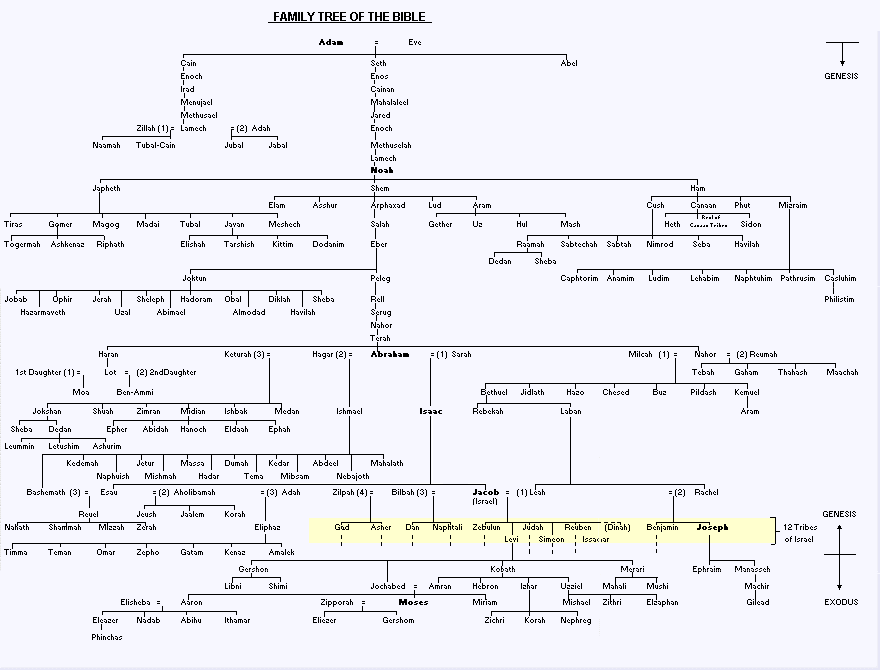
    Welcome to the Rogue Preacher’s sermon section. Below are some highlights, some sermons I enjoyed preaching and some sermon highlights. I won’t post every sermon I preach, but check back from time to time to see some I am particularly proud of.

    Genesis 11:10-32

    These are the descendants of Shem. When Shem was one hundred years old, he became the father of Arpachshad two years after the flood; and Shem lived after the birth of Arpachshad for five hundred years, and had other sons and daughters.

    When Arpachshad had lived for thirty-five years, he became the father of Shelah; and Arpachshad lived after the birth of Shelah for four hundred and three years, and had other sons and daughters.

    When Shelah had lived for thirty years, he became the father of Eber; and Shelah lived after the birth of Eber for four hundred and three years, and had other sons and daughters.

    When Eber had lived for thirty-four years, he became the father of Peleg; and Eber lived after the birth of Peleg for four hundred and thirty years, and had other sons and daughters.

    When Peleg had lived for thirty years, he became the father of Reu; and Peleg lived after the birth of Reu for two hundred and nine years, and had other sons and daughters.

    When Reu had lived for thirty-two years, he became the father of Serug; and Reu lived after the birth of Serug for two hundred and seven years, and had other sons and daughters.

    When Serug had lived for thirty years, he became the father of Nahor; and Serug lived after the birth of Nahor for two hundred years, and had other sons and daughters.

    When Nahor had lived for twenty-nine years, he became the father of Terah; and Nahor lived after the birth of Terah for one hundred and nineteen years, and had other sons and daughters.

    When Terah had lived for seventy years, he became the father of Abram, Nahor, and Haran.
    Descendants of Terah

    Now these are the descendants of Terah. Terah was the father of Abram, Nahor, and Haran; and Haran was the father of Lot. Haran died before his father Terah in the land of his birth, in Ur of the Chaldeans. Abram and Nahor took wives; the name of Abram’s wife was Sarai, and the name of Nahor’s wife was Milcah. She was the daughter of Haran the father of Milcah and Iscah. Now Sarai was barren; she had no child.

    Terah took his son Abram and his grandson Lot son of Haran, and his daughter-in-law Sarai, his son Abram’s wife, and they went out together from Ur of the Chaldeans to go into the land of Canaan; but when they came to Haran, they settled there. The days of Terah were two hundred and five years; and Terah died in Haran.

    The one thing about the book of Genesis is there is a lot of begetting. Chapter 11:10-32 is an excellent example of the begat phenomena, if you will. One is tempting to ask though, who cares? Does it matter that so and so had a child, lived for so many years and died and then the son had so many children and they were who again?

    Here we have the descendants of Shem, leading in a line to Abram finally, who will become for us Abraham, the Father of Faith. But we are getting a bit ahead of ourselves there. First, why does it matter who begat who? Are we not all God’s children?

    Practically, this passage gives us the lineage of the covenant. God will establish His covenant with Abraham, but before he did he first established a covenant with Noah. The lineage is meant to reflect that those who come after are inheriting the covenant, the obligations but also the benefits. This is key for us as Christians and also key for the author of the Gospel of Matthew, who traces Jesus lineage to Abraham in the same fashion. But once again we are way ahead of ourselves.

    This passage is a means of establishing human hierarchy. Remember that Noah blesses Shem, and the descendants of Ham, Canaan, are to be the slaves of his brother and his brother’s descendants. This passage helps to clearly distinguish between the “other” and helps establish the people of God as belonging to a cosmic order already.

    In many respects the passage promotes what we would call nationalism today, although a few thousand years ago, that concept wouldn’t make sense, but it would be more akin to tribalism and the concept that some humans are attached to the divine and cosmic orders, while others can be slaves, purchase and are not people of the covenant and cosmic order; not set aside as special.

    While lineage does mark one as part of particular community with historical roots and an ancient community which is good, it can also have dangerous effects, like alienating one from the rest of society, in this case from the rest of humanity. It has a separating effect.

    The ability to trace a lineage to divine covenants is not particular to the Israelites, in fact we in many ways continue this tradition today in the form of nation states. Germany saw itself as the chosen people, the US sees itself as fulfilling a manifest destiny and I am sure we will continue into the future not building bridges, but erecting barriers. And we must confront that our heritages and lineages while they help define who we are, they also define who is not “us.”

    Fundraising Event

    Diocese of Huron Youth Fundraiser
    Prepared by: The Rev Marty Levesque
    December 7, 2010

    Rationale

    This proposal is a blueprint for a youth fundraising event at the Cathedral Church of the Diocese of Huron, St Paul’s. The goal of the event is to raise funds to transport at least 100 youth from the Diocese of Huron to the 2012 CLAY gathering in Saskatoon.

    Following up on the success of CLAY, it is imperative that the diocese react to the energy within the diocese and move to support ministry in that area. Reacting and supporting “nodes of activity” is exactly the message Diana Butler Bass was attempting to impart to the diocese at the 2010 clergy conference when she spoke about complexity theory. As well, this type of event is also in line with Fresh Expressions of ministry as detailed at synod 2010.

    Furthermore, it is absolutely necessary that we teach and encourage the next generation of Anglicans in their faith. By doing so we encourage a younger generation to remain within the church. As well, the diocese would be grooming the next set of leaders that will guide the church in the future.

    Diocesan Culture

    A diocesan youth fundraising event will encourage a diocesan culture by fundraising for all youth, as opposed to individual congregations funding only their youth. If left to the parish level, the richer churches in the diocese would have the means to support their youth while other parishes without resources or small youth programs may fall between the cracks.

    A larger event for baseline transportation funding held at the cathedral imparts the message that we are all one family, united in the body of Christ that supports the future of the church. It provides the opportunity for all youth in the diocese to have equal access to youth programming, in this case CLAY 2012 Saskatoon.
    To the end that the event is a diocesan event, bus packages can be arranged for to bring people from outlying areas into London. This demonstrates that the diocese is not just the churches of London supporting youth initiatives, but a diocesan wide initiative.

    Or if it is the wish of the diocese more than one event can be arranged for. An event in Windsor, London and K/W would not only lower the initial cost of booking, but it would create a diocesan culture as the youth initiative fundraiser would tour the diocese itself. This option is more difficult, in some respects, as venues in the two other cities need to be sought and secured. A minimum seating capacity of 750 would be required and point persons would need to be sought in each city, although the main thrust of the marketing campaign can be run via the internet from London.

    The Event

    A Christian comedian (Jeff Allen, see http://www.jeffallencomedy.com/) plays the cathedral with an opening act, a praise band. Jeff Allen is a Christian comedian that performs a 90 minutes set. He is an internationally known and acclaimed comedian and performs regularly across North America and Europe. He is quite accustomed to playing for Christians and playing in churches.

    Youth of the diocese would be engaged in the promotion and operation of the event. They would work the doors, accept tickets and act as ushers at the event itself. The youth of the diocese would also serve as ambassadors in the marketing campaign leading up to the event so that all tickets are sold and we raise the most money possible.
    Proposed dates: Within this two week window, June 5-24 (mid-week is preferred by Jeff, Wed. or Thurs.) The linking of dates in other cities would lower some cost and provide a greater revenue stream.

    Structure for the Event

    The Holy Family Teen Life Band (The band from Crash the Cathedral) would open for Jeff Allen and warm up the crowd. They would begin with an approximately 30-35 minute set with PowerPoint for lyrics. A larger screen then the one used at Crash the Cathedral would be needed as we would be expecting the cathedral to be full.
    Jeff Allen would then take the stage at 7:30 and perform his set.

    At approximately 9:00 pm, a quick presentation to announce the amount raised with a large card board cheque presented to the diocese on behalf of the organizing team and the youth of the diocese.

    A closing prayer or speech and a blessing on behalf of either the cathedral or the diocese is offered. (Dean Dixon or one of the Bishops)

    Jeff’s merchandise would be available for sale after the show by his agents.

    If more than one event is scheduled in other cities, the opening act would have to be changed and a local praise band sought for each area.

    Marketing Campaign

    A web URL will be purchased and a landing page designed through google pages will be developed. This website will have all necessary information about the event(s). Included on this page will be links to eventbrite ticket sales for web based sales and a Facebook page. Outside Twitter use will direct people back to these pages.

    All community calendars in cities where there is an event taking place will contacted and have the event posted.

    Flyers and posters will be distributed to all parishes in the diocese.

    Each church in or directly surrounding London, from the deaneries of Delaware, Medway, Wellington and Brough will be encouraged and challenged to sell 25 tickets. Currently there are 53 churches in the 4 deaneries. Not all churches will meet the mark, but if 40 churches sold 25 tickets that would equate to all 1000 tickets sold, a sell out.

    Similarly if an event were to be held in Windsor, the 46 churches in Essex and Lambton would be also challenged in the same manner. And the same would be true for K/W and Cambridge.

    Leading up to the event if the tickets are not sold out, then a 5 minute multi-media presentation at synod could be used to encourage increased ticket sales. In conjunction with advertising to community churches and evangelical churches it is extremely likely that the event will sell out anyways.

    The members of youth synod from each parish would be asked to address their individual parishes about the importance of the event. Furthermore, permission would be sought from the Bishops for the organizer (Rev Marty Levesque) to attend all clericus’ and/or deanery council meetings throughout the diocese (depending on number of events, e.g. if only one event in London then only the 4 deaneries of London) in the New Year to make a multimedia presentation about the importance of this event and to get clergy buy in.

    With the Bishops support, presentations at all clericus’ and/or deanery council meetings and a presentation at synod this coming year it is extremely likely that this event would be a great success in the diocese and continue to build upon the identified “node of activity” so that youth ministry in the diocese continues to bear fruit.

    Budget

    Expenses Total
    Jeff Allen 5000 (US dollars)
    Expense for Jeff, flight, hotel etc. 1500
    Holy Family Band 500
    Advertising, including social media campaign, website and ticket sales through eventbrite 1000
    Equipment Rental 1000
    Miscellaneous 900
    Total 9900
    Revenue Total
    Tickets sales 15000-20000

    Profit for the event: 5100 -10100

    Operating Budget Required

    50% of the booking cost of Jeff must be paid up front. Along with advertising, equipment rentals and promotional cost a start up budget of 6000 is required. If Jeff is booked for multiple nights the start up budget would change depending on the number of nights added. This start up budget needs to be secured before proceeding any further.

    Proof Texting

    Stretching all the way back to Augustine in the fourth and fifth centuries the very idea of proof texting, the idea that any one verse or group of verses ought to be literally understood or to be interpreted in isolation from other scriptural texts, was seen as poor practice, poor interpretation, poor scholarship and poor biblical study.

    Augustine calls the practice sinful.

    Augustine and the early church fathers believed that isolating chapter and verse was detrimental to the understanding of scripture in general, and in particular could lead to the abuse of scripture and God’s word. They proposed and taught that when reading and applying scripture to life’s many situations one ought to never isolate chapter and verse. Instead one ought to interpret scripture as a part in relation to the whole.

    The danger lies in taking isolated passages as God’s law, immutable and unchanging. Yet, this is not Christian practice as evidenced from our early beginnings and the writings of St Paul. Christians believe that a new law and new relationship with God was inaugurated with Jesus Christ. It is for this reason that Christians do not practice the 613 Torah laws.

    As Christians we speak of the New Covenant, instead of the Old Covenant.

    This of course does not stop proof texting.

    Both the Old Testament and the New Testament are often abused in this manner. Many individuals use chapter and verse from the New Testament as means of providing illustrations in isolation of what we ought to do, or what God expects of us.

    For example, an often cited passage against homosexuality is Romans 1:26-32

    For this reason God gave them up to degrading passions. Their women exchanged natural intercourse for unnatural, and in the same way also the men, giving up natural intercourse with women, were consumed with passion for one another. Men committed shameless acts with men and received in their own persons the due penalty for their error.

    And since they did not see fit to acknowledge God, God gave them up to a debased mind and to things that should not be done. They were filled with every kind of wickedness, evil, covetousness, malice. Full of envy, murder, strife, deceit, craftiness, they are gossips, slanderers, God-haters, insolent, haughty, boastful, inventors of evil, rebellious towards parents, foolish, faithless, heartless, ruthless. They know God’s decree, that those who practice such things deserve to die—yet they not only do them but even applaud others who practice them.

    In isolation this passage seems to condemn homosexuality and when this passage is lifted out of the whole of Paul’s letter to the Romans, the New Testament and the bible, it would indeed be pretty damning. Yet if we continue to read we discover that Paul says something else entirely:

    Therefore you have no excuse, whoever you are, when you judge others; for in passing judgment on another you condemn yourself, because you, the judge, are doing the very same things. (My emphasis)

    Judging others is equated with all other sins against the Father. Paul’s point seems to be that God is the only judge and when we, humans, judge one and another we sin.

    Therefore one could conclude that the point Paul is trying to make is about judgment and not about homosexuality. Perhaps homosexuality is simply a means to illustrate how the sin of judgment is most heinous.

    Now I realize that providing an example of proof texting surrounding homosexuality is a charged issue and I suspect I will receive a few comments on it, so let me approach it from a slightly different perspective and with a different issue.

    Genesis 9:24-27 says:

    When Noah awoke from his wine and knew what his youngest son had done to him, he said,
    ‘Cursed be Canaan;
    lowest of slaves shall he be to his brothers.’
    He also said,
    ‘Blessed by the Lord my God be Shem;
    and let Canaan be his slave.
    May God make space for Japheth,
    and let him live in the tents of Shem;
    and let Canaan be his slave.’

    The descendants of Canaan, Africans, were subject to slavery and the slavery was defended as God’s punishment according to scripture. Slave traders, the American South and even the British Empire relied upon this interpretation to maintain the slave system, isolating this passage from the rest of scripture. Ignored were the passages where God sets his people free, reconciles his people and leaves the temple and Holy Jerusalem to be with his people in slavery and exile.

    Proof texting, as we can see, is very dangerous and can lead to all kind of abuses of God’s word including maintaining systems of oppression, domination and violence, like chauvinism, sexism, patriarchies, nationalism, militarism and such. Isolating chapter and verse creates and breeds misunderstanding about what we do as Christians and what God wants for us. And this misunderstands then continues in the world with people we seek to engage with and bring the Good News of Jesus Christ too.

    Here I am thinking of Richard Dawkins at the moment and many in the new atheist movement. Many times I encounter people, atheists of this particular variety, who engage me in conversations in an attempt to educate me as to what I believe (somehow I didn’t know before but luckily they have arrived to let me know). Often passages, chapter and verse, are quoted. The claims of course are proof texting claim.

    The argument goes that because the bible is the word of God, whether literal or inspired, depending on your theological bent, that every phrase and every word in the bible is somehow immutable and unchanging, even though it has been translated many times. Yet, if one is to read the whole and not the part, we see that God does in fact change his mind many times; He remembers his people and inaugurates a New Covenant through Jesus Christ.

    Proof texting, whether used as an attack against Christianity or used by Christians themselves to justify actions or behaviors creates misunderstanding and is very dangerous. And as St Augustine stated so many years ago, it is poor scholarship, poor biblical studies and a sin.

    So the next time that someone quotes a passage to you, chapter and verse, stop, and ask what the next verse is and if it might be important also.

    Social Media Etiquette

    Sometimes etiquette is lost online, in social media and through new media channels. While I am far from Emily Post and an expert, I have noticed some disturbing trends recently on different social media platforms.

    So here are a couple of helpful tips (I hope) on how to foster community and practice good etiquette on the inter-webs for churches, their priest and others.

    Profile Pics

    1. Never use a logo personally. Sure, it can work for a company or institution, but for a person, not so much. It is not like I can shake hands with a church logo or the Nike swoosh.
    2. South Park and other cartoon renditions are cute, but rather juvenile. Remember your picture will say much about how people see you. Now this doesn’t mean a little playfulness isn’t okay, just be aware if your profile picture is a cartoon character don’t be surprised if people don’t take you seriously.
    3. A picture is worth a thousand words. Make sure your profile pic or your church’s says what you want, old and traditional, fun and interesting, modern and thoughtful…your decision.

    Friending

    1. Contrary to popular belief, you do not have to friend someone if they send you a request. For instance, you don’t have to give your telephone number to just anyone. So why are you giving it or “friending” a long lost “friend” from grade 3. Are you seriously going to engage with them?
    2. If you decide to unfriend someone, cool, but don’t announce it.
    3. For churches, priest and pastors out there, it is okay to friend and follow each other…in fact, one could say that being social, friends and helping each other is building up the kingdom of God. So go for it! They are not competition.

    Conversation

    1. Always give credit where credit is due. Sure we want to look like the hippest person out there, but always tag back to where you saw something interesting. In academia this is sighting your sources. In social media, it is just polite to give a shout out to the person who found that great video, picture or quote. Don’t worry you will look cool by association. By not giving credit, you run the risk of angering the person and being unfriended, and losing your source for cool links to pass on.
    2. If you are talking about someone, give him or her a shout out and link back to them, either to their Facebook or Blog (or both), so that others may find this wonderful person you are speaking about. Hence the whole social media thing.
    3. Speaking of links…when possible, link back. This matters for other peoples Google juice and helps them out. Do for others and they will do for you.

    I realize this is a short list of social media etiquette for churches, priest and pastors. And it is by no means exhaustive. In fact, I am sure I missed something obvious. But following these simple rules should help out on social media and help increase your scope and deepen your friendships online.

    Genesis 11:1-9

    Now the whole earth had one language and the same words. And as they migrated from the east, they came upon a plain in the land of Shinar and settled there. And they said to one another, ‘Come, let us make bricks, and burn them thoroughly.’ And they had brick for stone, and bitumen for mortar. Then they said, ‘Come, let us build ourselves a city, and a tower with its top in the heavens, and let us make a name for ourselves; otherwise we shall be scattered abroad upon the face of the whole earth.’ The Lord came down to see the city and the tower, which mortals had built. And the Lord said, ‘Look, they are one people, and they have all one language; and this is only the beginning of what they will do; nothing that they propose to do will now be impossible for them. Come, let us go down, and confuse their language there, so that they will not understand one another’s speech.’ So the Lord scattered them abroad from there over the face of all the earth, and they left off building the city. Therefore it was called Babel, because there the Lord confused the language of all the earth; and from there the Lord scattered them abroad over the face of all the earth.

    Laziness sometimes has it’s own rewards, rarely, but it does sometimes. Or maybe I should say distractions have their rewards. Either way, it has been far to long since I blogged about the bible. Work sometimes consumes one’s life, and then the addition of study and class; moving and a cluster of other distractions and then you noticed you have fallen down on one of your commitments, to blog the bible.

    Yet there are times when it is a benefit. Allow me to explain.

    Today’s passage is the story of the Tower of Babel. It comes from J’s hand and is a mythological story to explain how and why people have different languages.

    In this passage, Yahweh is one god among many. If you notice in verse 7, Yahweh says to the council of other gods, “Come, let us go down, and confuse their language there, so that they will not understand one another’s speech.” It was J’s understanding that there were multiple gods throughout the world, yet Yahweh was the ruler, or king or lord of all the other gods; a trait very common throughout the Torah of J and an easy way to discern his penmanship.

    I find this passage striking for many reasons, but one of the reasons is fear; fear that God displays about humanity and more specifically about humanity working together. “And the LORD said ‘Look, they are one people, and they all have one language; and this is only the beginning of what they will do; nothing they propose will now be impossible for them.”

    Fear of humanity’s potential drives God to confuse their language so that they no longer understand one another, and then God scatters them abroad, over the entire face of the earth.

    While this passage is also the mythological explanation as to why there are many languages if we all descended from Adam and Eve, it also tells us a truth today. It is a truth that is present in any who have power and want to hold their power; they confuse first and then they divide. Machiavelli would be proud.

    My distractions have allowed me to come back to this passage now, during the Occupy Wall Street protest that have grown to other cities and other countries, such as Canada, who is all set to begins its Occupy Bay Street protest this coming weekend.

    Truly there is a subtle message in here about power dynamics between ruler and ruled. A message that when humanity comes together and unites under one voice, one language and works in unison there is nothing that is impossible.

    The Arab Spring has lead to more open democracies in the Middle East, the Western Fall seems to be a time when we as a people are awakening from a long slumber to cast off the systems of oppression and domination that control our lives. For the West, the dictator is not an individual or an oppressive regime, but an economic system that rewards greed and a few people at the expense of the majority. A system that oppresses many and that has been growing in power.

    Yet, this system like all tyrants can be confronted, but must be confronted jointly, together and as one voice. In doing so there is nothing that we, as the people of God, cannot do, nothing is impossible for us. But we must be vigilant. The system will attempt to confuse us; separate us into different focus groups and divide and scatter us.

    This passage speaks about the mythological understanding of how many languages came to be. But it also speaks about humanity’s potential, a potential that God himself saw and fears. What will we do with this potential?

    Priestly Duties

    What should a priest be?
    All things to all –
    male, female and genderless
    What should a priest be?
    reverent and relaxed
    vibrant in youth
    assured through the middle years
    divine sage when ageing

    What should a priest be?
    accessible and incorruptible
    abstemious, yet full of celebration,
    informed, but not threateningly so,
    and far above
    the passing soufflé of fashion

    What should a priest be?
    an authority on singleness
    Solomon-like on the labyrinth
    of human sexuality
    excellent with young marrieds,
    old marrieds, were marrieds, never
    marrieds, shouldn’t have marrieds,
    those who live together, those who live
    apart, and those
    who don’t live anywhere
    respectfully mindful of senior
    citizens and war veterans,
    familiar with the ravages of arthritis,
    osteoporosis, post-natal depression,
    anorexia, whooping-cough and nits.

    What should a priest be?
    all-round family person
    counsellor, but not officially because
    of the recent changes in legislation,
    teacher, expositor, confessor,
    entertainer, juggler,
    good with children, and
    possibly sea-lions,
    empathetic towards pressure groups

    What should a priest be?
    on nodding terms with
    Freud, Jung, St John of the Cross,
    The Scott Report, The Rave Culture,
    The Internet, the Lottery, BSE, and
    Anthea Turner,
    pre-modern, fairly modern,
    post-modern, and, ideally,
    Secondary-modern –
    if called to the inner city

    What should a priest be?
    charismatic, if needs must,
    but quietly so,
    evangelical, and thoroughly
    meditative, mystical, but not
    New Age.
    Liberal, and so open to other voices,
    traditionalist, reformer and revolutionary
    and hopefully, not on medication
    unless for an old sporting injury.

    Note to congregations:
    If your priest actually fulfills all of the above, and then enters the pulpit one Sunday morning wearing nothing but a shower-cap, a fez, and declares: ‘I’m the King and Queen of Venus, and we shall now sing the next hymn in Latvian, take your partners, please’. –
    Let it pass.

    Like you and I,
    they too sew the thin thread of humanity,
    Remember Jesus in the Garden –
    beside Himself?

    So, what does a priest do?
    mostly stays awake
    at Deanery synods
    tries not to annoy the Bishop
    too much
    visits hospices, administers comfort,
    conducts weddings, christenings –
    not necessarily in that order,
    takes funerals
    consecrates the elderly to the grave
    buries children, and babies,
    feels completely helpless beside
    the swaying family of a suicide.

    What does a priest do?
    tries to color in God
    uses words to explain miracles
    which is like teaching
    a millipede to sing, but
    even more difficult.

    What does a priest do?
    answers the phone
    when sometimes they’d rather not
    occasionally errs and strays
    into tabloid titillation,
    prays for Her Majesty’s Government

    What does a priest do?
    tends the flock through time,
    oil and incense,
    would secretly like each PCC
    to commence
    with a mud-pie making contest
    sometimes falls asleep when praying
    yearns, like us, for
    heart-rushing deliverance

    What does a priest do?
    has rows with their family
    wants to inhale Heaven
    stares at bluebells
    attempts to convey the mad love of God
    would like to ice-skate with crocodiles
    and hear the roses when they pray.

    How should a priest live?

    How should we live?

    As priests,
    transformed by The Priest
    that death prised open
    so that he could be our priest
    martyred, diaphanous and
    matchless priest.

    What should a priest be?
    What should a priest do?
    How should a priest live?

    By: Stewart Henderson, “Priestly Duties: Written for Eric Delve 23.5.96” in Limited Edition (Plover books, 1997).

    10 warning signs that your church is in trouble

    1. Attendance drops

      Temporary fluctuation in attendance can be normal over the life of a community. However, steady attrition over time is likely cause for concern. Decreases in attendance normally occur for one (or more) of three reasons.

      • A new leader of the community arrives.
        With a change in leadership comes a time of change when members decide if their commitment to their community will continue with the new leader. While the hope is that a church community is committed to itself, it needs to be acknowledged that at times personality does influence growth and attrition patterns in churches. The arrival of a new leader can lead to a decrease in attendance, at least in the short term.
      • Conflict in a congregation.
        Significant or unresolved conflicts over community direction, issues of worship or a myriad of other possible issues can cause division leading to congregants leaving for greener grass in other parishes.
      • Community Erosion
        Slow and steady decrease in attendance is a subtle but critical warning sign of a troubled parish. Attrition occurs slowly as congregants move, die or leave due to lack of interest or general unfulfillment. This is further compounded by a lack of new growth through new membership or children entering the parish.

      Of the three forms of attrition, the third is the most insidious as it is difficult to recognize and accept. Often problems in programming, community dynamics and leadership remain in place for years until the community reaches the tipping-point and enters into crisis mode. Parish leadership may blind themselves to the problems by refusing to accept responsibility or deflecting blame for the parish’s failures. This is a classic indicator of problems at the leadership level.

    2. Operational fundraising

      All fund raising is for the operational budget. The work of the parish has become the goal of keeping the doors open only, not doing the work of the gospel and the mission to which the baptized are called. When all fund raising is internal and the parish is focused on survival, the reason for being a Christian community is quickly lost.

    3. Disappearing programs

      Lack of interest or lack of volunteers, particularly for fundamental programs – such as Sunday school or fellowship time – indicates attrition and looming problems. Once programs cease, the community has admitted that they are in danger. This is a common early-warning sign that proactive leadership should be aware of when considering ending fundamental programming

    4. Reduction in staff numbers or hours

      When paid positions are eliminated or staff move from full time to ¾ time or ½ time to save money, this can be a sign the community is unable to meet its basic obligations. This warning sign is often seen together with operational fundraising as a last-ditch attempt to keep the doors open. While sometimes shrinking to grow can be a legitimate approach to a struggling parish, this is still a clear warning sign all is not well.

    5. Rapid progression through programs

      Communities that are in panic mode often fall into this pattern. They move quickly from one program to the next looking for a quick fix to their financial and attendance problems. The rapid introduction and progression through programs – often modeled after more successful churches or consultant advice – is often a sign of an impatient and desperate attempt to find a quick fix for the problems of the parish.

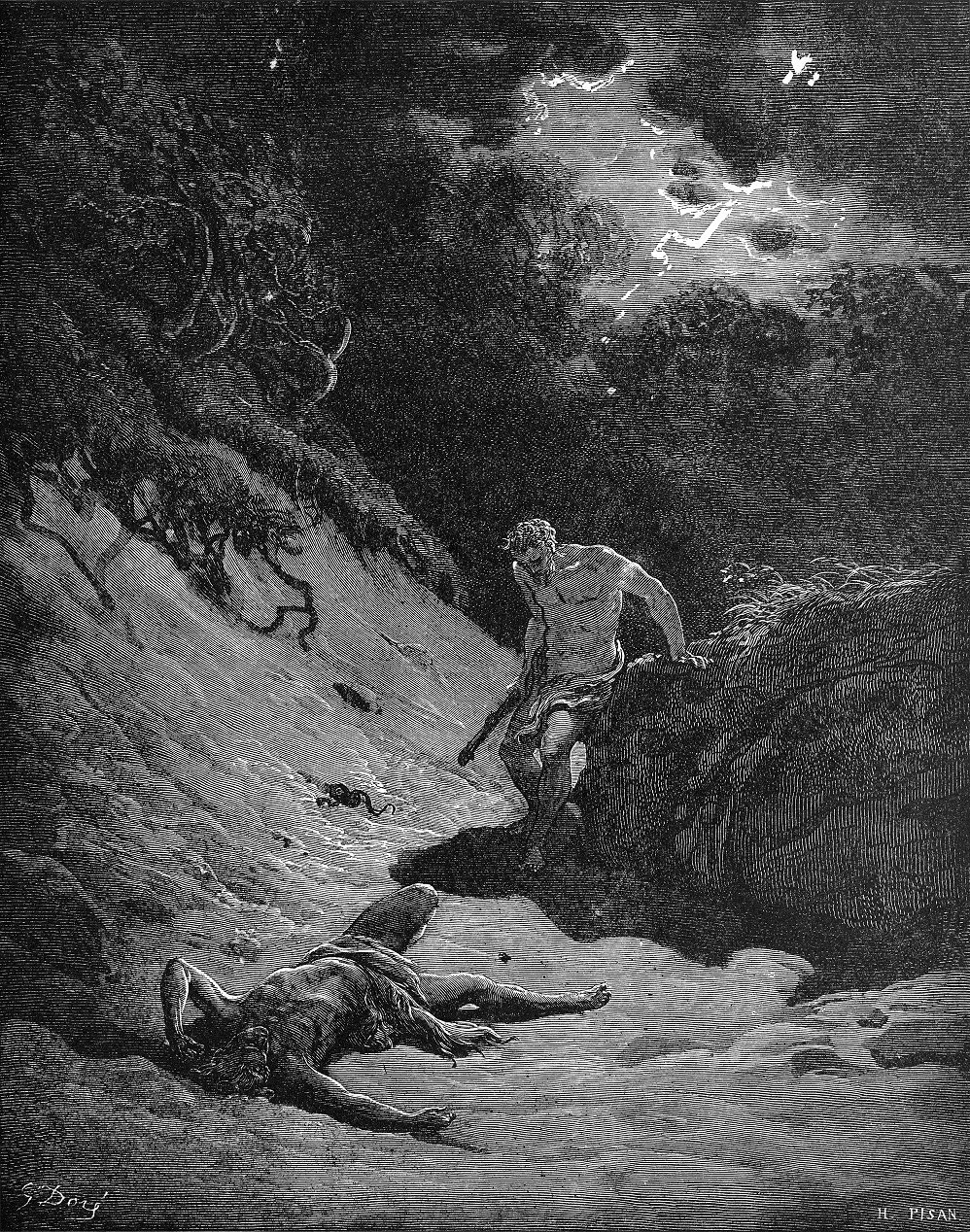
    6. Few givers give a lot

      The 80/20 rule applies in most circumstances in communities: 20% of the people do 80% of the work. However, a community dependent on only 20% of its givers is always in danger — even when it can make its budget. An 80/20 community is always one death away from financial crisis. Healthy communities divide the burden while struggling communities rely upon a few individuals. In some cases, this arrangement can lead to further problems as money and politics are closely related. A small concentration of either can spell danger.

    7. Constant or frequent turnover of staff and volunteers

      With constant turnover, effort is often duplicated and resources are wasted. Community identity is always in a state of flux. New directions and new visions are constantly implemented, upsetting the core of the community. Integrating new volunteers into the community is a sign of health, but regular turnover can be a sign of trouble in the parish, whether from politics, past conflicts, or leadership.

    8. Merging or partnering for survival

      Requiring partners to share resources, especially leadership, is an indication of a community that is suffering attrition and is in danger of closing. If a merger or partnership with another community is required to meet basic budget needs, then the community is in serious danger. This is often a Band-Aid solution to immediate problems.

      With no long-term plan to address the circumstances that led to the need to merge or partner, the problems will likely resurface over time. If there is a poisonous element in the community, it must be eliminated before joining with another community or risk poisoning it as well.

    9. Poor communication

      Gossip, infighting, lack of transparency and closed-door leadership meetings, especially surrounding important decisions, are indications of unhealthy internal communication within the parish.

      Poor external communication is also a sign that the parish is likely to struggle with growth and evangelism. Websites that carry outdated information, for example, are an obvious indication to the outside world that the parish is in crisis and unable to maintain the most basic communication requirements

    10. Emptying endowments

      When endowment capital is used for the operational budget with no repayment plan, it is often a Band-Aid solution to cover deeper problems. Using endowment funds for immediate problems with no long-term replacement plan is a sign that the parish has stopped considering its own future. If a parish stops funding its future, it may not have one.

    Youth Ministry, the Forgotten Ministry

    A strange title, I know. After all, much energy and talk is dedicated to youth ministry in a manner of speaking, but it is a ministry that is about a ghetto.

    When we speak of ministry to our congregations, we speak in broad open terms. We do ministry. Ministry is about visiting our parishioners; shut ins, providing pastoral care and support during difficult times, programs and education and making sure to provide a relevant worship experience with good sermons.

    And then we do youth ministry, which is somehow separate from the above. It is about games, and making Jesus fun, praise music and being a teenager’s buddy. Maybe we have watch Dogma one too many times, but we treat our youth different then we do anyone else. We dress up our liturgies and beliefs in praise services with the Buddy Christ and more often than not, it is an afterthought.

    Seriously, ask yourself how often your priest visits shut ins, elderly and the parish list. Hopefully quite a bit. Then ask yourself how often does your priest make an appointment to visit a teenager and sit down with them in a home visit? Not very likely that they search out the teenager specifically, but will perhaps at best visit a family as a whole. In fact, we go so far as to hire specialized workers, Family and Youth Ministry specialist to talk to this minority and group that we have unintentional other’d. We create special rooms for them away from everyone else, where hopefully they will not disturb the rest of us. And we create events tailored for them and only them. In essence we cut them off from the rest of the congregation, from the body of Christ, and then we wonder why they don’t feel connected or comfortable in their church.

    I don’t mean to belittle the ministry the dedicated Family and Youth Ministry specialists provide, but my question is why don’t priest and pastors visit teens? Why do we treat them differently? And why are we surprised when they act differently?
    For far too long we have forgotten youth ministry and have asked others to do it. We have delegated an entire area of ministry to others. And then we ask ourselves, where are the youth? Why aren’t they in church?

    Seriously??

    I mean, have we bothered to develop a relationship and build trust with them like we do their parents and grandparents? Are we there while they face difficult choices in life? Stuff surrounding sex, drugs, bullying, selfhood, becoming an adult, becoming a Christian? Are we walking with them in their journey of faith? Are we taking them as serious as we do Mrs. X, head of the altar guild and lifelong parishioner?

    And when they finally come out of those teen years and move out of their parents home are we really surprised that they don’t want to be part of a community of believers? After all what have we done for them? We ghetto-ize them, we trot them out to be cute for us in front of the congregation, we make them servers when old enough, but really spend no time with them and then they leave to go away to university and that is the last we see of them.

    Youth ministry, like any ministry, is about relationships. It is about building trust and being there in difficult times to be a friend, a guide, a mentor, and a spiritual advisor. It is about teaching them how to rely upon Jesus Christ, how to pray and to discern where the Holy Spirit is calling them in their lives.

    In effect, youth ministry is just ministry and the sooner we stop labelling it as something other, the better off we will be.

    Genesis chapter 10

    These are the descendants of Noah’s sons, Shem, Ham, and Japheth; children were born to them after the flood.

    The descendants of Japheth: Gomer, Magog, Madai, Javan, Tubal, Meshech, and Tiras. The descendants of Gomer: Ashkenaz, Riphath, and Togarmah. The descendants of Javan: Elishah, Tarshish, Kittim, and Rodanim. From these the coastland peoples spread. These are the descendants of Japheth in their lands, with their own language, by their families, in their nations.

    The descendants of Ham: Cush, Egypt, Put, and Canaan. The descendants of Cush: Seba, Havilah, Sabtah, Raamah, and Sabteca. The descendants of Raamah: Sheba and Dedan. Cush became the father of Nimrod; he was the first on earth to become a mighty warrior. He was a mighty hunter before the Lord; therefore it is said, ‘Like Nimrod a mighty hunter before the Lord.’ The beginning of his kingdom was Babel, Erech, and Accad, all of them in the land of Shinar. From that land he went into Assyria, and built Nineveh, Rehoboth-ir, Calah, and Resen between Nineveh and Calah; that is the great city. Egypt became the father of Ludim, Anamim, Lehabim, Naphtuhim, Pathrusim, Casluhim, and Caphtorim, from which the Philistines come.

    Canaan became the father of Sidon his firstborn, and Heth, and the Jebusites, the Amorites, the Girgashites, the Hivites, the Arkites, the Sinites, the Arvadites, the Zemarites, and the Hamathites. Afterwards the families of the Canaanites spread abroad. And the territory of the Canaanites extended from Sidon, in the direction of Gerar, as far as Gaza, and in the direction of Sodom, Gomorrah, Admah, and Zeboiim, as far as Lasha. These are the descendants of Ham, by their families, their languages, their lands, and their nations.

    To Shem also, the father of all the children of Eber, the elder brother of Japheth, children were born. The descendants of Shem: Elam, Asshur, Arpachshad, Lud, and Aram. The descendants of Aram: Uz, Hul, Gether, and Mash. Arpachshad became the father of Shelah; and Shelah became the father of Eber. To Eber were born two sons: the name of one was Peleg, for in his days the earth was divided, and his brother’s name was Joktan. Joktan became the father of Almodad, Sheleph, Hazarmaveth, Jerah, Hadoram, Uzal, Diklah, Obal, Abimael, Sheba, Ophir, Havilah, and Jobab; all these were the descendants of Joktan. The territory in which they lived extended from Mesha in the direction of Sephar, the hill country of the east. These are the descendants of Shem, by their families, their languages, their lands, and their nations.

    These are the families of Noah’s sons, according to their genealogies, in their nations; and from these the nations spread abroad on the earth after the flood.

    The sons of Noah: Shem, Ham and Japeth, or were they Japeth, Ham and Canaan?

    This chapter and the last are very good examples of the editor’s pen at work, cutting and slicing, adding where necessary to make the story move more smoothly. The idea behind all the editorial work is to make sure that the people of Israel do not exist in isolation from the rest of the world.

    This is one of our examples of universalism found in the Old Testament. Examples like all of humanity stemming from one man and one woman. The redactor used this material to provide a background of world history, however rudimentary, for the people of Israel, which was to begin, or take its foundational root with Abraham. This becomes more apparent later when Israel’s vocational role is to become a light to lighten the Gentiles. (Isa 49:6) Although we are getting way ahead of ourselves here, after all we are still in Genesis and have not reach Isaiah.

    This history of the world and therefore the people of the world is meant to explain how the coastal people came to be and how they are related to Israel. As well it explains who the hill people are and also who are all the tribes that inhabit the land of Canaan, which will eventually become the Promised Land.

    This passage also tells another story though, a story of family united, but about to be divided. I refer you to verse 32. These are the families of Noah’s sons, according to their genealogies, in their nations; and from these the nations spread abroad on the earth after the flood.

    All the people of the earth are of one family, united together after the flood, building nations and populating the land. A group of humans dedicated to each other and in community. Together they can accomplish anything, they have survived the flood and they have spread to all parts of the earth. But interesting enough, they have different languages. This of course will become of definite interest to us in the next chapter and also shows us how the redactor had insert this into the original material.

    There are many ways we can read this passage in a postmodern world. But stepping back from the desire to explain away this passage or read it through the eyes of our time, I think this passage is simply supplying history for the people of Israel. It is simply redacted back into the foundational story so to support the idea that the people of God, Israel, come from a common and single ancestor.

    Although, having said that, I would love to hear your opinion on chapter 10.

    Genesis 9:18-28

    The sons of Noah who went out of the ark were Shem, Ham, and Japheth. Ham was the father of Canaan. These three were the sons of Noah; and from these the whole earth was peopled.

    Noah, a man of the soil, was the first to plant a vineyard. He drank some of the wine and became drunk, and he lay uncovered in his tent. And Ham, the father of Canaan, saw the nakedness of his father, and told his two brothers outside. Then Shem and Japheth took a garment, laid it on both their shoulders, and walked backwards and covered the nakedness of their father; their faces were turned away, and they did not see their father’s nakedness. When Noah awoke from his wine and knew what his youngest son had done to him, he said,
    ‘Cursed be Canaan;
    lowest of slaves shall he be to his brothers.’
    He also said,
    ‘Blessed by the Lord my God be Shem;
    and let Canaan be his slave.
    May God make space for Japheth,
    and let him live in the tents of Shem;
    and let Canaan be his slave.’

    After the flood Noah lived for three hundred and fifty years. All the days of Noah were nine hundred and fifty years; and he died.

    A drunk man falls down and passes out naked in the street, or in his tent. And for his drunkenness he blames his youngest son for embarrassing him in front of his other two children. And then he curses not his son Ham who found him, but his son’s son, Canaan and all his descendants. And from that incident we have the biblical justification for slavery, or at least the first one.

    This passage, therefore, has been used by the Dutch Reformed Church in South Africa and by American slave owners in the South to justify the Apartheid system and the slave trade respectively throughout the years.

    But before even that, this passage allowed for the justification of the Israelites to invade, conquer and take the land of Canaan for themselves from the Canaanites, who they proceeded to enslave. And one wonders how much it still influences the current Israeli/Palestinian conflict.

    Untangling this passage is difficult. It seems to come from the J source and was redacted later to occur after the flood, instead of appearing before the flood as seems more natural. As well, this passage looks to have been adapted slightly to have Noah the vine grower practice husbandry as the hero from the Gilgamesh epic. In this manner the epic has been converted into Yahwism and eventual finds its place in the Old Testament canon.

    This passage therefor comes not only from the J source, but also from Babylonian myths. Something not often spoken about in Christian churches I would imagine. But we have tackled the question of myth already. Let’s turn to other questions that this passage raises.

    So what are we to do with a passage that has Noah curse an entire future population to be the slaves of others? Is slavery okay then? It is biblical after all. Is this another caution against sexual perversion? Or is it the ranting’s of a drunkard with a hang over? Where is the kernel of truth in here that God wants us to see?

    If you asked me, and I assume you have since you are reading my blog, I think the caution in this passage is to maybe ignore the preacher sometimes. Seriously, I just said that.

    Here we have a man speaking on behalf of God, cursing and blessing. Noah, who God said was righteous, was asked to build an ark and save a holy remnant. He was never tasked with the prophetic role for after the flood receded. He was asked to be fruitful and multiply, but not to curse and not to bless.

    So do we discount this passage? Well maybe we discount the blessing and curses because they come from a man and not from God. And maybe we learn to be more discerning and have received a warning from God about people who bless and curse in his name. Maybe we see in Noah’s actions, the actions that will lead to evil and we are to learn from them, so as not to repeat them and not follow the path of evil.

    The bible, I believe holds up for us examples of what to do, but also what not to do. And this I think is an example of what not to do, which is not take the Lord’s name and act in the place of God. The only one who can bless or curse is after all the one who created us.

    Genesis 9:1-17

    God blessed Noah and his sons, and said to them, ‘Be fruitful and multiply, and fill the earth. The fear and dread of you shall rest on every animal of the earth, and on every bird of the air, on everything that creeps on the ground, and on all the fish of the sea; into your hand they are delivered. Every moving thing that lives shall be food for you; and just as I gave you the green plants, I give you everything. Only, you shall not eat flesh with its life, that is, its blood. For your own lifeblood I will surely require a reckoning: from every animal I will require it and from human beings, each one for the blood of another, I will require a reckoning for human life.
    Whoever sheds the blood of a human,
    by a human shall that person’s blood be shed;
    for in his own image
    God made humankind.
    And you, be fruitful and multiply, abound on the earth and multiply in it.’

    Then God said to Noah and to his sons with him, ‘As for me, I am establishing my covenant with you and your descendants after you, and with every living creature that is with you, the birds, the domestic animals, and every animal of the earth with you, as many as came out of the ark. I establish my covenant with you, that never again shall all flesh be cut off by the waters of a flood, and never again shall there be a flood to destroy the earth.’ God said, ‘This is the sign of the covenant that I make between me and you and every living creature that is with you, for all future generations: I have set my bow in the clouds, and it shall be a sign of the covenant between me and the earth. When I bring clouds over the earth and the bow is seen in the clouds, I will remember my covenant that is between me and you and every living creature of all flesh; and the waters shall never again become a flood to destroy all flesh. When the bow is in the clouds, I will see it and remember the everlasting covenant between God and every living creature of all flesh that is on the earth.’ God said to Noah, ‘This is the sign of the covenant that I have established between me and all flesh that is on the earth.’

    For many years the bible has been used to justify all kinds of atrocities. After all if it is in the bible, then that must be the way God intended it. For instance a passage that we will look at next time, Genesis chapter 9:18-28, has traditionally been used to justify slavery in the United States of America before and during the civil war. As well, this same passage was fundamental to the Dutch Reform Church in South Africa in their theological justification of Apartheid.

    Our sacred texts have often been used to justify people’s earthly desires through the evoking of God’s holy name and scripture. And it can be hard to argue if your belief of scripture is that it is the inherent accurate word of God. But that also assumes you take each passage separately from the whole and ignore many contradictions. But then again that is the whole purpose of this blog, which is to explore some of these contradictions.

    But our passage is one in which I actually wish people would use to help justify a position and that is the environmental position. While God tells Noah and his son that they are to have the plants of the fields to eat as well as the animals, birds and fish, God does something absolutely remarkable here; God makes his covenant with all of creation. Not just with humanity, not just human centric, but with all of creation.

    Listen, “As for me, I am establishing my covenant with you and your descendants after you, and with every living creature that is with you, the birds, the domestic animals, and every animal of the earth with you, as many as came out of the ark.”

    This passage is often sited for the “bow in the sky”, the rainbow, as a sign of the covenant. But the covenant itself, I believe, is much more important and striking. The covenant is made between God and all of creation. We are all, human, animal, bird, fish, creepy thing of the earth, we are to all go forward and multiple. And God places the bow in the sky, the rainbow, to remind him of his covenant with not only humanity, but with the all of creation.

    God is presenting to us something fundamentally important. We are not to have dominion over the earth and subdue it, as often quoted reason for raping the earth of its natural resources. That command was giving before the flood, at creation and God saw the evil that is humanity and eliminated humanity from the earth, all but Noah and his sons and their wives.

    Having seen the type of evil that humanity, unchecked, can produced when they have dominion, God chooses now, to exercise his free will and change his mind, and instead he makes his covenant with everything and not just humanity.

    Something to keep in mind the next time you throw your coffee cup out the window of the car I would think.

    Genesis 8:20-22

    Then Noah built an altar to the Lord, and took of every clean animal and of every clean bird, and offered burnt-offerings on the altar. And when the Lord smelt the pleasing odour, the Lord said in his heart, ‘I will never again curse the ground because of humankind, for the inclination of the human heart is evil from youth; nor will I ever again destroy every living creature as I have done.
    As long as the earth endures,
    seedtime and harvest, cold and heat,
    summer and winter, day and night,
    shall not cease.’

    This final passage of chapter 8 demonstrates further some of the problems we have been having with Genesis thus far and also is an excellent example of the two different and distinct sources being blended together into one final text.

    In the J source, 2 of every kind of animal, male and female, had gone into the ark. This is so the population of every kind of animal may be renewed after the flood, from 2 shall come all. This is very reminiscent of Adam and Eve being the progenitors of all human beings.

    Yet this passage at the end of chapter 8 comes from the P source. Because the first thing that happens after the flood subsides is Noah builds an altar and sacrifices the clean animals to God. Well if there were only two of each then there would be no clean animals left to re-populate the earth and no more sacrifice to be had for God.

    This type of revision of the J source was done earlier if you remember, when Noah took two of every kind of animal into the ark and then later the text was amended to say two of every kind of unclean animal and seven pairs of clean animals.

    P is concerned about temple practices of sacrifice and revised the holy text so that P’s agenda would be writing into the history and sacred texts of the Jewish people.

    Which begs the question, or two or three questions; why would God allow that to happen? How many times has it happened? And how can we know what is the definitive word of God?

    Without giving some trite answers, let me say simply this, the bible has been translated many times. The originally meaning has gotten further and further away from us after each new translation, since translations are just interpretations anyway. The meanings of certain terms or words do not transfer from one language to another. Often a joke in one language just sounds strange in another.

    For example, the Old Testament is full of puns, puns that we don’t get because we are not Jews or reading Hebrew. And in a rush to claim authority and divine revelation for the bible we have forgotten some fundamental facts, namely we are reading someone else’s interpretation and not the definitive word of God. It has passed through the hands of many a translator.

    Does that mean we throw it all out? No. It just means that P interpreted the flood event so that it would make sense in his world. Likewise we are going to have to interpret God’s words and God’s already interpreted words so they make sense in a post-modern secular world that we find ourselves in.

    Do we add new words like P did to the sacred texts? Some would argue that tradition, liturgy and ceremony are additions to God’s holy words, especially surrounding the sacraments. So yes I think we do add to the singularity of God’s words with our own words, ceremonies and rites. They help us make sense out of the bible and God’s plan for us. They help us interpret the world around us through religious eyes and to see God’s glory in all things.

    So I guess the next time we celebrate the Eucharist or a baptism, we should remind ourselves that each choice we make and each words we use, add or change is an adjustment to what came before, just like P did. P adjusted the sacred texts to fit the style of worship of the people of God at that time. We adjust words as well, with new translations of scripture, new versions of the Lord’s prayer, new authorized Eucharistic prayers, gender inclusive language, etc…

    Additions can add to the diversity of our worship, which can be good or bad. Whether P’s additions are good or bad I will leave up to you to decide.

    Genesis 8:1-19

    But God remembered Noah and all the wild animals and all the domestic animals that were with him in the ark. And God made a wind blow over the earth, and the waters subsided; the fountains of the deep and the windows of the heavens were closed, the rain from the heavens was restrained, and the waters gradually receded from the earth. At the end of one hundred and fifty days the waters had abated; and in the seventh month, on the seventeenth day of the month, the ark came to rest on the mountains of Ararat. The waters continued to abate until the tenth month; in the tenth month, on the first day of the month, the tops of the mountains appeared.

    At the end of forty days Noah opened the window of the ark that he had made and sent out the raven; and it went to and fro until the waters were dried up from the earth. Then he sent out the dove from him, to see if the waters had subsided from the face of the ground; but the dove found no place to set its foot, and it returned to him to the ark, for the waters were still on the face of the whole earth. So he put out his hand and took it and brought it into the ark with him. He waited another seven days, and again he sent out the dove from the ark; and the dove came back to him in the evening, and there in its beak was a freshly plucked olive leaf; so Noah knew that the waters had subsided from the earth. Then he waited another seven days, and sent out the dove; and it did not return to him any more.

    In the six hundred and first year, in the first month, on the first day of the month, the waters were dried up from the earth; and Noah removed the covering of the ark, and looked, and saw that the face of the ground was drying. In the second month, on the twenty-seventh day of the month, the earth was dry. Then God said to Noah, ‘Go out of the ark, you and your wife, and your sons and your sons’ wives with you. Bring out with you every living thing that is with you of all flesh—birds and animals and every creeping thing that creeps on the earth—so that they may abound on the earth, and be fruitful and multiply on the earth.’ So Noah went out with his sons and his wife and his sons’ wives. And every animal, every creeping thing, and every bird, everything that moves on the earth, went out of the ark by families.

    This part of chapter 8 gets more confusing as the two sources have been comingled again. Both P and J have pieces in this part of the flood story.

    Apparently after 150 days the water abated and the ark came to rest upon Mount Ararat.  Okay, sounds good.

    But it rained for 40 days and 40 nights, after which Noah sent out a dove to look to see if the flood was over, but it found no place to land so the dove returned.

    Noah waits another seven days and again he sends out the dove.  This time the dove returns with a freshly plucked olive tree leaf. But Noah brings the dove back in and waits again another seven days.

    Again Noah sends out the dove.  This time it does not return.

    At this time Noah removes the cover of the ark and God commands him to leave the ark….after 40 days and nights, plus 14 days of waiting for the waters to subside.

    Obviously the math does not calculate properly here. How can Noah leave the ark after 54 days, but the ark has not come to rest upon Mount Ararat, which is due to happen 96 days after the flood began?

    So was it 54 days or 150 days?

    It may in fact have been both. The reason I say this is there is much archeological evidence to support a great flood that occurred roughly 10 000 years ago. Many of the costal regions flooded, never to return, when the ice caps began to melt and sea levels rose.

    This type of cataclysmic event would naturally be documented in the sacred texts of many people, which could explain why the days do not line up.  But just because the days do not line up does not mean there was not a “Great Flood”.

    For instance, here is an example of a 10 000 year village in the English Channel. http://www.livescience.com/history/070809_aqua_dig.html

    There are also other examples, a 10 000 year old pyramid off the coast of Japan, another temple complex off the coast of India from the same time period. There obviously was a great flood that people interpreted as an act of God.

    So does it matter then that the Great Flood may not have happened, at least not according to the biblical version? Does it matter that the flood can be shown to be the melting of the ice caps after the last ice age?

    Maybe it matters to some, but not to me. It doesn’t matter to me whether this story is “true” in the historical sense, it still carries with it many truths that God wishes us to know and understand.

    Stewardship of the earth is vital, as we learn from this passage, because the earth is a delicate balance. And if we continue down the current path, then we may see another great flood as the ice caps melt from global warming and New York city disappears, along with many costal towns and cities

    Looking beyond the history or interpretation of history, it is always important when reading the Torah to remember that God preserved this story not because of its scientific factual-ness, but because within it is a truth that He wishes us to understand.

    So let’s sit down and keep reading our way through the Torah and eventually through the rest of the bible.

    Copyright and Fair Dealing

    I couldn't resist the temptation (or the irony)....

    Copyright is an issue discussed in many churches far less than it ought to be. I have seen countless examples of churches breaking or ignoring copyright law, mainly for one of two reasons:

    1. Ignorance of the copyright laws
    2. The belief that because of its non-profit status or overall ‘good intentions’ the church is somehow exempt from certain laws

    Of course, it should go without saying that neither of these are valid reasons for breaking copyright law or any laws for that matter. But somehow this one seems to slip through the cracks.

    So what can we, as a church, do to protect ourselves and protect and honour the producers of materials that we wish to use? How can we use materials fairly while respecting those who used their time and talents to produce them? How can we understand what copyright law covers and what is available for Fair Dealing?

    At the root, education is the key. Ignorance of the laws simply cannot be an excuse. I for one have unfortunately broken copyright laws because of my personal lack of understanding. As such, I have recently taken it upon myself to begin to educate myself about copyright law. Realizing how little I know, I was inspired to write about the experience and share the knowledge that I discovered.

    Why Copyright Law?

    Copyright laws exist to protect content creators and ensure that they receive fair compensation for their work, which may also be their livelihood. The term Fair Use is an American term and is often used in explaining copyright law, but Canada has a slightly different approach called Fair Dealing.

    When considering Fair Dealing, there are a number of things to keep in mind:

    1. The Purpose of the Dealing Is it for research, private study, criticism, review or news reporting? It expresses that “these allowable purposes should not be given a restrictive interpretation or this could result in the undue restriction of users’ rights.” In particular, the Court gave a “a large and liberal interpretation” to the notion of research, stating that “lawyers carrying on the business of law for profit are conducting research”.
    2. The Character of the Dealing How were the works dealt with? Was there a single copy or were multiple copies made? Were these copies distributed widely or to a limited group of people? Was the copy destroyed after being used? What is the general practice in the industry?
    3. The Amount of the Dealing How much of the work was used? What was the importance of the infringed work? Quoting trivial amounts may alone sufficiently establish fair dealing as there would not be copyright infringement at all. In some cases even quoting the entire work may be fair dealing. The amount of the work taken must be fair in light of the purpose of the dealing.
    4. Alternatives to the Dealing Was a “non-copyrighted equivalent of the work” available to the user? Was the dealing “reasonably necessary to achieve the ultimate purpose”?
    5. The Nature of the Work Copying from a work that has never been published could be more fair than from a published work “in that its reproduction with acknowledgement could lead to a wider public dissemination of the work – one of the goals of copyright law. If, however, the work in question was confidential, this may tip the scales towards finding that the dealing was unfair.”
    6. Effect of the Dealing on the Work Is it likely to affect the market of the original work? “Although the effect of the dealing on the market of the copyright owner is an important factor, it is neither the only factor nor the most important factor that a court must consider in deciding if the dealing is fair.” http://en.wikipedia.org/wiki/Fair_dealing#Canada

    Individuals, churches and other organizations may use these categories determine whether they may use copyright materials. Although during my time in the church, I must admit, I have witnessed many obvious violations to these rules due to either ignorance or arrogance.

    To help individual churches and priest conform to copyright law in Canada, what follows is some general infractions that occurs and some general information of how to comply with copyright law.

    Images

    General

    When looking for images for a website, blog post, sermon series or poster, the first instinct of many churches is to do a google search and take the first image found. This is easy, but it’s also a violation of Fair Dealing.

    Many artists are willing to allow free use of their images but require acknowledgement of their work. This creates traffic back to their portfolio and can increase sales and provide for their livelihood.

    Something also to consider, is some artist will allow certain organizations to use their materials for free but not others. Artists are allowed to determine the “moral” use of their images. For instances, an atheistic artist may allow free use of his/her image except for religious organizations.

    Even when an image is free, it is best to check with the artist or read the parameters that govern the use of the image.

    Images in Sermons

    Using a photographer’s pictures or a designer’s Photoshop files in a sermon PowerPoint presentation, may be allowed, but only if acknowledgement of the artist is sited at the end of the presentation or the artist has given permission for its use.

    Images in promotional materials

    Using unauthorized images in church flyers for a parish event would constitute copyright infringement even if acknowledgment were given to the artist. In this case permission from the artist is needed or the image needs to be purchased.

    Solution

    When it comes to images, there is a wealth of free resources online. http://www.christianphotos.net/, http://www.creativemyk.com/ and sxc.hu are excellent starting points for churches looking for royalty-free images.

    If you have an image that you want to use but don’t know where it came from, http://www.tineye.com is a website that can help find the original source of the image. Once you know that, you can ask permission or determine if using it would be considered Fair Dealing.

    Films

    Pizza and Movie night or Film and Discussion groups are a common educational tool in many churches. But often, these are in direct violation of copyright law and Fair Dealing.

    These free nights affect the market value of the copyright work.

    Solution

    Fortunately, there is once again a simple solution. A licence to show many movies at church events will cost only between $60-205, depending on your church’s size. http://canada.cvli.com/main.cfm

    Music

    Most churches though do purchase a One License or CCLI. (http://www.onelicense.net/ or http://www.ccli.com/). Somehow, music copyright has been impressed in us more than other forms of media. However, infringements still occurs when a priest or pastor wants to add in a new piece of music or make changes to a piece without due diligence.

    For instance, changing content (substituting words) to appeal to a particular theology violates copyright law. The new piece of music would be considered derivative work.

    Solution

    In this case, awareness is key. Understanding the terms of use of the licence that the church owns and following it will solve most if not all of the music broadcast issues.

    For recorded music, a SOCAN licence can be purchased from http://www.socan.ca/. This license will allow previously recorded music to be played at your event, such as WOW Praise music played during a dinner or such.

    Why it is important

    Why is it so important for churches and church leaders to adhere to the Canadian Copyright Law? Aside from protecting the rights of the artist, it becomes an issue of hypocrisy. If we wish to speak ethically about the world then we simply must comply with the laws and not circumvent them when it becomes burdensome.

    The Christian life requires constant diligence and this is especially true for the leaders of a Christian community. After all, if we can’t bother to adhere to the law, then why would the parishioners listen to our message? As Christ lived as an example, so to must the church.

    The longer that the church compromises copyright law the more damage is done to our reputation. We begin to lose our credibility to speak ethically to a society, about how we ought to be as a people, a culture and civilization. In many cases we quickly begin to resemble the Pharisees that Jesus denounced. And once our reputation begins to suffer, the more irrelevant we become.

    Genesis 7

    Then the Lord said to Noah, ‘Go into the ark, you and all your household, for I have seen that you alone are righteous before me in this generation. Take with you seven pairs of all clean animals, the male and its mate; and a pair of the animals that are not clean, the male and its mate; and seven pairs of the birds of the air also, male and female, to keep their kind alive on the face of all the earth. For in seven days I will send rain on the earth for forty days and forty nights; and every living thing that I have made I will blot out from the face of the ground.’ And Noah did all that the Lord had commanded him.

    Noah was six hundred years old when the flood of waters came on the earth. And Noah with his sons and his wife and his sons’ wives went into the ark to escape the waters of the flood. Of clean animals, and of animals that are not clean, and of birds, and of everything that creeps on the ground, two and two, male and female, went into the ark with Noah, as God had commanded Noah. And after seven days the waters of the flood came on the earth.

    In the six-hundredth year of Noah’s life, in the second month, on the seventeenth day of the month, on that day all the fountains of the great deep burst forth, and the windows of the heavens were opened. The rain fell on the earth for forty days and forty nights. On the very same day Noah with his sons, Shem and Ham and Japheth, and Noah’s wife and the three wives of his sons, entered the ark, they and every wild animal of every kind, and all domestic animals of every kind, and every creeping thing that creeps on the earth, and every bird of every kind—every bird, every winged creature. They went into the ark with Noah, two and two of all flesh in which there was the breath of life. And those that entered, male and female of all flesh, went in as God had commanded him; and the Lord shut him in.

    The flood continued for forty days on the earth; and the waters increased, and bore up the ark, and it rose high above the earth. The waters swelled and increased greatly on the earth; and the ark floated on the face of the waters. The waters swelled so mightily on the earth that all the high mountains under the whole heaven were covered; the waters swelled above the mountains, covering them fifteen cubits deep. And all flesh died that moved on the earth, birds, domestic animals, wild animals, all swarming creatures that swarm on the earth, and all human beings; everything on dry land in whose nostrils was the breath of life died. He blotted out every living thing that was on the face of the ground, human beings and animals and creeping things and birds of the air; they were blotted out from the earth. Only Noah was left, and those that were with him in the ark. And the waters swelled on the earth for one hundred and fifty days.


    We have arrived at the Great Flood in Genesis. This is an intricate story that needs to be broken down to see the various parts, namely the different sources or editors of the text.

    The first thing we should notice is that in the previous chapter (6:19) Noah is told by God to bring two of every kind of living animal, male and female. Yet at the beginning of this chapter in verse 2 Noah now is to take seven pairs of the clean animals and only a pair of the animals that are not clean.

    This discrepancy is due to the first part of chapter 7 is written by P (the Priestly source), while chapter 6 was written by J (the Yahwist source). And if you remember there was some 5 or 6 centuries between those two sources.

    But why add to the story and scripture? Well for the priestly source, which is concerned with their worldview, the Temple and sacrifice at the Temple is central to the worship of God. The extra clean animals would therefore be needed for sacrifices, while the pair of unclean animals was brought on board the Ark to keep them alive. A slight revision.

    Something for us to consider then is how does our world and our worldview affect scripture? As language evolves, do we change the meaning of scripture and re-interpret or translated it in new and perhaps misleading ways? Should we only read scripture then in its purest form or translation, like the NRSV (New Revised Standard Version) and ignore all copies of the Message (scripture in today’s vernacular?)

    There definitely seems to be a longing in humanity to twist scripture to their own ends, as did the Priestly source. If we can add, or alter scripture just enough then the more difficult parts can be removed and it can be sanitized for us. But then it is obviously not the word of God anymore, or at least not entirely.

    We are also introduced to the number 40 in this passage. 40 is important because it comes to signal the amount of time required for trial and/or testing. For example the Israelites wondered in the desert with Moses for 40 years, Jesus is tempted in the desert for 40 days and 40 nights and likewise God makes it rain for 40 days and nights, causing the flood.

    Perhaps the 40 days and 40 nights as a time of trial and testing for Noah may also be a time of trial and testing for us also. We are after all approaching Lent soon, and using those 40 days that are designed for us to walk with Jesus in the desert would be a good time for us to sit down with scripture and really dive deep into the word of God.

    40 days to sit with scripture, whether that is one passage that you have always struggled with, or one chapter each day, the time of trial and testing that we endure, like Noah can help us come to understand what the word of God is truly saying aside from what our own worldviews and desires would prefer.

    Genesis 6:9-22

    These are the descendants of Noah. Noah was a righteous man, blameless in his generation; Noah walked with God. And Noah had three sons, Shem, Ham, and Japheth.

    Now the earth was corrupt in God’s sight, and the earth was filled with violence. And God saw that the earth was corrupt; for all flesh had corrupted its ways upon the earth. And God said to Noah, ‘I have determined to make an end of all flesh, for the earth is filled with violence because of them; now I am going to destroy them along with the earth. Make yourself an ark of cypress wood; make rooms in the ark, and cover it inside and out with pitch. This is how you are to make it: the length of the ark three hundred cubits, its width fifty cubits, and its height thirty cubits. Make a roof for the ark, and finish it to a cubit above; and put the door of the ark in its side; make it with lower, second, and third decks. For my part, I am going to bring a flood of waters on the earth, to destroy from under heaven all flesh in which is the breath of life; everything that is on the earth shall die. But I will establish my covenant with you; and you shall come into the ark, you, your sons, your wife, and your sons’ wives with you. And of every living thing, of all flesh, you shall bring two of every kind into the ark, to keep them alive with you; they shall be male and female. Of the birds according to their kinds, and of the animals according to their kinds, of every creeping thing of the ground according to its kind, two of every kind shall come in to you, to keep them alive. Also take with you every kind of food that is eaten, and store it up; and it shall serve as food for you and for them.’ Noah did this; he did all that God commanded him.

    God’s decision to destroy all flesh he created because they were evil and filled with violence should give us pause. Especially as we look around at our world and the amount of violence that occurs each and every day. If this passage doesn’t worry you as a person of faith, then I am not sure any amount of discourse will help.

    But as much as it worries, it should also give hope. Noah, who walked with God, is being saved from certain death because he was a righteous man. Now while God took Enoch, who also walked with Him, he decides instead to save Noah and his family and all the innocent animals of the earth.

    Noah is to build the ark according to the instructions that he receives from God and when the time is right Noah is to save humanity and indeed all of creation. And for doing this, for obeying God, God promises to establish his covenant with Noah.

    This is the first mention in the scriptures of a covenant, let alone “the” covenant. And it comes about because God promises to do something, flood the world and destroy all creation, and Noah promises to do something for God, obey God, build an ark and save what God has created.

    The covenant is a joint endeavour and it requires a balance of sorts. It is like an equation, each side must be equal. Now I don’t mean to say that humanity is equal to God. What I am inferring here is that without the equal obligations or promises a covenant cannot exist.

    This is the first example of the covenant in scriptures and the recipe is simple. God will protect you and give you life if you but obey. And if you obey, then God must fulfill His obligations.

    Theologically this type of thinking has many problems and it is a problem that Paul will address in his letters when he talks about faith and works. But that would be getting way ahead of ourselves I think. We are after all only in Genesis at this point. And what is of interest is the contractual nature of the covenant, the quid pro quo.

    This type of legal basis for the covenant will come to dominate the Jewish tradition. This is extremely important for Christians as we will see much later in scripture. But it is best that we keep this tucked away in the back of our mind. What should be noted and filed away in the back of your mind is how a covenant is established and administered.

    Two promises fulfilled; one by God, another by Noah. Obey and you shall be saved.

    Genesis 6:1-8

    When people began to multiply on the face of the ground, and daughters were born to them, the sons of God saw that they were fair; and they took wives for themselves of all that they chose. Then the Lord said, ‘My spirit shall not abide in mortals for ever, for they are flesh; their days shall be one hundred and twenty years.’ The Nephilim were on the earth in those days—and also afterwards—when the sons of God went in to the daughters of humans, who bore children to them. These were the heroes that were of old, warriors of renown.

    The Lord saw that the wickedness of humankind was great in the earth, and that every inclination of the thoughts of their hearts was only evil continually. And the Lord was sorry that he had made humankind on the earth, and it grieved him to his heart. So the Lord said, ‘I will blot out from the earth the human beings I have created—people together with animals and creeping things and birds of the air, for I am sorry that I have made them.’ But Noah found favour in the sight of the Lord.

    I apologies for taking so long to update. I have been struggling with this passage and what to say about it. The amount of questions that come from reading it just seemed to increase each time that I come back to it. In many ways it felt like I was reading the teaser for a new program on Space.

    In this passage we have the sons of God who take human wives and have children. The children born are the heroes of old. Sounds very similar to Hercules and much of ancient Greek mythology. God, the high God has sons who are also divine that wonder the earth and take human sexual partners.

    Also The Nephilim were on the earth in those days. The Nephilim are mythical giants. Perhaps similar to the Titans from Greek mythology, but that is nothing but shear speculation on my part.

    I feel as though I should be getting my popcorn out and a giant diet Coke, sitting back and getting ready to watch the new screening of The Clash of the Titans. This is followed up with God watching humanity, seeing the wickedness of humans and deciding to blot out all of creation. Except that Noah has found favor with God.

    Clearly those in ancient Israel did not see God has omniscient. God did not or could not foresee the wickedness of humanity. But this does explain previous passages where God spoke in the plural. God clearly was referring to his divine sons when speaking in the plural, perhaps even to a divine council of gods over which Yahweh was the supreme ruler.

    Obviously this is pre-Christian understanding of the world, but what should be troubling for Christians in this passage is that according to doctrine, Jesus is the only son of God. Except here we have scripture that clearly stipulates to their being many sons of God. Of course this does not change that Jesus Christ is the first born of all creation and the first born of the dead. Those pieces of doctrine are unaffected by this passage.

    The next thing we grapple with is that God is sorry that he had made humanity. Sorry implies that God is less than perfect. God made a mistake, or so he seems to be admitting.

    Frankly, this passage should trouble Christians greatly because it challenges some of our basic assumptions about God. What it does highlights for us though is the mythological nature of Genesis and the first five books of the bible really. These foundational myths and stories are exactly that, stories. It is difficult for many Christians to accept that maybe God didn’t create the world according to the tales in Genesis. Having said that, that doesn’t preclude God from still being the creator.

    Growing to a mature faith in God we come to realize that faith doesn’t provide certainty. Faith still is the confident belief or trust in a person, idea, or thing that is not based on proof. But we need to mix our faith with reason and understanding that within these stories is God’s revealed truth, maybe not literal truth but allegorical, mythological, eschatological and so on.

    The sons of God took human wives and giants once roamed the earth. What does this tell us of our world and God’s action in it? To that I have no answer today, but a renewed desire to keep reading scripture in hopes that the answer will soon be found.

    Genesis Chapter 5

    This is the list of the descendants of Adam. When God created humankind, he made them in the likeness of God. Male and female he created them, and he blessed them and named them ‘Humankind’ when they were created.

    When Adam had lived for one hundred and thirty years, he became the father of a son in his likeness, according to his image, and named him Seth. The days of Adam after he became the father of Seth were eight hundred years; and he had other sons and daughters. Thus all the days that Adam lived were nine hundred and thirty years; and he died.

    When Seth had lived for one hundred and five years, he became the father of Enosh. Seth lived after the birth of Enosh for eight hundred and seven years, and had other sons and daughters. Thus all the days of Seth were nine hundred and twelve years; and he died.

    When Enosh had lived for ninety years, he became the father of Kenan. Enosh lived after the birth of Kenan for eight hundred and fifteen years, and had other sons and daughters. Thus all the days of Enosh were nine hundred and five years; and he died.

    When Kenan had lived for seventy years, he became the father of Mahalalel. Kenan lived after the birth of Mahalalel for eight hundred and forty years, and had other sons and daughters. Thus all the days of Kenan were nine hundred and ten years; and he died.

    When Mahalalel had lived for sixty-five years, he became the father of Jared. Mahalalel lived after the birth of Jared for eight hundred and thirty years, and had other sons and daughters. Thus all the days of Mahalalel were eight hundred and ninety-five years; and he died.

    When Jared had lived for one hundred and sixty-two years he became the father of Enoch. Jared lived after the birth of Enoch for eight hundred years, and had other sons and daughters. Thus all the days of Jared were nine hundred and sixty-two years; and he died.

    When Enoch had lived for sixty-five years, he became the father of Methuselah. Enoch walked with God after the birth of Methuselah for three hundred years, and had other sons and daughters. Thus all the days of Enoch were three hundred and sixty-five years. Enoch walked with God; then he was no more, because God took him.

    When Methuselah had lived for one hundred and eighty-seven years, he became the father of Lamech. Methuselah lived after the birth of Lamech for seven hundred and eighty-two years, and had other sons and daughters. Thus all the days of Methuselah were nine hundred and sixty-nine years; and he died.

    When Lamech had lived for one hundred and eighty-two years, he became the father of a son; he named him Noah, saying, ‘Out of the ground that the Lord has cursed this one shall bring us relief from our work and from the toil of our hands.’ Lamech lived after the birth of Noah for five hundred and ninety-five years, and had other sons and daughters. Thus all the days of Lamech were seven hundred and seventy-seven years; and he died.

    After Noah was five hundred years old, Noah became the father of Shem, Ham, and Japheth.

    The desire to show that the history of Israel was no human accident, but that from the beginning it had been shaped by the sure and sovereign will of God, Genesis has constructed for us a genealogy. The descendants of Israel begin the telling of their history with the purposeful creation of Adam by God and then trace their genealogy from Adam to Noah, and then from Noah to Abraham.

    This long chapter of begatting is P’s (the priestly source) attempts to draw a divine origin for the people of Israel, probably over and against the other surrounding peoples, such as the Babylonians. In such manner Israel becomes the People of God and all other civilizations become the “other” and need not be treated as equal.

    For one, this would allow the People of God to justify their entry into the Promised Land as conquerors. So you could see how P would want to re-write divine origins to justify the actions of the nation. In a way it makes perfect sense.

    It also allows a people to perform acts of brutality and aggression as the Chosen People of God. It is this same mentality that has lead the United States of America to the belief that their way of life is the best, since they are the new chosen people. Which prompts the desire to impose their way of life upon others in the name of freedom.

    Aside from this there are a few other things that I wish to draw your attention to and perhaps this may support the idea that P has revised some of the early tradition and oral sources of J and E. In the previous chapter Cain knew his wife and she bore Enoch. And from Enoch line comes Lamech. But in this chapter we pick up the genealogy from Adam’s third son, Seth.

    And from Seth we get a line that leads to, well you guest it, Enoch. Then it leads to Mathuselah and then Lamech, just like the previous chapter.

    Is this P blending again, or is this a different genealogy altogether, but wiyj the same names? After all, the people of Israel cannot be descended from Cain; they would have to have a divine ancestry that traced back to Adam through his third son or they would be just like everyone else in the world. So is this revisionist again? Or are there two genealogies wit the same names?

    The next thing of course is Enoch himself. Enoch walked with God. Does this mean he was a priest or prophet? Did he somehow know God while others did not? It would seem to be the case to me at least that he did know God in a special way.

    And then he is no more because God takes him. Takes him where? Heaven? Since all others die, this seems very important in some way. Later in the tradition there is Elijah, who was taking up bodily into heaven, but others die and then ascend, like Moses. So is this a case of bodily going to heaven? Is it like Elijah’s bodily ascension?

    Whatever the answer is, the importance of having a genealogy that has divine origins or divine creation is very important to every culture. As such we should not be surprised to see such a genealogy amongst the Hebrew scriptures, nor surprised that Christians claim this same genealogy.

    The question is this though, does one need claim this genealogy to be considered made in the image and likeness of God?

    Why should social media be important to the church?

    Social media’s importance, frankly, can be found in scripture. Matthew 28:18-19, the Great Commission to the disciples was and still is to go forth into the world baptizing in the name of the Father, the Son and the Holy Spirit and teaching all that Jesus had taught. Christians cannot be divorced of the call to go out and evangelize. It is who we are.

    Social media allows the church and individual Christians to fulfill the Great Commission. Social media allows us to go where the next generation is and to engage with them openly and honestly. Yet many in the church are guarded and they doubt the importance of social media. But what if they knew…

    Having a social media strategy is no longer an option for the church in North America. It simply is something we must do. With over 50% of the population of the planet under the age of 30 and 96% of millennials in North America having joined a social network, we can no longer afford to be silent.

    After all, if we are not talking to them about Christ, then who is?

    Does this mean we rush out and spend big money on social media, trusting the first person to promise a large ROI? Obviously not. We have to come to understand the social media environment and how it is changing and evolving. For example here is a social media map from 2005 courtesy of www.xkcd.com:

    And here is one from 2010.

    Sound research into the changing landscape will show that Myspace is not the place to break into the social media anymore. Also good research will also help you identify the demographics that you wish to reach. For instance, the fastest growing demographic on Facebook is women 55-65. Yet you are unlikely going to get that demographic on Twitter. Knowing what networks people frequent will undoubtedly shape the social media strategy that your parish and community employs.

    Who you wish to reach becomes just as important as how. If you want to reach the next generation, then pull up a keyboard and jump in before it is too late.

    Using Social Media and Letting Go

    I am not sure if there are any hard rules pertaining to social media. There are no prescribed dos and don’ts that will lead to eventual success. What to post, who to engage with are difficult questions and much of social media is being, well, social. It is engaging with the greater community and seeing where the conversation goes allowing it to unfold naturally.

    Yet one of the toughest things to do for those that are new to social media is letting go. When you engage with others this means giving up control of your website, blog or Facebook page. People will comment, after all this is what is going to generate traffic and interest about you and your brand, or your church. What they will say though, you have no idea.

    Does this mean you should monitor your web traffic to make sure nothing untoward is said about your brand? And when some disparaging comment is made, how do you handle it? Do you erase it, block the person, and eliminate the ability for comments to be posted? Do you practice censorship?

    I should perhaps add a small caveat though. Racist comment or other forms of hate speech do not add to dialogue and this is perhaps the few instances that I would condone censoring comments.

    But I can imagine the impulse is to block all comments that are negative. You don’t want your brand to be seen in a negative light. But this strategy has a negative effect. The people whose comments are blocked or erased will generally become angry at you or your organization. They will feel shut down, and no dialogue will ensue. Whatever their complaint was will now be magnified.

    They will do what people normally do, they will talk. Maybe they will do it on their own blog or Facebook page. Maybe they will tell others offline. But you can be assured that what started as one negative comment that could have been dealt with in dialogue openly for all to see will quickly escalate and turn into a damage control situation.

    Probably the best way to handle the negative comment is not to shut the conversation down, but to wait and allow one of your “brand evangelists” to address the comment for you. This way you continue to appear and remain open for dialogue and constructive criticism and your “brand evangelists” deal with the perceived negative comment.

    I guess I should retract my first statement and propose one simple rule when using social media for your business or your church. Let go and let the conversation happen.

    Genesis 4:17-26

    The Beginnings of Civilization

    Cain knew his wife, and she conceived and bore Enoch; and he built a city, and named it Enoch after his son Enoch. To Enoch was born Irad; and Irad was the father of Mehujael, and Mehujael the father of Methushael, and Methushael the father of Lamech. Lamech took two wives; the name of one was Adah, and the name of the other Zillah. Adah bore Jabal; he was the ancestor of those who live in tents and have livestock. His brother’s name was Jubal; he was the ancestor of all those who play the lyre and pipe. Zillah bore Tubal-cain, who made all kinds of bronze and iron tools. The sister of Tubal-cain was Naamah.

    Lamech said to his wives:
    ‘Adah and Zillah, hear my voice;
    you wives of Lamech, listen to what I say:
    I have killed a man for wounding me,
    a young man for striking me.
    If Cain is avenged sevenfold,
    truly Lamech seventy-sevenfold.’

    Adam knew his wife again, and she bore a son and named him Seth, for she said, ‘God has appointed for me another child instead of Abel, because Cain killed him.’ To Seth also a son was born, and he named him Enosh. At that time people began to invoke the name of the Lord.

    Are you ready for some begat-ing?

    The Genesis story takes a very interesting twist here for me. To recap where we are, Adam and Eve have left the Garden of Eden and they had two sons, Cain and Abel. Cain attacked Abel and killed him. So now there are three people on earth and Cain decides to leave his mother and father’s side and God’s presence and wanders the earth alone.

    During the course of his wonderings he finds, and “knows” his wife. That means sex, in case you didn’t know. Hey, not everyone in the world has known someone. But I digress.

    Here is the problem for me and the classic Sunday school question, if there are only three people on the planet, were did Cain’s wife come from?

    Seriously, and no arguments from silence either. First there are two creation stories and now we have people appearing so that Cain has a woman to marry and bear him a son.

    Another interesting question is this, why is civilization formed from Cain and his descendents. It is only at the very end of the passage that we hear of Adam and Eve having another son, Seth.

    We are approaching a point where we must start to ask the question, is Genesis history or is it mythological. It seems to me that it is mythological. These stories are not factual but and this is a big but, that doesn’t mean they are not true.

    illustrated by Milo Winter

    Let me explain. We have all heard the story of the tortoise and the hare. We know that this story tells us a truth right? Hard work and determination will win the day. Does it matter that a tortoise and a hare never actually raced? The story is still true right?

    This seems to be the case with some or much of the Genesis story so far. It isn’t factual in a scientific sense, but it tells us a truth, whether that be a theological, metaphysical, epistemological, eschatological, mythological or normative truth.

    In these stories that have been collected and preserved for us is God’s revealed truth. It would be rather presumptuous to think that God’s truth was limited to only science. God can and does reveal His truth to us in a myriad of ways, and story is but one way.
    Knowing that God has revealed something to us let us go back to this passage and not worry about the fact there should only be three people on the planet, but let’s look at anew and see what truth it has to reveal to us.

    Fresh Expressions Ministers vs. Social Media Douchebags – a match made in hell

    The Social Media Douchebag

    Fads, trends, buzz words and industry jargon are the tools of the trade used by Social Media Douchebags to obfuscate their lack of skills and knowledge of the emerging social media industry.

    They prey on unsuspecting people desperate to be part of the Web 2.0 revolution (see that, I inserted 5 year old jargon there to confuse you). According to the sales pitch, companies and individuals can and will fall increasingly behind the times and become irrelevant in today’s fast paced market.

    Slick salespeople are ready to sell you on SEO (search engine optimization), LinkedIn profiles, blogs, cross-communication and community development through online resources like Twitter and Facebook. Through a synergistic application of new emerging techniques they will be able to monetize your blog into a book deal in no time flat. You will be able to produce your own commercials and broadcast them via Youtube, causing you and your brand to go viral!

    Sound confusing? Don’t worry, there’s an emerging industry full of Social Media Douchebags who are more than happy to help you with everything from building your LinkedIn profile, to operating your Twitter account to managing your “brand” online. How else is a newbie supposed to navigate the Twitterverse?

    The Fresh Expressions Minister

    The church has its own emerging “professionals”: the Fresh Expression Ministers. This group of dedicated renewal experts are all too happy to come to your church and tell you that your tradition is wrong, that it doesn’t speak to the times and is irrelevant to today’s confusing post modern secular world.

    The first thing to do is throw the font out with the bath water.

    Your church needs to be gutted for liturgical renewal. The space needs to be flexible for the new rock/praise service you simply must do to attract young families.

    The next thing is to empty out the endowments to pay for these projects to bring youth into the church. Build a skate park in the parking lot, and hand out bibles. Maybe take your church to a bar and talk about Jesus with the patrons.

    The Fresh Expression Minister will show you flashy videos of churches that are casting off their tradition and heritage to attract new people into the building to consume a cathartic Sunday morning experience. Brief testimonials will be delivered by the new congregants about how relevant this new style of church is in their lives. You will swoon and before you and the rest of your leadership team knows it, you have been sold the new Fresh Expressions model of ministry.

    Problem is, that is not Fresh Expressions; at least not according to the Fresh Expressions people.

    Buyer Beware

    Social Media is about community and the internet is a meritocracy. The best rise to the top and the betterment of the community as a whole is the goal of those who are truly invested in Social Media.

    Whether the Internet lives up to this ideal or not, you can’t sell merit. Some Social Media Douchebags will try, but eventually the internet sees through the smoke and mirrors and calls out those that are less than honest.

    This is also starting with the Fresh Expressions movement. The desire to make the Christian story relevant to a new generation is commendable, but not at the expense of the entire tradition. The theological grounding of the Anglican tradition simply can’t be represented by the Fresh Expressions movement in its Canadian incarnation. Fresh Expressions Canada has even partnered with the United Church of Canada to create a broader – and more diluted – base for it to sell it wares.

    The theological principles and grounding of the original movement has been lost as the current leaders of the Canadian movement seek to find new “clients” to sell their liturgical innovations. The watering down of the “product” continues as entire centuries of tradition and prayer books are scuttled in favour feel-good liturgies and innovation. Eucharistic prayers are completely re-written without any thought to their sotoriological significance. The epiclesis is trashed, gutted or altered beyond recognition that we can no longer be sure if the Holy Spirit is descending or someone is passing gas.

    Don’t get me wrong, as an ordained person who practices Fresh Expressions and whose partner works in the social media industry it is difficult to criticize movements that I see such possibility in, but I’m left wondering at times at the horrible hybrid that could be released upon the world if the Social Media Douchebag and the Fresh Expressions Minister were ever to join forces.

    Simply put, it would be a match made in hell.

    Genesis 4:1-16

    Cain Murders Abel

    Now the man knew his wife Eve, and she conceived and bore Cain, saying, ‘I have produced a man with the help of the Lord.’ Next she bore his brother Abel. Now Abel was a keeper of sheep, and Cain a tiller of the ground. In the course of time Cain brought to the Lord an offering of the fruit of the ground, and Abel for his part brought of the firstlings of his flock, their fat portions. And the Lord had regard for Abel and his offering, but for Cain and his offering he had no regard. So Cain was very angry, and his countenance fell. The Lord said to Cain, ‘Why are you angry, and why has your countenance fallen? If you do well, will you not be accepted? And if you do not do well, sin is lurking at the door; its desire is for you, but you must master it.’

    Cain said to his brother Abel, ‘Let us go out to the field.’ And when they were in the field, Cain rose up against his brother Abel and killed him. Then the Lord said to Cain, ‘Where is your brother Abel?’ He said, ‘I do not know; am I my brother’s keeper?’ And the Lord said, ‘What have you done? Listen; your brother’s blood is crying out to me from the ground! And now you are cursed from the ground, which has opened its mouth to receive your brother’s blood from your hand. When you till the ground, it will no longer yield to you its strength; you will be a fugitive and a wanderer on the earth.’ Cain said to the Lord, ‘My punishment is greater than I can bear! Today you have driven me away from the soil, and I shall be hidden from your face; I shall be a fugitive and a wanderer on the earth, and anyone who meets me may kill me.’ Then the Lord said to him, ‘Not so! Whoever kills Cain will suffer a sevenfold vengeance.’ And the Lord put a mark on Cain, so that no one who came upon him would kill him. Then Cain went away from the presence of the Lord, and settled in the land of Nod, east of Eden.

    O, beware, my lord, of jealousy;
    It is the green-ey’d monster, which doth mock
    The meat it feeds on. That cuckold lives in bliss,
    Who, certain of his fate, loves not his wronger:
    But O, what damnèd minutes tells he o’er
    Who dotes, yet doubts, suspects, yet strongly loves!

    Long before these famous words where penned by Shakespeare the author of Genesis spoke about jealously. And when that author spoke about jealousy, jealously doesn’t just mock, it kills.

    We all try to please those we love and it hurts when we try our best and they choose another over us. This is the case for Cain, whose countenance falls (in other words, you could see the disappointment on his face).

    But Cain allows the stain of jealousy to mark him and of course the stain of murder. But it is jealousy that leads Cain to murder. He gives into those dark feelings that all humans possess. He cannot control his dark side.

    Cain’s punishment for jealousy and murder is to be a fugitive who wanders the earth; a person with no home. Cain is to be never welcomed by strangers and to always be alone in the world.

    But to me the interesting part is this, God did not banish Cain. Cain left voluntarily. Cain went away from the presence of the Lord. And even though Cain walks away from God, God still puts a mark on Cain to protect him.

    Jealousy may have gotten the better of Cain, but God advocates for justice out of his abundant love for Cain. Cain must be punished for his sin, but even though he is punished, he is still loved and protected by God.

    Genesis 3

    The First Sin and Its Punishment

    Now the serpent was more crafty than any other wild animal that the Lord God had made. He said to the woman, ‘Did God say, “You shall not eat from any tree in the garden”?’ The woman said to the serpent, ‘We may eat of the fruit of the trees in the garden; but God said, “You shall not eat of the fruit of the tree that is in the middle of the garden, nor shall you touch it, or you shall die.” ’ But the serpent said to the woman, ‘You will not die; for God knows that when you eat of it your eyes will be opened, and you will be like God, knowing good and evil.’ So when the woman saw that the tree was good for food, and that it was a delight to the eyes, and that the tree was to be desired to make one wise, she took of its fruit and ate; and she also gave some to her husband, who was with her, and he ate. Then the eyes of both were opened, and they knew that they were naked; and they sewed fig leaves together and made loincloths for themselves.

    They heard the sound of the Lord God walking in the garden at the time of the evening breeze, and the man and his wife hid themselves from the presence of the Lord God among the trees of the garden. But the Lord God called to the man, and said to him, ‘Where are you?’ He said, ‘I heard the sound of you in the garden, and I was afraid, because I was naked; and I hid myself.’ He said, ‘Who told you that you were naked? Have you eaten from the tree of which I commanded you not to eat?’ The man said, ‘The woman whom you gave to be with me, she gave me fruit from the tree, and I ate.’ Then the Lord God said to the woman, ‘What is this that you have done?’ The woman said, ‘The serpent tricked me, and I ate.’ The Lord God said to the serpent,

    ‘Because you have done this,
    cursed are you among all animals
    and among all wild creatures;
    upon your belly you shall go,
    and dust you shall eat
    all the days of your life.
    I will put enmity between you and the woman,
    and between your offspring and hers;
    he will strike your head,
    and you will strike his heel.’
    To the woman he said,
    ‘I will greatly increase your pangs in childbearing;
    in pain you shall bring forth children,
    yet your desire shall be for your husband,
    and he shall rule over you.’
    And to the man he said,
    ‘Because you have listened to the voice of your wife,
    and have eaten of the tree
    about which I commanded you,
    “You shall not eat of it”,
    cursed is the ground because of you;
    in toil you shall eat of it all the days of your life;
    thorns and thistles it shall bring forth for you;
    and you shall eat the plants of the field.
    By the sweat of your face
    you shall eat bread
    until you return to the ground,
    for out of it you were taken;
    you are dust,
    and to dust you shall return.’

    The man named his wife Eve, because she was the mother of all who live. And the Lord God made garments of skins for the man and for his wife, and clothed them.

    Then the Lord God said, ‘See, the man has become like one of us, knowing good and evil; and now, he might reach out his hand and take also from the tree of life, and eat, and live for ever’— therefore the Lord God sent him forth from the garden of Eden, to till the ground from which he was taken. He drove out the man; and at the east of the garden of Eden he placed the cherubim, and a sword flaming and turning to guard the way to the tree of life.


    Image By Bryant Arnold

    Growing up in the midst of the feminist revolution didn’t stop this story from being told to me at church and in popular society in a certain sexist manner.

    The nobility of man, the servant of the Lord, who always did as he was asked without question was a theme stressed in the recounting of this tale. A noble savage indeed who would to this day, still be tilling the soil in the Garden of Eden if not for that temptress woman, that she-devil.

    And woman, well she is a vixen, a creator of sin that convinces man to have at the “apple”. She must have used her feminine charms to seduce poor and noble man into committing the first sin. It was woman who was responsible for the expulsion from the Garden of Eden. She did it, she made us do it.

    What an interesting telling of the tale.

    And as I reflect upon this story and write this entry I am struck by how stupid, obliviously and without reason man is depicted in the story. Man cannot even think for himself. What an oaf. What a child…pointing to her and telling God like a child caught with his hand in the cookie jar that “she made me do it.”

    And for centuries women have been blamed for our banishment from Eden. And why? Cause they offered us the forbidden fruit? Nothing is said, at least in popular religious culture that I have experienced, about the male sin. Yes the male sin, man said yes. He agreed.

    Sure women offered the forbidden fruit, a sin. But man said yes, also a sin. And because man said yes, and women offered the forbidden fruit they were expelled from paradise. Man was forced to labour and woman was to suffer pain in child-birth.

    What a minute…is this story about sex? Uh, who would have thought.

    Genesis 2:4b-25

    In the day that the Lord God made the earth and the heavens, when no plant of the field was yet in the earth and no herb of the field had yet sprung up—for the Lord God had not caused it to rain upon the earth, and there was no one to till the ground; but a stream would rise from the earth, and water the whole face of the ground— then the Lord God formed man from the dust of the ground, and breathed into his nostrils the breath of life; and the man became a living being. And the Lord God planted a garden in Eden, in the east; and there he put the man whom he had formed. Out of the ground the Lord God made to grow every tree that is pleasant to the sight and good for food, the tree of life also in the midst of the garden, and the tree of the knowledge of good and evil.

    Then the Lord God said, ‘It is not good that the man should be alone; I will make him a helper as his partner.’ So out of the ground the LordGod formed every animal of the field and every bird of the air, and brought them to the man to see what he would call them; and whatever the man called each living creature, that was its name. The man gave names to all cattle, and to the birds of the air, and to every animal of the field; but for the man there was not found a helper as his partner.So the Lord God caused a deep sleep to fall upon the man, and he slept; then he took one of his ribs and closed up its place with flesh.And the rib that the Lord God had taken from the man he made into a woman and brought her to the man. Then the man said,
    ‘This at last is bone of my bones
    and flesh of my flesh;
    this one shall be called Woman,
    for out of Man this one was taken.’
    Therefore a man leaves his father and his mother and clings to his wife, and they become one flesh. And the man and his wife were both naked, and were not ashamed.

    A river flows out of Eden to water the garden, and from there it divides and becomes four branches. The name of the first is Pishon; it is the one that flows around the whole land of Havilah, where there is gold;and the gold of that land is good; bdellium and onyx stone are there.The name of the second river is Gihon; it is the one that flows around the whole land of Cush. The name of the third river is Tigris, which flows east of Assyria. And the fourth river is the Euphrates.

    The Lord God took the man and put him in the garden of Eden to till it and keep it. And the Lord God commanded the man, ‘You may freely eat of every tree of the garden; but of the tree of the knowledge of good and evil you shall not eat, for in the day that you eat of it you shall die.’

    This passage comes from the J source, which is the oldest source in the Pentateuch, dating to approximately 950 BCE.

    This is a very interesting passage for many reasons; the most notable is that it offers another account of creation. It doesn’t just pick the story up from where we left off in Genesis 1, where God was resting after speaking creation into existence.

    In this passage God had already created the heavens and the earth, and as of yet He hasn’t created any kind of plant, nor has He caused it to rain, since there was little point since there was no one to till the ground. Before plant and before animal the first thing God formed from the dust of the earth was man. This is obviously very different from the first account of creation.

    Then the Lord God planted a garden and placed man in it. God made every tree grow out of the ground including the tree of life and the tree of the knowledge of good and evil. God then commanded man to till the ground but not to eat of the tree of Knowledge of good and evil.

    God then creates the animals for man, but man still needs a partner. So God caused man to fall asleep and then He operates on him, removing a rib and using that rib to create woman.

    Aside from this being the second account of creation, notice the differences. First the order of creation is different. Man is created first and not last. Notice also that God doesn’t speak things into existence, He plants, He operates, He breathes. God is depicted as being anthropomorphic.

    This is very different from the creator God of Genesis 1. This is a tangible God, a God that walks about in the Garden of Eden. This is a physical God, a God of substance. And I think the type of God that Christ called Abba.

    And finally in verse 24 there is a little treaty about how man should cling to his wife after leaving his mother and father. Now this is really out of place. How can man leave his mother and father if there is only one man and one woman? There are no parents to leave yet.

    Definitely odd indeed, unless this story is being used to explain the origins of the family unit, of sexuality and of an agrarian lifestyle?

    All of that aside, I find this story striking for the obvious reason; there are two different accounts of creation. And since both are part of Holy Scripture and they seem to contradict each other, then perhaps we are not to accept these stories as factual or scientific and instead we are to see them as mythical stories about God that tell us a truth. Now whether that is a theological truth, metaphorical truth, allegorical truth, revelatory truth, etc. requires a lifetime of study, which I would certainly encourage.

    But this opens us to an interesting thought and a debate that is hotly contested. Is the bible inherent truth? Is it historical? Is it an accurate account of the creation of the world, science and big bang aside?

    We are two pages in, two chapters into our exploration of sacred scripture and already the looming question as presented itself…if some of the bible is just stories that tell a truth, how do we distinguish from factual truth and the other forms of truth?

    I wish I had an answer right now, but alas I don’t. Hopefully scripture will glean us an answer as we continue…

    The Lost Art of Discernment

    The deployment of human resources in a large institution like the Anglican Church of Canada can be extremely difficult. In many ways the church, like any institution, sends new recruits out to smaller postings until they have obtained an adequate amount of experience and seniority. It is at that time that clergy begin the journey back to cities and larger parishes.

    In conjunction with this traditional practice is the assumption that clergy are not supposed to stay in one place for too long. Most clergy spend 5-10 years at a posting before being moved along to another parish. I have heard many reasons for this, but none have ever struck me as particular valid or insightful.

    In both cases the career track of the clergy seems to take precedence and be more important than an exercise in discernment. In many ways the clergy of the church are on a journey to Tarshish.

    “I have done all I can do here, put my programs in place, it is time to move on.”

    “I have been here for 5 years (or ten or fifteen for that matter), I need a change of scenery, new challenges and a better parish.”

    “I see my time here as temporary. I’m planning to move soon.”

    What is common amongst the above example is the amount of “I” statements, which I find to be incredibly ironic since we are called by God to serve. Caught in the western consumer mindset we have forgotten what vocational holiness looks like and instead have centered our call on a career in the church.

    Would it not be better to ponder whether God has called us to that little country parish instead of a big city parish, or He wants us to stay in one place for 20 years because we may have done all we want, but we haven’t yet accomplished what God wants from us in that place?

    It may not be pretty and it certainly is not easy, but vocational discernment is a necessity for ordained ministry. We go where we are called, whether that is Tarshish or Nineveh.

    As a side note, a truly great book on discerning vocational holiness is “Under the Unpredictable Plant”, by Eugene Peterson.

    Diocesan Web Strategy

    Diocese of Huron Web Strategy

    Prepared by: Rev’d Marty Levesque

    August 1st, 2010

    Rationale

    Web presence is a vital component to the success of any company or organization. As today’s society uses the web to research businesses and organizations before even stepping foot in the door, first impressions are made online more than ever. For churches, the internet has become an increasingly common first moment of contact and the first opportunity of evangelism. The critical power of the first impression means that we must be just as conscious of what a website says about us as we do about the quality of our buildings and services.

    Currently, the Diocese of Huron does not have a web strategy to ensure the quality and content of its parish websites. Each parish constructs its own web presence as it deems necessary and many have no presence at all. As a consequence, there is a huge inconsistency in the way the diocese is presented online. Some parish websites are well put together and informative, some are built by well-intentioned clergy or parishioners with little understanding for online conventions, accessibility or cross-browser compatibility, and some look to have been designed well over 10 years ago and are no longer current or fashionable.

    The development and implementation of a diocesan web strategy will ensure that every parish has a professional web presence that meet a set of quality, accessibility and messaging standards. This plan will benefit the diocese in the following areas.

    Diocesan Culture

    Consistent messaging can create an outwardly-facing diocesan culture to help fight against the rise of congregationalism and re-enforce the Anglican culture. Every church in the diocese would have a web page with the same feel and standards of content while still allowing for individuality through customizable layouts and designs.

    Response to changing needs

    A standardize and centralized content management system will enable rapid creation of internal and external websites as needed. Websites for deaneries, special-initiatives and groups such as the ACW and Huron Church Camp could develop a greater sense of community within all of these structures and foster both internal and external communication for them

    Communication and Outreach

    Implementing a unified web strategy paves the road for a more centralized communication approach from the dioceses. By creating a web presence strategy, the stage is set for future diocesan communications initiatives such as a possible social media strategy.

    Accessibility

    While “508 web accessibility” is not law in Canada, it is an American law which has become the industry standard of web site design and development. 508 allows for screen readers and “search bots” to access the information on the screen for web readers for the visually impaired and to maximize analytic information for search engines.  A professionally developed and designed site would take these into account and ensure that our websites are as accessible as our front doors.

    Professionalism and consistency

    Web address and e-mail address for all diocesan employees will create a branding effect and a more professional web presence. Every church web address would end in diohuron.org – e.g. stgeorgeslondon.diohuron.org and every individual upon entering the diocese would be assigned an e-mail address – e.g. martylevesque@diohuron.org. This also allows for consistent communication throughout the diocese as church house does not need to update e-mail list each time clergy move from parish to parish, or switches services providers.

    How and How Much?

    The Diocese of Huron web strategy would be implemented by a local IT company in conjunction with a communications representative from the diocese of Huron. A framework for all diocesan sites would be built using a content management system that will allow for the creation of each parish website. Technically this means that one main website would be created for the entire diocese, and each parish would have its own child website created from the same mould.  Ideally there will be a number of choices for each site regarding functionality, visual design and layout that will allow each parish to customize their site within the given parameters.

    Using a centralized content management system has the potential to decrease costs significantly.  The average cost for the design and development of a professional site for an organization is $3000-5000. If each of the 80 parishes in the diocese were to contract for the production of a professional quality website the cost would be approximately $250 000-400 000.

    In addition, the average cost of domain names is $15 per year. Hosting services have a vast range is price, but an average plan for the storage capabilities of an average parish is $7 a month (this does not include additional storage requirements for podcast casting or video casting). Therefore each parish with a website and domain name is paying approximately $100 a year on web presence, at the very least.

    The use of WordPress multi user sites or a content management system would drop the cost of initial development to 15-25 000 and the average maintenance and upgrade cost to approximately $50/year. An overall reduction of over 80% initially and 50% on an ongoing basis.

    If each parish in the diocese were to pool their resources and each parish contribute $100 per year to the diocese web strategy, $8000 per year would be raised. Since the cost to design and develop a multi user site would be approximately 15- 25 000, the Diocese of Huron would sign 2 or 3 year contract with a local IT company, amortizing the cost over a 2 or 3 year period.

    This web strategy would continue past the original development stage and parishes would be asked to continue to support the project each and every year as maintenance costs would need be taken into account, the development of new plug ins as they become available and the development of new skins for a fresh appearance are continually developed.

    Execution

    Three quotes would be sought from local companies and a decision would be made as to which company the diocese would use to implement this project.

    A central person would be designated as the liaison between the IT company and the individual churches. This would allow for smooth communication between the company and the diocese and not over load the IT company with “80 clients” calling about their individual needs.

    A training manual will be developed so that clergy, wardens or laity would be able to simply and effectively “design” their individual parishes’ websites from the choices of skins, color schemes and available plug ins.

    Furthermore the centralized person would also be designated to provide deanery training sessions and help facilitate the development of the individual websites on the multi user platform and educate local clergy in the operation of the system.

    Conclusion

    In conclusion, this web strategy contained within this document is only a skeletal framework for a direction forward into the World Wide Web. It is both efficient and cost effective. It allows the diocese as a whole to raise its digital presence to a professional level that allows for effective communication and evangelism.

    To demonstrate the need to implement this web strategy a brief website analyses could be conducted of randomly chosen parishes in each deanery. A complete website analysis of each parish in the diocese is beyond the scope of this and future reports. Therefore it was determined that a sampling would suffice. One website from each deanery will be randomly selected and tested for code errors that may cause it to improperly render on various browsers or indicate future maintenance issues. As well during the testing it will be determined whether the current websites are 508 accessible for those suffering from disabilities. Given the importance we have placed on making our buildings accessible, it is the opinion of the writer of this report that our websites should also be equally accessible.

    If this initial report is accepted and the wish of the Bishops to proceed forward then a technical analyses will then be conducted as out lined above.

    Genesis 1:1-2:4

    Being raised in a scientific age and having attended secular institutions until my formation in seminary I have always struggled with creation Ex nihilo. There was nothing and then God spoke and creation came into existence. A creator God, as depicted here, is a very distant God, one who breathes life into the world and then sits back and watches from a distance. This is definitely Aristotle’s clock maker God, the prime mover; definitely not the close personal God that Christ refers to as Abba.

    This passage, also, is from the P source in the Pentateuch and as we will see later it is but the first (really the second, but that is another story) story about creation. In case you are new to biblical studies, much like myself in many ways, there are four sources of material in the Pentateuch, the first five books of the bible. They are J, E, P and D. Each of the sources are from different time periods, J being the oldest and P the newest.

    Scholars generally agree that the reason that this passage was edited into Genesis was to provide scripturally-based reason as to why the Sabbath must be observed. Since during the act of creation, God rested and blessed that day to make it holy, there is scriptural reason for Sabbath observance.

    All that being said, there are a few things that strike me on which I want to focus.

    In verse 26 when God creates humankind, he does so by saying “let us make humankind…”

    Is this a royal we? Or are there others with God? Later in verse 27, God returns to speaking in the singular. Where did they go?

    Another point of interest is verse 1 of chapter 1 and verse 1 of chapter 2. In each case heavens is referred to in the plurals. Is there more than 1 heaven or is this a reference to the stars of the sky?

    And something I have always struggled with, why would God give dominion over all the earth over to humankind? After all the effort to create, well everything, why relinquish control to humankind? I mean, surely God must have known the ecological disaster that a decision like that would eventually cause? I think as we go through the rest of the bible we will eventually return to this theme of land. Perhaps this is the beginning of the development of a theology of land?

    To be honest there is much more in this passage and many more questions, but to ask every question and attempt to answer each would be an endeavour that is well beyond my skill. We have, after all, just begun to scratch the surface and I am sure some of these questions will return to us as we continue through the bible. For now though, this should suffice to whet my appetite.

    Why Blog the Bible

    Have you ever read the bible cover to cover? Many people attempt this and it is easily done in a year. However I am afraid my endeavour will take a little longer than that.

    The goal of the exercise is to not only familiarize myself better with the sacred scriptures, but also to get a better understanding of why we can’t touch the dead skin of a pig, or in what type of fish Jonah spent three days.

    The bible is filled with many wondrous and bizarre stories. Sometimes comical, sometimes insightful and sometimes downright weird, my reflections on the bible, its stories and characters is one man’s attempt to gain a better understanding into the divine and how and why the divine operates in this world.

    What is your because?

    When was the last time you spontaneously tried a restaurant? No recommendation from a friend or even a review – you just saw a sign and said what the heck, let’s give that a try?

    If you are like me, cold calls to restaurants are not high on the priority list. We often base our decision to go to a new restaurant because “we heard it was good” from a friend or colleague, or it received great reviews.

    That being the case then why do we expect people to simply walk into our churches because we have a pithy quote on our sign and have painted our doors red? True, we will, on the odd occasion, have a cold call from a seeker, but these occurrences are far from the norm.

    What’s far more common is a friend or colleague recommending their church to you, just like a restaurant. They do so because they know why they love their church, and they can articulate exactly what their church does well and what they particularly enjoy. It could be a good youth group, a strong music program or maybe their preacher is fantastic at liturgy and always provides inspiring and relevant sermons.

    Whatever the reason is, if parishioners know exactly why their church is the best they will be willing to share their feelings with friends or colleagues.

    So my question then is this: why would someone come to your church? What is your because?

    Can you or your parishioners finish this statement quickly and concisely…

    “You should come to my church, St Switham’s by the Swamp, because…”

    If you or your parishioners can’t finish this statement to briefly and effectively describe your church, is it any wonder that few new people darkening it’s the doors? If people aren’t walking out on Sundays excited to share their experience with a friend, then why would we expect hundreds of people to flock to our churches on “bring a friend” Sunday or “back to church” Sundays?

    The best and oldest form of evangelism is still our parishioner’s social networks. But to leverage these networks we must first inspire them, educate them and then give them permission to go out into the world and tell people that their church is the best because

    Are fonts a big deal?

    When choosing a font for church publications it is important to remember that your choice of font says much about you and your level of professionalism.  There are, after all, fonts appropriate for every job and every situation.

    Far too many churches and pastors, although, do not take the time to properly choose fonts for their publications and instead rely upon their personal favorite.

    An example of this that occurs far too often is the choice to use Comic Sans in all church publications. Most pastors do not realize that Comic Sans was originally created as a casual script typeface that was modeled on the fonts used in American comic books for several decades.  The purpose of the new font was to replace Times New Roman in the word balloons of cartoon characters in the beta version of Microsoft Bob.

    So what? The font is meant to symbolize fun and youthfulness. An impression most pastors want to convey to the world in hopes of luring in new congregants and growing their churches.

    Yet, using a font designed to emulate a comic book font does say something about your church. It says we are youthful and childish, which is perfectly appropriate for children’s ministries and Sunday school. But is it really appropriate for a wedding or funeral, or for the bulletin were the sacrament of the Eucharist is about to be celebrated?

    What message are we trying to convey to the world when we use Comic Sans for a Eucharistic bulletin? Is the sacrifice of Christ childish and fun? Is it meant to represent playfulness of God in the redemption of the world? I am going to go out on a limb and say, probably not.

    Pastors need to take the same time and dedication to font choices that they do for choice of vestments or liturgical space. Each of these choices says something about us, our churches and how we view ministry.

    How I became friends with a brick, part 2

    I came across this and decided that I need to make an addition to my last post on social media and the church. While this post deals specifically and only with Facebook, it does however give a bit of insight into how to use that specific application, for a business or maybe a church.

    Hopefully, I will stop being friends with a bricks, buildings or groups and I can once again, in church land at least, become a fan of an institution, specific church or group within the church.

    http://www.readwriteweb.com/biz/2010/07/why-your-company-should-have-a-facebook-page-not-a-profile.php

    How I became friends with a brick.

    When it comes to social media trends, I’m comfortably in the middle of the early majority crowd. I don’t use every new tool, but I enjoy finding the right one for the right job.

    I’m not an expert when it comes to the ‘proper’ use of social media either. I’m not sure such a thing exists. Some people tell me that there’s no wrong way to use Twitter or Facebook. Yet some are deeply offended to see a locked Twitter feed or anything on Myspace.

    We all know the social rules in our own offline contexts. I wonder how the congregation would respond if a newcomer started cheering my entrance this Sunday with an Arsenio Hall fist pump.

    Of course, social rules can be challenged and changed. But this isn’t usually done from the outside or the new adopter. The cheering newcomer would be quietly pulled aside and educated about how to properly behave during the service (if such a thing also existed). Meanwhile a long-term member might, just might, be able to start the wave.

    As social media and “web 2.0” is finally reaching the late majority and laggards, churches are finally climbing on board.

    The social web is a powerful tool unlike any that have been available to us before. It’s an opportunity to engage with social networks 24/7. It’s an easy way to reach people that have never considered stepping foot in our doors. And we are running right at them, fists pumping and voices whooping.

    Don’t get me wrong, I love my church, I even love the building, but I have never been “friends” with a building. A building and I don’t hang out and have beers or talk hockey. Having a building tell me what event is coming up inside of it seems a little unnerving to me.

    Organizations have also started becoming friends with me. I am friends with many people in the men’s group – but I’m not sure how to be friends with a collective or if I want to…

    These might seem trivial complaints, but they’re just small examples of how we, as the church, can look silly by failing to consider the accepted social conventions.

    Facebook has tools for groups and organizations to engage in a meaningful and comfortable way with the x.x millions of members that are familiar with the conventions and rules of that network.

    I’m using Facebook as an example because it seems to be the most commonly adopted social-media tool by churches.

    But this is a concern for any new social context, online or offline.

    When we enter into a new community without first learning about its acceptable social conventions, we risk making a bad impression.

    We reveal our ignorance and risk appearing arrogant and indifferent to it. We think we are saying that we are cool and connected but others hear that we are out of date and out of touch. We are the ones pumping our fists and whooping at the sermon and are surprised when nobody wants to join us for coffee afterward.

    When we use new tools to engage with people, we have a tremendous opportunity to connect with new people in new ways and spread the Good News of Jesus Christ. But if we don’t do it with respect and awareness for the social conventions of the community we enter, we can only hope someone will gently pull us aside and inform us of the rules before we become the butt of the joke.

    To that end here are a few places to start and learn about the most popular social media tools and how you can use them for your church or organization to help make your journey into web 2.0 a little more seamless.

    http://blog.facebook.com/blog.php?post=324706977130

    http://mashable.com/2010/03/24/brand-facebook-now/

    http://business.twitter.com/twitter101/best_practices

    http://mashable.com/2010/06/22/linkedin-groups-2/

    Why is the church dying?

    Today I attended Change Camp at Museum London. Change Camp is a un-conference, which means instead of a speaker or a scripted event, the day is allowed to unfold naturally and is only loosely guided by facilitators. In many ways it is a lot like a visioning day, where a church community comes together to envision what they want their community to look like and decide how to get there.

    As I sat through the day, participating with the larger community of London to develop and learn to care for its citizens – especially the weakest among us – I was struck by something that I found odd at first and then later by something that upset me.

    Let’s start with the odd.

    During the day, I looked at all the people that had come together from diverse lives to help their fellow human beings and to shape their community into a healthy and vibrant city. I looked around and it hit me: why am I the ONLY clergy here?

    I listened to a group of people that wanted change in their lives and their city. I listened to people that want their neighborhoods to be safe, healthy and prosperous places. These people had given up on their elected officials doing something to improve their city, and they had most certainly given up on the church. So they got together to fix the problem and they did so without us.

    Then came the angry.

    In the afternoon, I sat with three city councilors as they identified all the necessary parties that would need to come together to discuss development in our city. They identified citizen-led and driven community groups (like the SOHO Community organization), developers and government as key players. Notably absent from the discussion was the church.

    Three city councilors, discussing stakeholders in the health and sustainability of their communities and the church didn’t even cross their minds.

    Why? Why would it? Clergy, and the church at large, are often visibly absent from political or public meetings for the development of the communities and cities they serve. So why involve the church now? Why ask for their participation?

    We stopped participating in any kind of public event long ago. We stopped speaking to the face of power many years ago. We have been totally marginalized. Worse yet, we have done it to ourselves. We have accepted it, shrugged our shoulders, and stayed home to complain about days gone by when we used to have a strong voice in our communities.

    Long gone are the days when the clergy would show up to public meetings, give a voice to the marginalized, the weak and the poor. We have retreated so far from public life that now public life has forgotten us. We have ceased to matter and will continue to not matter as long as we pass up opportunities like Change Camp to participate civilly and publically in our communities.

    We have retreated so deep into our churches that we have become obsolete.

    When we talk about a better world from the pulpit, when we preach social justice and then fail to show at events designed specifically to foster dialogue between citizens, organizations and government to make our communities better, we become nothing less than hypocrites. We lack authenticity.

    And that, my friends, is why the church is dying.

    LJ-Thank you, Thank You Very Much

    I was just compared to Johnny Bravo….I am so entertained. As long as it is not the episode where he gets turned into a hot girl and goes all drag queen, then I am all good 😉

    This makes me want to take a poll. What cartoon character best describes me? Or better yet, best describes you? Remember the good ole days when Saturday mornings was 7 hours of none stop cartoons? Aww, I am getting all nostalgic for my sandbox and my Tonka trucks and hours of mindless entertainment with no responsibility. (And yes I know, that was last year for yours truly :P)

    ~amused