Rogue Preacher

Caught between two cities

  • Facebook
  • LinkedIn
  • Twitter
  • email

Menu

Widgets

Search

Skip to content
  • Blog Series: The Bible
  • Projects
  • Sermons
  • Social Media
  • Marty in the Media
  • About

Search

Categories

Civic engagement

Our message will heal the world, one demonstration at a time

September 28, 2017Marty Leave a comment

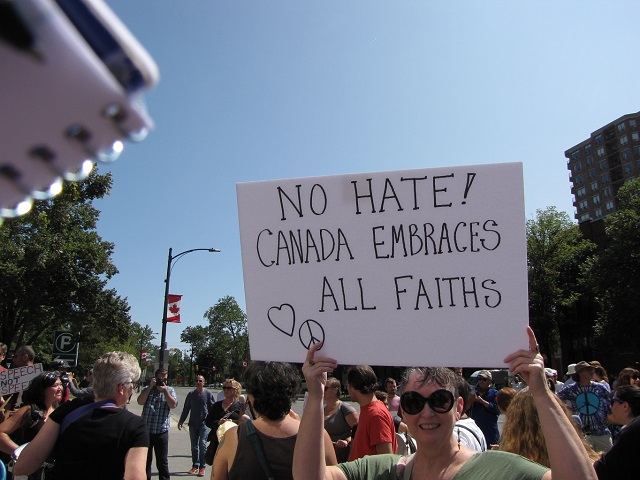
Diocesan clergy and laity joined more than 500 other Londoners on Saturday, August 26th, to send a clear message: diversity is strength, love trumps hate, God’s grace has no limitation.

We marched towards London City Hall with Bishop Linda’s words in our hearts and on our minds: “In the midst of the current political and cultural divisions we are to hold fast to the Gospel of Jesus and the Two Greatest Commandments: love God with all our hearts, mind, soul and strength and love our neighbours as ourselves. This includes not only refugees seeking asylum but also those who try to spread a message of discrimination and intolerance.”

This was an important message for us to carry to the counter-protest. This was a Gospel message that is replete with examples from scripture. “Remember the alien for you were once an alien in the land” (Ex 22:21), the Good Samaritan (Luke 10:25-37); “Love your enemy and pray for those who persecute you” (Matthew 5:44); and “There is no longer Jew or Greek, there is no longer slave or free, there is no longer male and female; for all of you are one in Christ Jesus.” (Gal 3:28).

So we stood as a visible symbol of Christ’s love in the world for all: for refugees, for those of different faith traditions, and for those on the other side of the protest. We saw them not as adversaries, but as brothers and sisters who are also in need of God’s grace. It was this message, the Christian message and the heart of the Gospel that we will heal the world with and help bring about the Kingdom of God, one demonstration at a time.

From the Huron Church News September 2017 Edition

On Leaving London

November 28, 2016Marty Leave a comment

This past Sunday I attended St Andrew Memorial’s 75th-anniversary celebration. It was great to be back at St Andrew Memorial and back in London. It has been just about 10 years since I first came to London On from the Nations Capital. 10 years is a long time. And now that I have moved and have begun to settle in Waterloo On at my new parish of All Saints, I thought it was a good time for a retrospective of the last decade.

As a mechanic and a budding academic and theologian I left Ottawa  in 2007,  with a BA in Philosophy under my belt and looking forward to studying Theology at Huron University College. Little did I know that during the decade to come I would earn not one but two masters: A Masters of Divinity with Distinction and a Masters of Arts, Theology.

I would serve two different communities as lead pastor. The first was Counterpoint, a Fresh Expression church plant in Brantford On. The second was St Andrew Memorial in London On.
1933944_295513460444_7505182_n

The beginning of Counterpoint

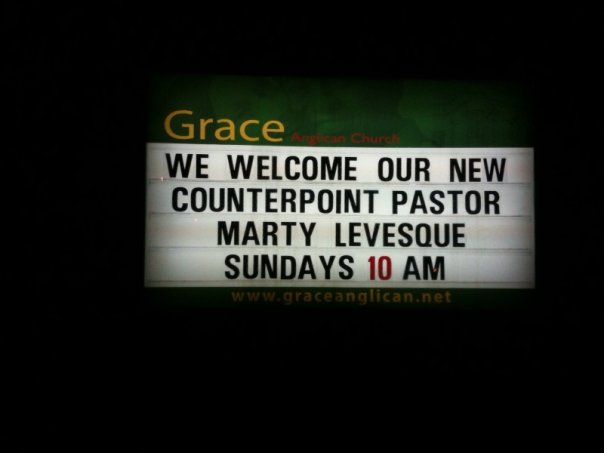
Counterpoint was a most interesting experience. I began my ministry there with the three families as my plant team. Our service reflected that we were something new and something fresh, but also we leaned on the historical roots of the Anglican Church. Our first Sunday together was September 13, 2009, a welcome BBQ with our sponsoring congregation of Grace Church Brantford. September 20 marked the first Sunday of my ministry with my 3 families and planting a new church in the Diocese of Huron.

Over the course of the next eight months, we worked hard to advertise, market, and evangelize our friends and neighbours. We reached out to the community, learned their needs and sought to meet those needs as the hands and feet of Jesus Christ. Our attendance gradually increased, moving from 19 on my first Sunday to averaging over 50’s in March of 2010.

Unfortunately, my time with Counterpoint would be cut short due to complications with the sponsoring parish and the rector of Grace Church. Even though Counterpoint was thriving, Grace was not. The decision to alter the planting of this new church in the Diocese of Huron was made without consultation of the new plant community and myself. As the relationship between the rector and myself continued to sour the bishop decided that he needed to act and I was removed from Counterpoint in May of 2010.

Unfortunately, the energy and missional focus was lost and the community never fully recovered. After a few more years of struggling along, the plant was brought to a conclusion and the opportunity to plant a new church in the Diocese of Huron was lost.
14656351_1139501742763931_3264078459171291920_n

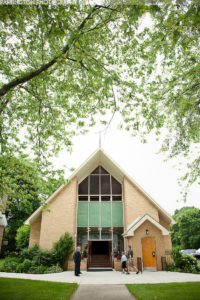
St Andrew Memorial

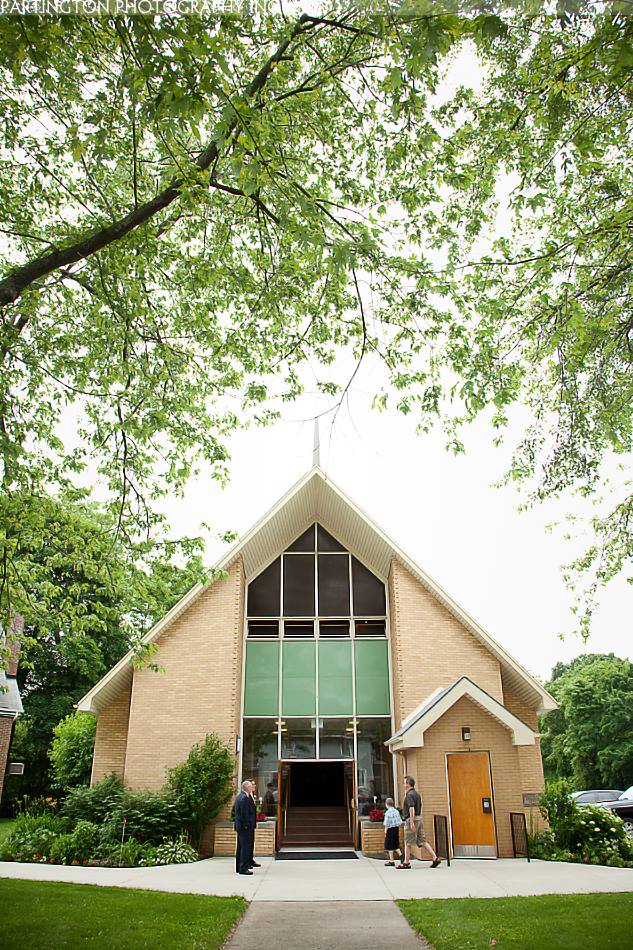
My next stop was St Andrew Memorial in London. I began my ministry there in November 2010 tasked with the revitalization of an underperforming parish. Since the turn of the century, St Andrew Memorial had depleted their capital reserves, their stewardship had dropped over 35% and attendance had steadily declined.

When I arrived the average Sunday attendance was 50 and they were running a structural deficit of approximately $15 000 per year. We got to work immediately rebranding the parish, updating their vision, mission and values and creating an online and social media presence. Over the next 5 years, we would work to update and modernize the facilities through a major capital campaign.
praying-for-snow

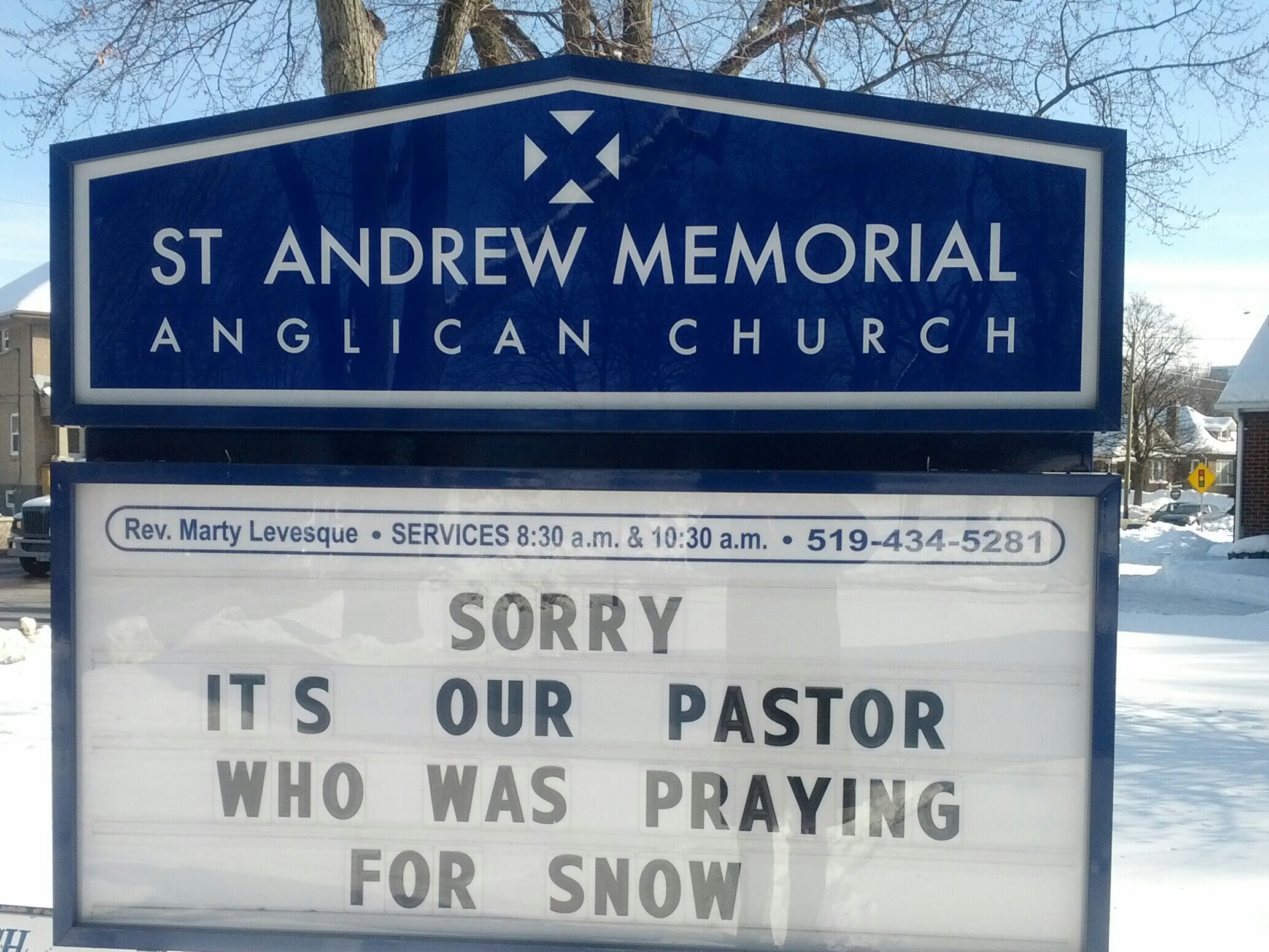
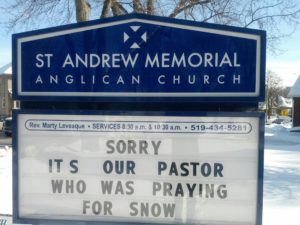
The new sign

During this time a new exterior illuminated signage was installed, the kitchen was renovated and brought up to code, the Sunday School room was renovated and modernized to create a welcoming and warm learning environment, a new audio and visual system was installed in the sanctuary and the old church was converted to accommodate the London Consistory Club and The Learning Center.

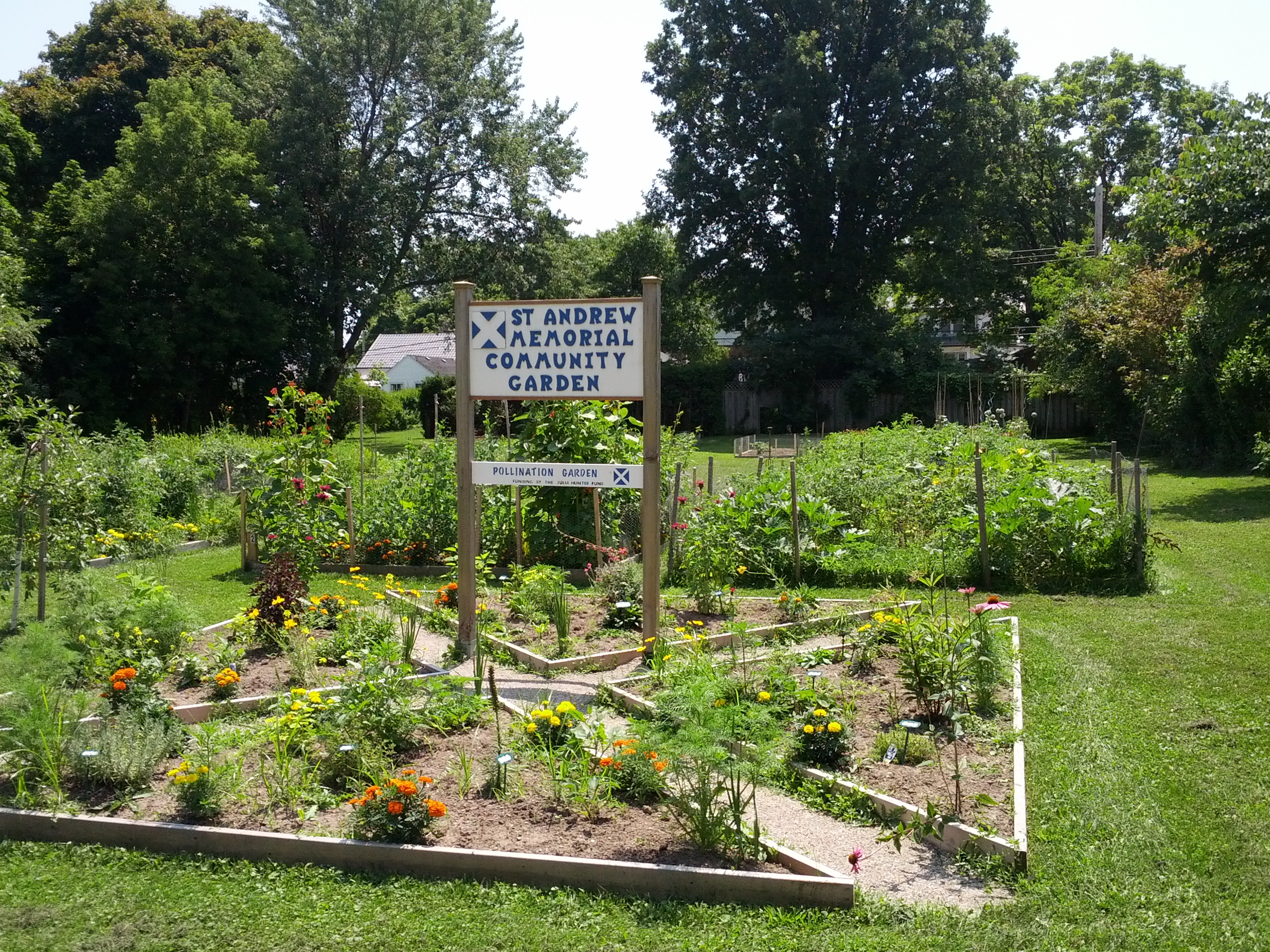
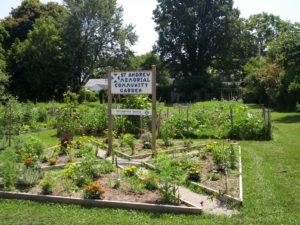
The empty lot next to the rectory was converted into a community garden in 2011. This was made possible through partnerships with London Community Resource Center, a SPARKS community development grant from the City of London, a micro-grant from LondonSOUP and support from the London Community Foundation and the Faith In Action trust of the Diocese of Huron.
summer-2014

Community Garden, Pollination Garden and Fruit trees

St. Andrew Memorial also has begun to add fruit trees to ring the garden, making this garden project a focal point for area residents and helping to make Old South one of the best neighborhoods in London, Ontario in which to live and work. 2014 saw the addition of the pollination garden thanks in part to the Julia Hunter Foundation. Over the years, the continued work of St. Andrew Memorial through the Community Garden has resulted in thousands of pounds of fresh produce being sent to the Fellowship Centre at St. Paul’s Cathedral to feed our brothers and sisters in London.

In addition, political activity and petitions have helped the Government of the Province of Ontario enact legislation to ban neonicotinoids, the pesticide responsible for the destruction to the pollinator population.

As a result of the great work done through the Community Garden St. Andrew Memorial has been featured in news stories in the Huron Church News, Anglican Journal, and the London Community News, which has helped create a point of entry into the parish and a point of evangelism.

With the closing of our neighboring parish, Christ Church, St. Andrew Memorial brought the Community Breakfast program to its campus in the spring of 2014. This monthly breakfast program offers hospitality meals to area residents.

As my time came to a close in April 2016 at St Andrew Memorial the structural deficit had been eliminated and the endowments of the parish were being rebuilt, having been doubled in the past 6 years. Sunday attendance had risen from 50 to 75 and the parish was once again a strong healthy congregation in Old South.

The mission outreach of St Andrew Memorial continued to grow each year between the garden, the breakfast and a myriad of other mission outreach activities including the sponsoring of a Syrian refugee family. The parish reached a tithe, which is to say, they gave away in direct mission activities 10% of their income to the building of the kingdom of God.
council-gallery

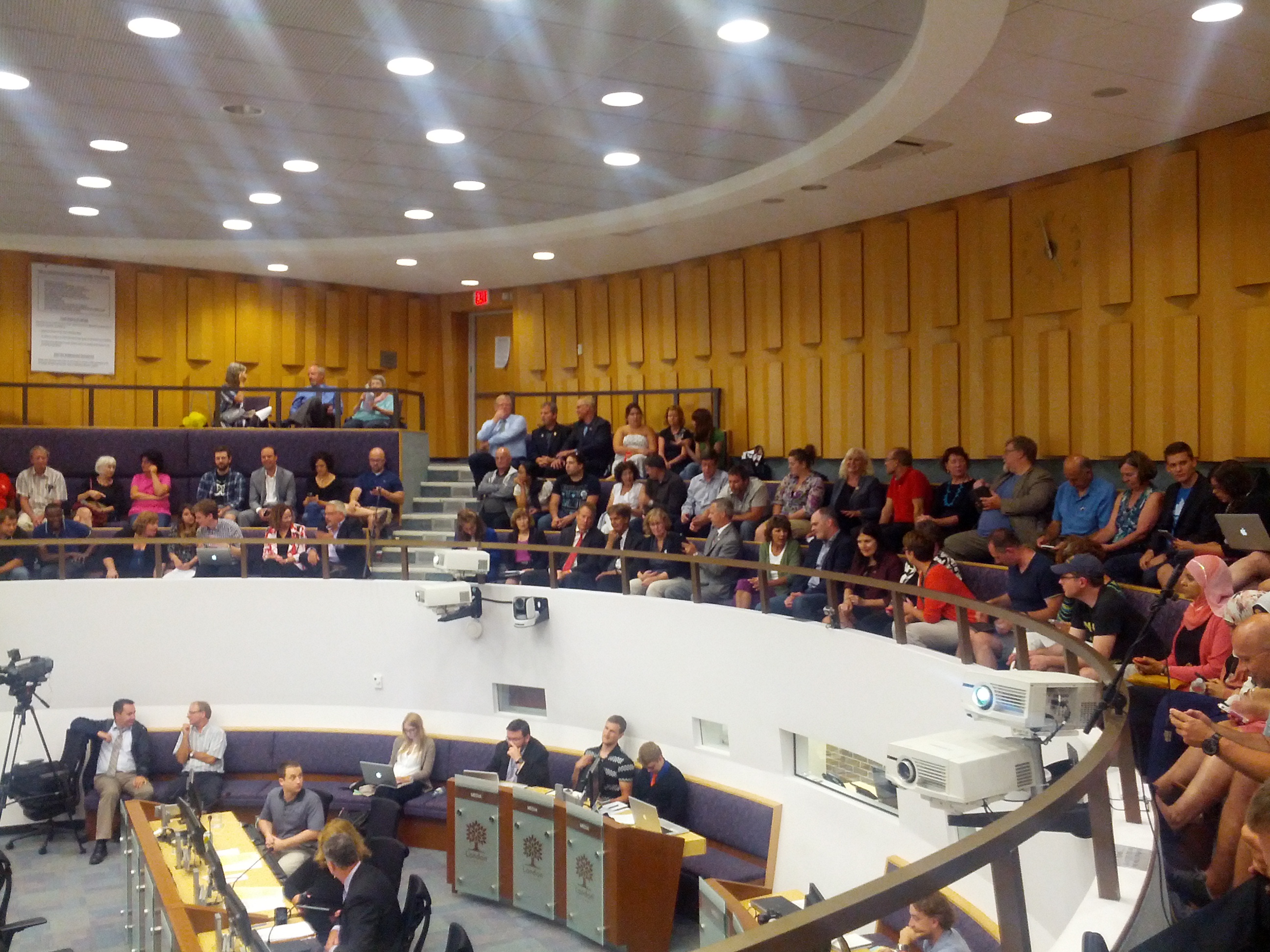
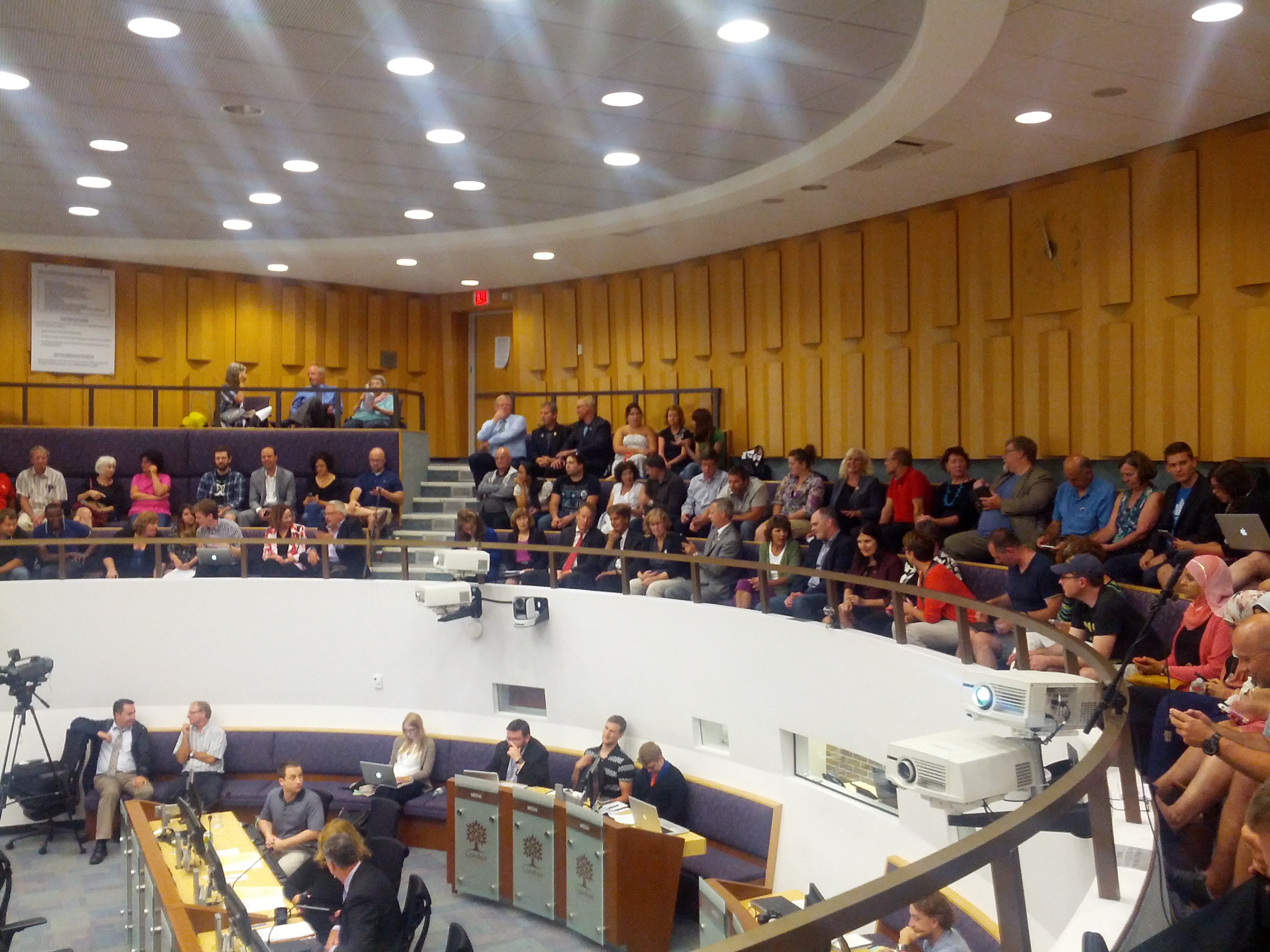
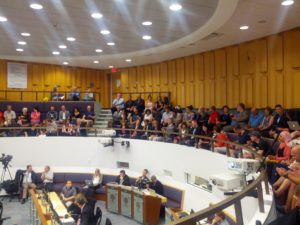
City Council Gallery before vote on Fanshawe/Kingsmill redevelopment

My time in London was not limited to just the parish though. I had the opportunity to become involved deeply in the life of the community and the city. When city council looked to cut the affordable housing budget, I organized the Anglican churches in London, along with our ecumenical partners to bring a petition forward to city council expressing on behalf of the various communities and congregations that we opposed the cut to the affordable housing budget. City council reversed its decision and the budget was maintained.
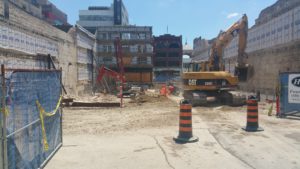
20160617_133808

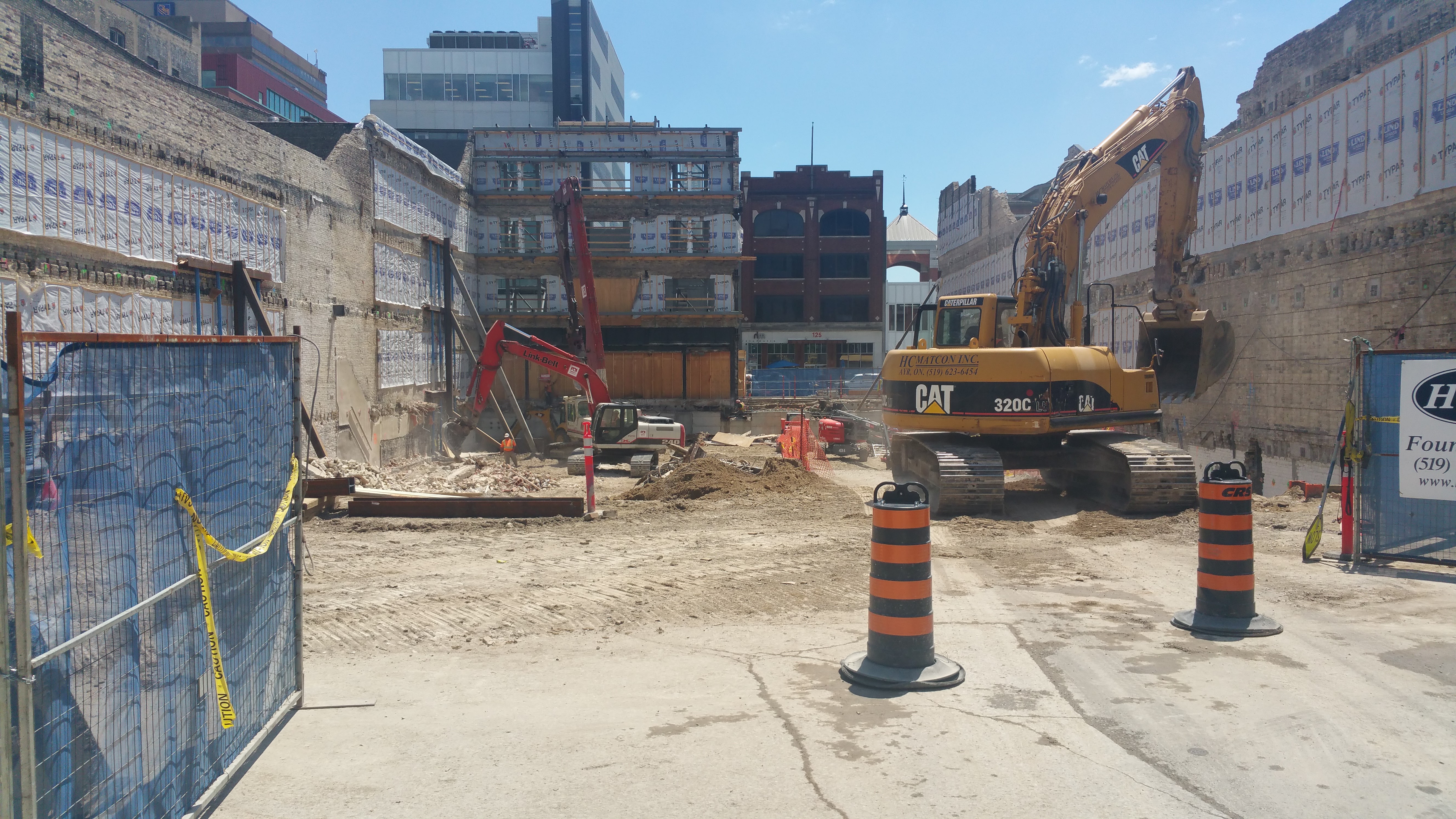
Work has begun on the old Kingmill’s department store

These political activities lead to me being asked to serve on the board of directors for Emerging Leaders London. Emerging Leaders is a non-profit whose mandate is to retain, attract and connect young talent in London On. Of the many activities of Emerging Leaders, London X, Work in London Symposium and monthly mixers, the work I am most proud of was the organizing and advocating to London City Council, working in partnership with Fanshawe College, for the creation of the new downtown campus location in the old Kingsmill department store. This work will profound alter and help to revitalize the downtown core.

I also had the privilege to serve the board of directors of Mission Services London. During my 2 year tenure on the board of directors, we oversaw the development of the new Mission Services Thrift store, an expansion of 10 000 square feet of retail space and the relocation of the Mission Services head office to this new location. The increased size of the store will add a much-needed revenue into Mission Services through this social enterprise.

As a priest, I spend much of my days meeting with people, connecting people and working behind the scenes to help build strong Christian communities and connect those communities with the broader society where we all join together to be the hands and feet of Jesus Christ in the world today. I hope that the work I do each day will have an impact on my congregation, the community and the city in which I live and work.

As I look back over 10 years of service in London I can say that I am proud of what I have accomplished working with so many great people and great communities. I look forward to seeing the seeds that were planted continue to grow. And I pray that the mark I left on London will have a positive effect on the city and its citizens and people of faith.

This past Sunday was difficult in some ways, to come back to St Andrew Memorial and London, but it was also good. It marked for me an end. And as I drove to work today, to sit at my desk and plan the ways All Saints Waterloo will move into the future, grow and make an impact in its community and city I find myself looking forward with confidence and anticipation at what God has in store for me, this community and the next 10 years.

I would be remised if I didn’t take a moment to thank many of the people that I had the privilege to work with, learn from and be mentored by.

Rev Dr. William J Danaher Jr., friend and mentor who encouraged me to continue my education and pursue an MA.

Dr. Dan Smith, that one professor who helps you always be a better student and nurtures a passion in you for education and theology (and even the Greek language).

Dr. John Thorp, my MA thesis advisor who helped focus my thoughts.

Rev Rae Fletcher, mentor, priest and friend. You taught me to listen to my better angels and to see the positive in the people God sends my way.

Kent and Susanne Thomas, Peggy Rayner, Jim Stewart, long time wardens of St Andrew Memorial. All of you saw something in me and were willing to follow and to take calculated risks.

Nancy Barwick, the community garden coordinator. Your work to build, organize and plan has helped make the garden possible.

Lori Inrig, the community breakfast convenor. Your passion and kindness to provide that little extra at the breakfast is an inspiration of the type of kindness we all ought to reflect as children of God.

All the people of St Andrew Memorial for walking with me, forming me and helping me become a better pastor, a better friend, and a better husband and father.

Sean Quigley, executive director of Emerging Leaders London: friend, interlocutor, and drinker of beers.

Glen Pearson, mentor, friend and inspiration.

Peter Rozeluk, executive director of Mission Service who encouraged me to be a public theologian.

Rev Kevin Dixon, friend and mentor. Who has never been afraid to simply say, “oh, Marty…just shut up!”

Rev Canon June Hough, friend and mentor, who always made me laugh and waste just a few hours at the Waltzing Weasel.

And of course, Carolyn Marshall, spouse, lover, and best friend. I could have done none of the above without her steadfast support.

London’s New Mission Field: The Next 25 Years

September 23, 2014Marty Leave a comment

Steven Strogatz theory of synchronization, or spontaneous order, has made the rounds across the Internet. You may have come across examples of Strogatz theory on your Facebook wall if you remember the videos of synchronizing metronomes.

There are, of course, many other examples of sync theory in our world. Everything from fireflies that synchronize to Anglicans that all respond in unison after someone calls out, “The Lord be with you”.

But what does sync theory have to do with the church? The theory posits that all things come into alignment and synchronization. Through this synchronization, male fireflies are better able to attract more females when they band together. Anglicans in a crowded room hush and are ready to listen or pray. And for the church at large it hears and responds to the world around it, coming into synchronization and thereby growing and thriving.

This doesn’t mean we bend or change ourselves to fit society, nor throw out our traditions. As much as we listen to the community around us, the community around us also will listen to us and adapts to us as we come into relationship. The changes that we make to our spaces, our services, or where our services are even held also requires society to change from the strictly profane to quasi-sacred, even if the sacred looks very different then what we are used to today. It is about coming into sync and relationship with one and another; church and neighbourhoods.

If you are wondering what happened in the video above, it is simple, physics happened. Strogatz, an expert in applied mathematics, uses this experiment to illustrate his theory of spontaneous order.

In spontaneous order, Strogatz explains that living organism and even inanimate objects fall into sync with one another in ways that seem unnatural and inexplicable. As we just saw in the video, metronomes are placed on a small board and each ticking with the same speed but at different intervals; so they each move at the same X number of beats per minute. The board with the ticking metronomes is then placed on two bottles of water.

For a few moments nothing seems to happen, but you slowly notice and hear the metronomes slowly coming into sync with each other. The metronomes, Strogatz explains, are “speaking” to each other. Each metronome was in fact reacting to the motion the others generated across the surface of the board as it rested on the water bottles. They were each communicating their individual timing to each other, allowing them to line up rhythmically, even though scientifically speaking they should never break their individual timing.

But what does this have to do with the church?

In London we have an upcoming municipal election. This new council will be task with implementing The London Plan, which was developed through the ReThink process, the largest citizen engagement process in history of city planning with over 10 000 individual Londoners helping to shape their collective future. This long-range 25-year plan will be for everything from housing and retail development to transit for the city of London. It is imperative that the Diocese of Huron and the Deanery of London listen closely to the decisions that are being made and adjust accordingly. We must come into sync with the world developing around us.

One of the important ways we will come into sync is being very conscious of future transit developments and infill housing developments. Below is the proposed BRT (Bus Rapid Transit Routes). As is common along rapid transit routes in every other Canadian city, infill and densification occur. This makes these routes and the development that will occur around them, the new mission field in London and parishes that are along these routes are poised to make significant gains if the Diocese and the Deanery are willing to invest in them and help them come into sync with their neighbourhoods and transit villages.

Map-1---City-Structure-Composite

The parishes North to South that look to benefit from The London Plan most are:

  • St John the Divine, Arva (Tansit Village at Masonville Mall)
  • St Luke’s Broughdale (Richmond BRT Route)
  • St Paul’s Cathedral (Transfer Point North/South and East/West)
  • St Andrew Memorial (Wellington BRT Route)
  • St Stephen’s Memorial (Wellington BRT Route)
  • The parishes East to West that look to benefit from The London Plan are:

  • Church of the Ascension (Transit Village Located at Highbury and OxFord and Transit hub at Highbury and Dundas)
  • St Paul’s Cathedral (Transfer point North/South and East/West)
  • Bishop Cronyn Memorial Church (Dundas BRT Route)
  • St George Wharncliffe (Oxford BRT Route)
  • St Aidan’s London (Transit Village Located at Wonderland and Oxford)
  • * It should be noted that both St Aidan’s and Church of the Ascension would reap secondary benefits since both mission points are quite physically far from the proposed transit villages. Both congregations will have much work to do if they are able to reap the benefits from infill, densification and rapid transits routes in the coming 25 years, but it is still possible.

    ** It should also be noted that St John the Evangelist and All Saints Hamilton Road are close to the BRT route but will have the same problems of being just enough off the beaten path, so to speak, as does St Aidan’s and Church of the Ascension.

    The growing mission field will encircle the Transit Villages and the BRT routes. The parishes listed above will directly benefit in an increased mission field with new evangelistic opportunities to grow their respected churches and have new ministry opportunities. The time is now to begin investing in these parishes for the future, especially for the next 25 years. As we listen and come into sync with the changing world and prepare ourselves to serve the neighbourhoods we find ourselves located in, it is imperative that we synchronize with the developments of the city of London if we are to have the biggest impact for Christ.

    BRTBus Rapid TransitSpontaneous orderSync TheorySynchronizationTransit Villages

    Church and Politics

    September 3, 2014Marty Leave a comment

    The church and politics seem like the same animal to me most days. Both are institutions built around people and both can become paralyzed by just a few individuals. And yet both can also do some amazing things.

    In the church, just like in politics there often is an old power broker who will use a wedge issue to their personal advantage, not caring about the overall health of the community, but rather they are more concerned about maintaining or expanding their position. It can be quite frustrating watching a community shoot itself in the foot, whether that be the church or a city.

    For the past few weeks Joe Swan, Bud Polhill, Bill Armstrong, Stephen Orser, Paul Van Meerbergen, Denise Brown, and Sandy White have used the Fanshawe/Kingsmill development (a little background info) as that wedge issue in London. By splitting the council vote they were able to say that they want Fanshawe to relocate a campus downtown but not for the deal presented. The idea is to appeal to both sides of the fence, but to do nothing.

    It seemed like a golden opportunity might slip between council’s fingers. But then something marvellous happened. The community, institutions and individuals, began a campaign to change the mind of just one councillor.

    To give you an example of the kind of public pressure that came forward, check out Citizen Corps blog on the list of supporters. Hundreds of others not listed signed petitions, called or e-mailed their councillors.

    Council GalleryAnd as a packed gallery sat and watched council go through the motions of debating the issue there was a sense of anticipation. As each councillor rose to speak to the issue they re-affirmed their previous position. That was until Denise Brown finally rose to speak to the motion last.

    Her tone was firm, and she explained how had spent hours and hours in research. She had spoken to Fanshawe, sought outside advice and even looked to other cities like Kitchener/Waterloo for advice and knowledge. There was something brewing in the gallery, a palpable sense of optimism.

    As Denise spoke, much like a preacher, she wound up her speech by simply stating that she would reverse her position and support the deal. The gallery erupted in applause. For well over a minute Mayor Joni Baechler could not restore order, for the sense of jubilation and optimism had boiled over. Mayor Baechler indulged the gallery with a sly smile.

    As I sat there, looking out over dozens of organizations, institutions and everyday citizens, there was the sense that something special had happened this night, something wonderful. A sense of renewal and rebirth was gripping the city and new possibilities for a better tomorrow was at our doorsteps.

    As a preacher myself, the emotion in the gallery, the trial of the past month, the work to encourage just one councillor to change their vote, all of it was worthwhile and for me it looked not like politics but it looked like church. It looked like church because as I sat there I was able to see the old church power broker being transformed, stepping out in faith and allowing new life to flourish in her community.

    I have no idea if Denise Brown is a Christian or not. But tonight politics and the church mirrored each other and we journeyed from the cross to the empty tomb.

    Affordable Housing

    February 13, 2013Marty Leave a comment

    I want to thank all the parishes that joined together to put forward a single voice to City Council surrounding the Affordable Housing budget. I also want to thank the other parishes that circulated the petition and collected signatures.

    Together we demonstrated that we can make a difference and be a force for positive change in the world. I am honoured to walk with you all in ministry.

    Thank you.

    Letter that was sent to City Council

    To: Members of City Council,
    London Ontario

    We the parishes of

    St Andrew Memorial
    Bishop Cronyn Memorial Church
    St Alban the Martyr
    The Church of St Jude
    St Luke the Evangelist
    Church of the Epiphany
    Good News Christian Reformed Church
    Church of the Hosannas
    St Aiden’s Church
    Rowntree Memorial United Church
    All Saints Anglican
    Christ Church
    Holy Trinity Church
    St Mark’s Church
    St Stephen’s Memorial
    St Paul’s Cathedral
    Redeemer Lutheran Church
    St Ansgar Church
    Trinity Lutheran Church
    Wesley Knox United Church
    Calvary United Church
    St John the Divine, Arva

    Upon learning that City Council was proposing a budget cut to the Affordable Housing Reserve Fund for the fiscal year 2013 and subsequent years, in the amount of 1 million dollars, we began to organize and to prepare a response from our various faith communities. What began with one or two parish communities has grown dramatically and continues to grow as new parishes come on board each and everyday.

    We had begun to circulate a petition in our various communities and have garnered thousands of signatures thus far. The petition was/is asking for City Council to maintain its investment in Affordable Housing at the 2 million dollar mark, acknowledging that objective 5.3 of the housing strategy is to “Maintain annual $2 million City investment in affordable housing”.

    We understand the very tough decisions council is faced with and it was a pleasant surprise to see that City Council decided to vote down this proposed cut and instead chose to maintain funding for Affordable Housing at current and recommended levels.

    While we will still continue to watch the outcome of the budget proceedings leading up to the final vote with great interest, we the aforementioned communities wish to express our deepest thanks and gratitude to you, the members of City Council, for maintaining Affordable Housing at its current and recommended levels, and helping us to care for some of the most disadvantaged Londoners.

    Sincerely,

    The Christian Communities of London, Ontario

    Guest blogging

    September 20, 2012Marty Leave a comment

    Recently I was asked to put pen to paper, or hands to keys and be a guest blogger for an organization here in London, On.

    Emerging Leaders is a dedicated non-profit seeking to help keep create talent and young leaders in London, On. through a variety of efforts.

    Take a few moments and stop by to read my contributions, but also some of the contributions of many young and talented Londoners.

    Cheers

    Your Rogue Preacher

    Musings on Rhetoric in Politics

    May 3, 2012Marty 2 Comments

    I understand that politics is about rhetoric and hyperbole. Through rhetoric, the art of persuasion, politicians, activist and yes preachers attempt to sway public opinion to their cause or viewpoint, whatever that may be.

    Lately though I have notice a disturbing trend in the political rhetoric. It has been escalating in absurdity in the effort to win cheap political points. And of course there are many who I could point to who are guilty of this: Councilor Stephen Orser of London On. and his use of a Nazi propaganda posters in council chambers in his crusade against fluoride in the water or perhaps Mayor Rob Ford of Toronto and his fight for subways and holding off the attacks of the “war on cars”.

    It seems the rhetoric gets more exaggerated with each passing year. In the 80’s we had the “war on drugs”. I could see that, and even possibly getting behind using the term “war” in such a manner. Today though, we have the “war on sugar”, the “war on Christmas” and like Rob Ford said, the “war on cars”.

    I for one find this analogy distasteful and disrespectful. War is not a term to be used lightly. War is ugly, brutal and devastating and it leaves it marks on those who suffered through it for the rest of their lives and the lives of their families.

    Comparing a disagreement about public policy between light rail and subways as a “war” is ludicrous at best. It belittles the sacrifice of so many and the loss of life in actually wars and the scars that are born, internally and externally, on those that fought in real “war”.

    By using this kind of inflammatory language the rhetorician does nothing but polarizes the debate. Remember the “you are either with us, or with the pedophiles” from Minister Vic Toews? There can be no debate, discussion or agreement reach. Polarized.

    I am not sure how many Christmas trees have lost their lives in the “war on Christmas” or how many Elves now have prosthetic limbs. Although it is entertaining to imagine a war torn field in France perhaps with bloody Christmas trees, but it is also quite ridiculous.

    I am not sure how many Hemis are buried or where the monument is the brave sacrifice of so many carbs and fuel injectors for the greater benefit of our society as they sought to defend the way of life of car culture.

    My hope is the next time and each time a politicians use such outrageous rhetoric we as engaged citizens would write to them and explain to them what real “war” is like, the horrors of “war” and how their glib treatment of those who suffered through “war” is unacceptable.

    Let us use our voices to help politicians dial down the rhetoric so we can make our cities, provinces and nations work again. So that we don’t fight a “war on Christmas”, but instead disagree over the implications of a religious holiday being forced upon a secular society and what are the limits of public versus private space. I would much rather be part of that debate then fighting a so called “war on Christmas”.

    What is hiding behind the veil?

    April 26, 2011Marty 1 Comment

    The question of public spaces being free of religious symbols has reached new heights in the European Union. Countries like France have sought to ban outward symbols of religion, focusing of the veil wore by Muslim women, but not exclusively. The government law has also attacked outward expressions of Christianity and Judaism, amongst others. Although it should be noted that the focus that drove the enquiry into the religious symbols and the new law did stem from the desire of French secular society to mask the veil.

    And while this debate has captured much attention on both sides of the issue, about freedom of expression and religion versus that of women who are oppressed and forced to wear the veil, I wish to focus rather on the veil itself as a symbol of wholeness. In contrast I also wish to draw attention to secular societies mantra of a separation of religion from the state and therefore a separation of private and public lives as a symbol of disfunctionality.

    In essence that the veil allows Muslim women to enter into society as complete and whole human beings, while the rest of secular society must learn to live with split personalities, the private religious personality and the public non-religious persona. As such I hope to demonstrate in this reflection that Muslim women are actually more whole and actualized human beings then the supposedly free moral agents of secular society.

    Secular society has for centuries now sought a separation between the church and state, between a citizen’s private religious belief and having those beliefs hoisted upon society at large. As such societies have pushed religion to the private realm. Religious believers have had to lead in effect double lives because of this forced separation. This has naturally caused that religious believers are not whole persons therefore in their public dealings.

    Personally this has been brought to the forefront recently in the Canadian 41st election. Religious beliefs have no place in the public debate we are taught. The discussion centers on public policy and private religious beliefs held by the leaders of the political parties do not seem to come into play. This assumption is based on the secular argument that religion has no place in public policy.

    The problem with this assumption is the belief that citizens, or leaders, can distance themselves from the very beliefs that have spurned them to public service and participation. In essence, that the faith beliefs of individuals form their morals and values and whether we wish to admit it or not, those same values influence who we vote for and the policies we would support. Yet secularization teaches us to separate those morals and values out from our choices; that our choices are to be free of private influences and for the public good only.

    This creates within citizens a type of schizophrenia. We are asked to make decisions and set policies upon what we believe to be the best for society, but we are also asked not to have our private religious views enter the debate or influence our decision. This position has not only created a split personality in citizens but as placed a veil between public and private lives, obscuring one from the other.

    The veil worn by Muslim women has for centuries identified them and set them apart within society, it has also served another feature. It has allowed for Muslim women to participate in society as whole human beings, no distinction between public and private, between religious and secular. The veil represents who they are as private individuals as well as public figures. The veil allows them to be fully human in the public setting. It stakes a claim to the public space of the private religious leanings yes, but it does more than simply that. It allows for the full participation of private individuals in the public sphere, in other words, as whole human beings.

    The veil has become a symbol, yes. A symbol of Islam, but also a symbol of what a complete human may look like. Such a symbol though is a threat to secular society, which seeks to encourage individualism to maintain discontent in society. The very social contract is based upon such individualism and the threat of violence held by the state. Individuals give up their private desires for the safety and protection of the state. Yet individuals are being encouraged to continually seek what is in their best interest. Essentially a state of war between individuals remains at a cease-fire, but with no long-term solution in place.

    So long as society maintains a scapegoat, a visible minority, the problems facing the type of schizophrenia that secularization causes will continue to go undetected. The specter of religion will always be enough to unite the individuals into suppressing the very rights that they continue to hold dear, the freedom of expression, religion and being a whole individual in society.

    It remains in society’s best interest therefore to continue to sow discontent between individuals and to separate individuals into private and public beings. By doing so secularization continues as an uncheck monster forever veiling the truth of wholeness of human beings from the very citizens of society it seeks to protect.

    Reflection on public space

    April 14, 2011Marty Leave a comment

    Place and space are two distinct concepts but concepts that have been used inter-changeably far too often in dialogue surrounding the church’s place in the world and its space within secular society. In both cases, place and space has been, at least since the enlightenment, a move within the discourse to speak of both space and place as a physical limited space that has barriers, edges and a perimeter and within these specific boundaries the church must claim either its space or a place in civil society.

    The concept of spatiality has been used in a very Baconian sense; it is limited and quantifiable. It can be measured and defined and as such there is a limited amount of space that exist that the church must share with the rest of civil society. And in this sense the church’s place in the world has been slowly eroded as secular society has slowly taken root over the last few hundred years and begun to occupy more space within civil society. The space that the church occupies as a result has continually contracted.

    The advent of the social contract and the necessary negotiated pluralism of western democracies have slowly forced the church from a place of prominence in civil society to a separate sphere altogether. The church ended up being regulated to the “private” sphere of influence of citizens’ lives while the “public” sphere has been reserved for reason and pluralistic debate of the kind that reaches for the common good. This separation of private/public space has in a sense created a separation in citizens’ lives from the public realm and has encouraged the thinking that there is indeed a limited amount of space. The agreement as to how this is done is through the social contract of a given nation state. In the case of the United States of America there is a sharp distinction between these two spheres, while in Canada this separation is not as clear, but tends toward the relegation of religion to the private sphere.

    A consequence to this is that the nation state becomes the one polis that all people in a pluralistic society become subject to above all others. Pluralism in this sense of dividing space is that it requires a tempering of an individual citizen’s particular religious commitment to his/her commitment to the nation state. To keep peace among a large population with a variety of religious views, the nation state is therefor held up to be the means by which the common good is reach and particular religious convictions must either come in line with the nation state or become antithesis to the social contract.

    The basic assumption therefore is that the nation state is one polis, or one city and within which there is a division of goods and labour which follow certain binaries or dichotomies: civil society and the state, sacred and secular, eternal and temporal, religion and politics, church and state. This modernist thinking has for too long though occupied our thinking about the church’s place in society and where our space is in civil society.
    Instead of seeing civil society made up of finite goods and labour, writers such as William Cavanaugh have reached back to the writings of Augustine for inspiration on how to re-imagine modern society, the one polis or one city and map a place for the church in the world and space in secular society; from one city to two.

    Augustine concepts are not new; they have merely ceased to be applied in modern political thought. For Augustine there is not one city, but two cities that use the same amount of finite goods and labour, but use them for different purposes. This is not to say there is a competition for the goods, but that the two cities exist simultaneously and use the same goods but for different ends. The nation state uses these goods and labours for the common good, but the church would use these goods and labours to help transform the earthly city or the nation state.

    Underlying Augustine’s proposition of two cities is that while they use the same goods and labours and occupy the same space, they also exist temporally, that is through time. The earthly city is on a trajectory towards the heavenly city and the role of the church is to help guide that transformation. Augustine basis his thought upon the realized kingdom of God through the sacrifice of Christ upon the cross that was inaugurated and the not yet that is the fallen and broken world in which we live as we await the return of Christ.

    For Augustine the already is not some principle or transcendental reality, but is a reality to which the church bears witness too in history. Christ has been triumphant and the powers and principalities of the world are passing away. The kingdom of God has been realized. But it is also not yet, not because God is holding back from fully enacting the kingdom, but because humans are holding back, trapped in sin due to the fall. As such, coercive government, of the kind that enacts a Hobbesian social contract where the threat of violence against individuals is held by the state, is not natural but a result of the fall. The earthly city of which is the nation state uses the threat of violence and has dominion over and against other rational human beings is seen by Augustine as necessary for the common good, but is antithesis to scripture and the will of God.

    The role of the church therefore becomes one that bears witness to the heavenly kingdom. It does so, as Cavanaugh has demonstrated, by enacting a comedy during a tragedy. To illustrate this metaphor Cavanaugh compares the two-city model of Augustine to Richard Strauss’ opera Ariadne auf Naxos. In the opera the host has two performances to be played, a tragedy and a comedy. The composer not wanting his masterwork of the tragedy to be followed by the frivolous offering of the comedy is outraged. The situation becomes worse when the announcement comes from the prima donna that they have to leave early, so both offerings must occur simultaneously.

    The tragedy, the earthly city and the comedy, the heavenly city, therefore occur at the same time, in the same place and make use of the same resources; the stage, the audience, the space and time. In Christian theo-political imagination then the comedy is meant to save us from the tragedy of violence that we impose on ourselves through the nation state and the social contract. The church interrupts the tragedy of the earthly city by enacting the comedy of the redemption of Christ. The church does not allow the earthly city to define one public space, but constantly redefines what is truly public.

    The church therefore is not a separate institution relegated to the private sphere in citizens’ lives. It is not enacting a wholly separate drama either. The church seeks to work with other actors and players to try to divert the tragedy into the drama of redemption. As such, when we envision space and place we must always remain aware that the church is not separate or competing for limited space, but is in fact part of the tragedy told and the comedy meant to transform. In a very real sense there are two cities that exist simultaneously and that space and place are not limited in a Baconian sense. Space and place exist both physically and temporally across time. Space and place are also not limited by human reason but are open to the abundance of God and they occur both here in the earthly city and also simultaneously in the heavenly city at the end of time.

    Reflection on Violence

    March 10, 2011Marty Leave a comment

    The tensions held by Christians are prevalent throughout Christian thought, practices and theology. We hold in tension the realized kingdom of God, inaugurated by the passion of Jesus Christ, but that kingdom is also not yet realized for Christ is yet to come again to judge the living and the dead. This is but one example of the kind of tension that Christians live in. In many other places throughout scripture and in the traditional practices of the church we run into tensions between not only how things ought to be, but also contradictory messages and practices in institutional structures and in Holy Scripture also.

    This contradiction is intimately present in post-enlightenment western states where there is a distinct separation between church and state. This separation became a necessity, philosophers and political theorist thought, in order to prevent the kind of religious wars that was sweeping through Europe between Protestants and Catholics just prior to and during the enlightenment. Yet this separation creates another tension that Christians have yet to resolve.

    Paul was aware that Christian needed to be part of the collective whole of a society, if they were going to speak to society about the kingdom of God and the injustices present within it. This is abundantly clear in Romans 13:1 where he writes, “Let every person be subject to the governing authorities; for there is no authority except God, and those authorities that exist have been instituted by God.” Yet, if we follow the directive of Paul to its natural conclusion then we run the risk of losing the very prophetic tradition that Jesus himself belonged to. This tradition is ripe with examples of prophets and martyrs calling society back into relationship with God through the covenant, whether that is the Old Testament covenant or the New Covenant inaugurated by Jesus Christ. Without this prophetic voice, society runs the risk of straying from the will of God and being totally unaware that they have strayed.

    Therefore if Christians hold themselves accountable to the state’s laws as suggested by Romans 13 they run the risk of losing the prophetic tradition and being unaware of the new movements of the Spirit in the community. Yet Christians cannot simply remove themselves from the social contract of any given nation state; they still must be held accountable and subject to the laws of that state. This tension, like so many other tensions in Christianity is between the realized and the not yet, and it can have adverse effects on the church as a whole and specific denominations within the body of Christ.

    So when do Christians ignore the laws of a nation state for the sake of justice and when do they adhere to those laws? Furthermore, is there a time for violence to overthrow unjust political structures and if so, what kind of violence? Is there a time when it becomes necessary to over turn the nation state in the creation of something new, something that furthers the kingdom of God? In other words, doing the right thing according to established law is precisely what must be suspended in order to dissolve a body of established law that is unjust.

    This tension is nothing new in many ways, for this question of suspension of law to dissolve a body of established law that is unjust rings with echoes of Luther. Therefore the question becomes, when does violence, and what form of violence, becomes a necessity of the Christian community and can those actions be done within the confines of the Christian tradition?

    Politically, the threat of violence is held by the state. This violence is held by the state to help create and preserve order. This is the basis of the social contract for Hobbes and in many ways it rings true for many nation states in the world today. The state has two kinds of violence according to Walter Benjamin, which he elaborated upon in his essay, critique of violence, written in 1921. They are law-instating violence and law-preserving violence. In both cases the state uses violence to bring about a state of a peace between citizens within a certain geographic boundary.

    Law-instating violence is done when a polity comes into being, but it can also be done by a military in innovating coercive action to handle an unruly population. As an example of this we have to look no further than the current unrest in Libya. The Libyan government is using this kind of violence against its citizens in an effort to maintain control and keep the current legal framework in power. The second kind of state violence, law-preserving violence, is the kind of violence used by the state to preserve peace amongst its citizen. This is exactly the kind of violence that Hobbes envisioned in Leviathan. The police and courts use the threat of violence and violence itself to maintain the institutional structures of society.

    Neither of these two types of violence are Christian in any way, although they may have been done in the name of Christianity, that is for sure. For Christians, these two types of violence represent earthly ventures and do not reflect the Kingdom of God, whether that Kingdom is realized or not. Because these types of violence are not grounded theologically it is extremely difficult to accept them within the bounds of Christian doctrine, although many have sought to use portions of scripture to justify these types of violence. Christians therefore need a third type of violence if they are to exercise some level of political will upon the nation state. (I want to state at this time that violence does not have to be physical to be violence. What is being sought is the end of unjust laws, therefore the destruction of law and possibly the government that imposed the aforementioned law, is violent; but physical harm may never occur.)

    Benjamin puts forward an interesting proposition, divine violence as a third type of violence used and unleashed against the coercive force of a legal framework. This does not mean that God acts directly with humans as passive observers. It means that through the body of Christ in this world, the church, Christians can engage in the prophetic tradition as a means of correcting unjust structures within society.

    We have recently seen examples of this type of violence against legal frameworks that are unjust in our world. The general strikes and protest in Egypt are precisely the kind of violence that needed to occur against an unjust political regime. The outright destruction of the laws of the previous Egyptian government was a requirement. And from this death the new Egypt is reborn.

    Political action and violence therefore allows for the continued act of creation through the body of Christ. Although, it should be noted that I believe the kind of political action that usurps unjust political structures fully cannot at anytime resort to classical violence, the first two kinds that Benjamin spoke of. The kind of violence that is required is a divine violence that subverts the current political structure much like the sacrifice of Christ subverted the need for a physical revolution. Simply being willing to stand and say no more, becomes in essence joining with Christ upon the cross to break the cycle of the first two kinds of violence and join with Christ in inaugurating the Kingdom of God.

    In conclusion, I believe that Benjamin’s divine violence shatters and destroys are pre-conceived notions of violence. The concept of violence is subverted through the sacrifice of Christ allowing Christians to stand in the shadow of the cross and face unjust structures of society knowing that there sacrifice will lead to new life, to resurrection.

    Expressions in Chalk

    August 3, 2010Marty 1 Comment

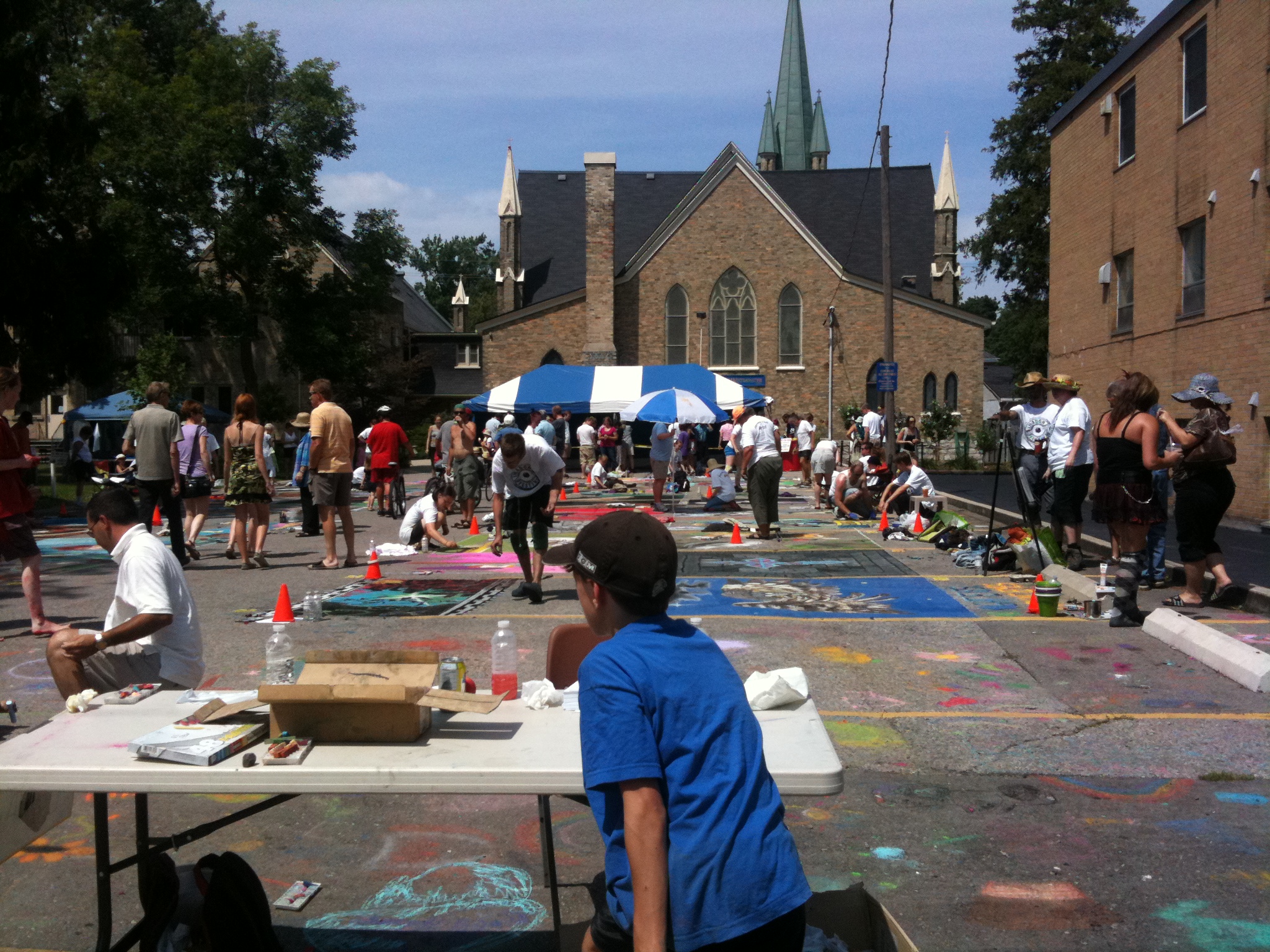
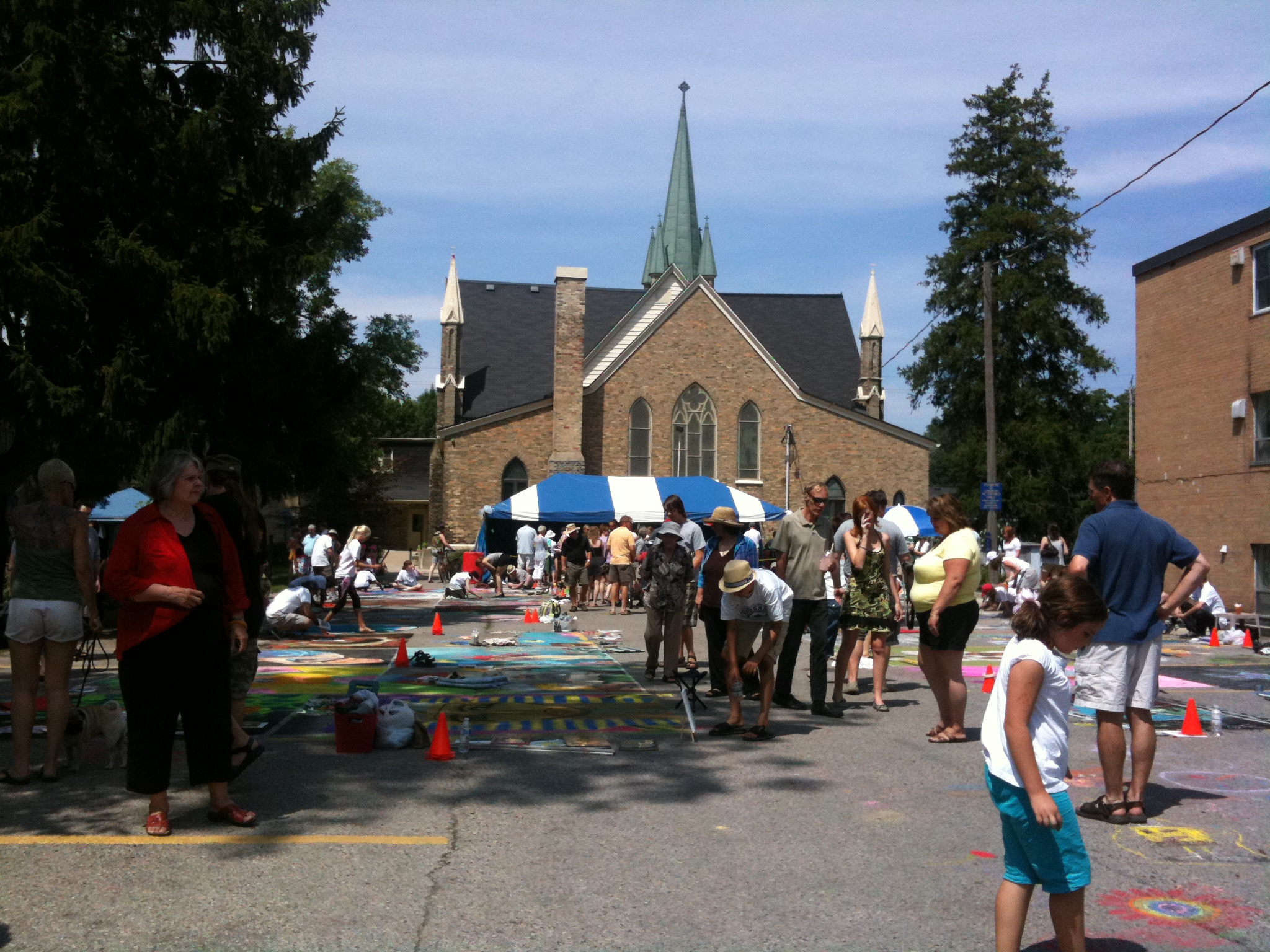
    This past weekend my wife and I attended http://www.imadon.org/

    I joined hundreds of people who walked by and watched art in progress as various artist in various categories competed with each other. People from all walks of life took time out of their weekend to go to Wortley village and join in the experience. I meet dozens of people, young families, artist, bikers and such. The entire mosaic that is London was out in full force.

    But the greatest part of the experience for me was the involvement of the Anglican Church. The previous years exhibition had always been held downtown, right by the JLC http://www.johnlabattcentre.com/ This year though St James Westminster http://www.saintjameswestminster.ca/main.php hosted the event in their parking lot.

    What an incredible and simple way to reach out to hundreds of people, to let them know where the local church is and who we are. A truly unique, impressive and simple action of hospitality managed to also be an incredible act of outreach and evangelism.

    Could it have been better? Perhaps…a bbq selling hotdogs and hamburgers, free water and music all day long would have helped. Opening the church proper to allow access to washrooms could have been a good gesture. But regardless of what could have been, it was still rather impressive and a joy to witness.

    Was anyone converted that day? Probably not, but hundreds of people will remember where St James is and how they hosted a civic event.

    A seed planted.

    Nuit Blanche

    June 21, 2010Marty 1 Comment

    For those unfamiliar with Nuit Blanche you will have to wait another year to experience local artist taking over the night.  If you are interested in finding out what you missed though, check it out here http://www.nuitblanchelondon.ca/

    Street theater in alley ways, parking lot performances and night club galleries is the bohemian experience that Nuit Blanche is for one night. In a few cases you become the model and eventually the artist will use you in social commentary.

    Live art is more than stepping back passively to experience a piece being created. Part of you can be drawn into the creative vortex of the artist and your energy inspires the artist to continue to create in the moment, a Rite of Spring so to speak; a rebirth.

    As we walked back to our car from downtown we passed the empty and dark Cathedral. I began to envision some of the performances on the lawn, or better yet, the doors of the cathedral church opened wide on a Saturday night for hundreds of visitors to walk in, experience art in progress and be welcomed into our church building.

    I am sure of the hundreds of people that attended Nuit Blanche many have never set foot in a church, let alone our church. What a great opportunity for evangelism, outreach and welcoming another community into our midst. What a great opportunity it would be to use our facilities to help another community within the city. What a wonderful chance to open our doors and say come in.

    I move on from the closed doors and the dark lawn and continue walking on Richmond Street wondering what could be next year at Nuit Blanche and I felt hope and a sense of possibility.

    Proudly powered by WordPress | Theme: Fictive by WordPress.com.