Genesis 6:1-8

When people began to multiply on the face of the ground, and daughters were born to them, the sons of God saw that they were fair; and they took wives for themselves of all that they chose. Then the Lord said, ‘My spirit shall not abide in mortals for ever, for they are flesh; their days shall be one hundred and twenty years.’ The Nephilim were on the earth in those days—and also afterwards—when the sons of God went in to the daughters of humans, who bore children to them. These were the heroes that were of old, warriors of renown.

The Lord saw that the wickedness of humankind was great in the earth, and that every inclination of the thoughts of their hearts was only evil continually. And the Lord was sorry that he had made humankind on the earth, and it grieved him to his heart. So the Lord said, ‘I will blot out from the earth the human beings I have created—people together with animals and creeping things and birds of the air, for I am sorry that I have made them.’ But Noah found favour in the sight of the Lord.

I apologies for taking so long to update. I have been struggling with this passage and what to say about it. The amount of questions that come from reading it just seemed to increase each time that I come back to it. In many ways it felt like I was reading the teaser for a new program on Space.

In this passage we have the sons of God who take human wives and have children. The children born are the heroes of old. Sounds very similar to Hercules and much of ancient Greek mythology. God, the high God has sons who are also divine that wonder the earth and take human sexual partners.

Also The Nephilim were on the earth in those days. The Nephilim are mythical giants. Perhaps similar to the Titans from Greek mythology, but that is nothing but shear speculation on my part.

I feel as though I should be getting my popcorn out and a giant diet Coke, sitting back and getting ready to watch the new screening of The Clash of the Titans. This is followed up with God watching humanity, seeing the wickedness of humans and deciding to blot out all of creation. Except that Noah has found favor with God.

Clearly those in ancient Israel did not see God has omniscient. God did not or could not foresee the wickedness of humanity. But this does explain previous passages where God spoke in the plural. God clearly was referring to his divine sons when speaking in the plural, perhaps even to a divine council of gods over which Yahweh was the supreme ruler.

Obviously this is pre-Christian understanding of the world, but what should be troubling for Christians in this passage is that according to doctrine, Jesus is the only son of God. Except here we have scripture that clearly stipulates to their being many sons of God. Of course this does not change that Jesus Christ is the first born of all creation and the first born of the dead. Those pieces of doctrine are unaffected by this passage.

The next thing we grapple with is that God is sorry that he had made humanity. Sorry implies that God is less than perfect. God made a mistake, or so he seems to be admitting.

Frankly, this passage should trouble Christians greatly because it challenges some of our basic assumptions about God. What it does highlights for us though is the mythological nature of Genesis and the first five books of the bible really. These foundational myths and stories are exactly that, stories. It is difficult for many Christians to accept that maybe God didn’t create the world according to the tales in Genesis. Having said that, that doesn’t preclude God from still being the creator.

Growing to a mature faith in God we come to realize that faith doesn’t provide certainty. Faith still is the confident belief or trust in a person, idea, or thing that is not based on proof. But we need to mix our faith with reason and understanding that within these stories is God’s revealed truth, maybe not literal truth but allegorical, mythological, eschatological and so on.

The sons of God took human wives and giants once roamed the earth. What does this tell us of our world and God’s action in it? To that I have no answer today, but a renewed desire to keep reading scripture in hopes that the answer will soon be found.
Genesis Chapter 5

This is the list of the descendants of Adam. When God created humankind, he made them in the likeness of God. Male and female he created them, and he blessed them and named them ‘Humankind’ when they were created.

When Adam had lived for one hundred and thirty years, he became the father of a son in his likeness, according to his image, and named him Seth. The days of Adam after he became the father of Seth were eight hundred years; and he had other sons and daughters. Thus all the days that Adam lived were nine hundred and thirty years; and he died.

When Seth had lived for one hundred and five years, he became the father of Enosh. Seth lived after the birth of Enosh for eight hundred and seven years, and had other sons and daughters. Thus all the days of Seth were nine hundred and twelve years; and he died.

When Enosh had lived for ninety years, he became the father of Kenan. Enosh lived after the birth of Kenan for eight hundred and fifteen years, and had other sons and daughters. Thus all the days of Enosh were nine hundred and five years; and he died.

When Kenan had lived for seventy years, he became the father of Mahalalel. Kenan lived after the birth of Mahalalel for eight hundred and forty years, and had other sons and daughters. Thus all the days of Kenan were nine hundred and ten years; and he died.

When Mahalalel had lived for sixty-five years, he became the father of Jared. Mahalalel lived after the birth of Jared for eight hundred and thirty years, and had other sons and daughters. Thus all the days of Mahalalel were eight hundred and ninety-five years; and he died.

When Jared had lived for one hundred and sixty-two years he became the father of Enoch. Jared lived after the birth of Enoch for eight hundred years, and had other sons and daughters. Thus all the days of Jared were nine hundred and sixty-two years; and he died.

When Enoch had lived for sixty-five years, he became the father of Methuselah. Enoch walked with God after the birth of Methuselah for three hundred years, and had other sons and daughters. Thus all the days of Enoch were three hundred and sixty-five years. Enoch walked with God; then he was no more, because God took him.

When Methuselah had lived for one hundred and eighty-seven years, he became the father of Lamech. Methuselah lived after the birth of Lamech for seven hundred and eighty-two years, and had other sons and daughters. Thus all the days of Methuselah were nine hundred and sixty-nine years; and he died.

When Lamech had lived for one hundred and eighty-two years, he became the father of a son; he named him Noah, saying, ‘Out of the ground that the Lord has cursed this one shall bring us relief from our work and from the toil of our hands.’ Lamech lived after the birth of Noah for five hundred and ninety-five years, and had other sons and daughters. Thus all the days of Lamech were seven hundred and seventy-seven years; and he died.

After Noah was five hundred years old, Noah became the father of Shem, Ham, and Japheth.

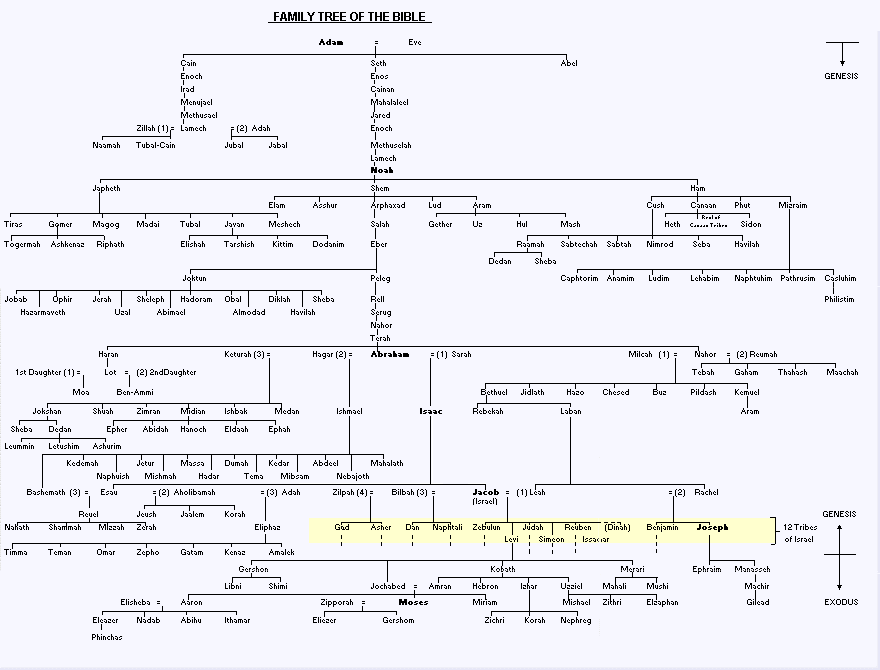
The desire to show that the history of Israel was no human accident, but that from the beginning it had been shaped by the sure and sovereign will of God, Genesis has constructed for us a genealogy. The descendants of Israel begin the telling of their history with the purposeful creation of Adam by God and then trace their genealogy from Adam to Noah, and then from Noah to Abraham.

This long chapter of begatting is P’s (the priestly source) attempts to draw a divine origin for the people of Israel, probably over and against the other surrounding peoples, such as the Babylonians. In such manner Israel becomes the People of God and all other civilizations become the “other” and need not be treated as equal.

For one, this would allow the People of God to justify their entry into the Promised Land as conquerors. So you could see how P would want to re-write divine origins to justify the actions of the nation. In a way it makes perfect sense.

It also allows a people to perform acts of brutality and aggression as the Chosen People of God. It is this same mentality that has lead the United States of America to the belief that their way of life is the best, since they are the new chosen people. Which prompts the desire to impose their way of life upon others in the name of freedom.

Aside from this there are a few other things that I wish to draw your attention to and perhaps this may support the idea that P has revised some of the early tradition and oral sources of J and E. In the previous chapter Cain knew his wife and she bore Enoch. And from Enoch line comes Lamech. But in this chapter we pick up the genealogy from Adam’s third son, Seth.

And from Seth we get a line that leads to, well you guest it, Enoch. Then it leads to Mathuselah and then Lamech, just like the previous chapter.

Is this P blending again, or is this a different genealogy altogether, but wiyj the same names? After all, the people of Israel cannot be descended from Cain; they would have to have a divine ancestry that traced back to Adam through his third son or they would be just like everyone else in the world. So is this revisionist again? Or are there two genealogies wit the same names?

The next thing of course is Enoch himself. Enoch walked with God. Does this mean he was a priest or prophet? Did he somehow know God while others did not? It would seem to be the case to me at least that he did know God in a special way.

And then he is no more because God takes him. Takes him where? Heaven? Since all others die, this seems very important in some way. Later in the tradition there is Elijah, who was taking up bodily into heaven, but others die and then ascend, like Moses. So is this a case of bodily going to heaven? Is it like Elijah’s bodily ascension?

Whatever the answer is, the importance of having a genealogy that has divine origins or divine creation is very important to every culture. As such we should not be surprised to see such a genealogy amongst the Hebrew scriptures, nor surprised that Christians claim this same genealogy.

The question is this though, does one need claim this genealogy to be considered made in the image and likeness of God?

Why should social media be important to the church?

Social media’s importance, frankly, can be found in scripture. Matthew 28:18-19, the Great Commission to the disciples was and still is to go forth into the world baptizing in the name of the Father, the Son and the Holy Spirit and teaching all that Jesus had taught. Christians cannot be divorced of the call to go out and evangelize. It is who we are.

Social media allows the church and individual Christians to fulfill the Great Commission. Social media allows us to go where the next generation is and to engage with them openly and honestly. Yet many in the church are guarded and they doubt the importance of social media. But what if they knew…

Having a social media strategy is no longer an option for the church in North America. It simply is something we must do. With over 50% of the population of the planet under the age of 30 and 96% of millennials in North America having joined a social network, we can no longer afford to be silent.

After all, if we are not talking to them about Christ, then who is?

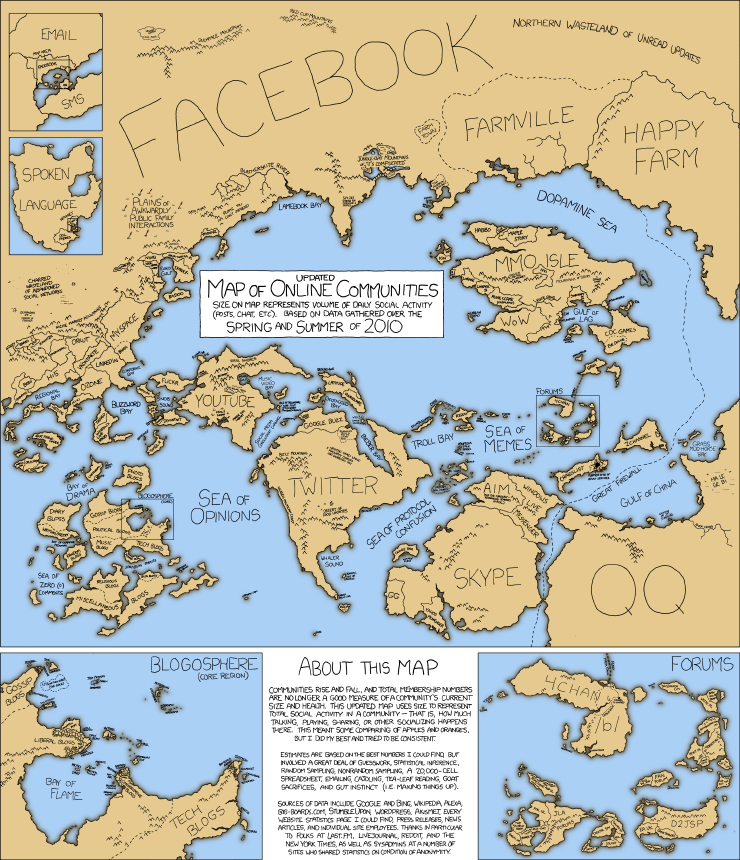
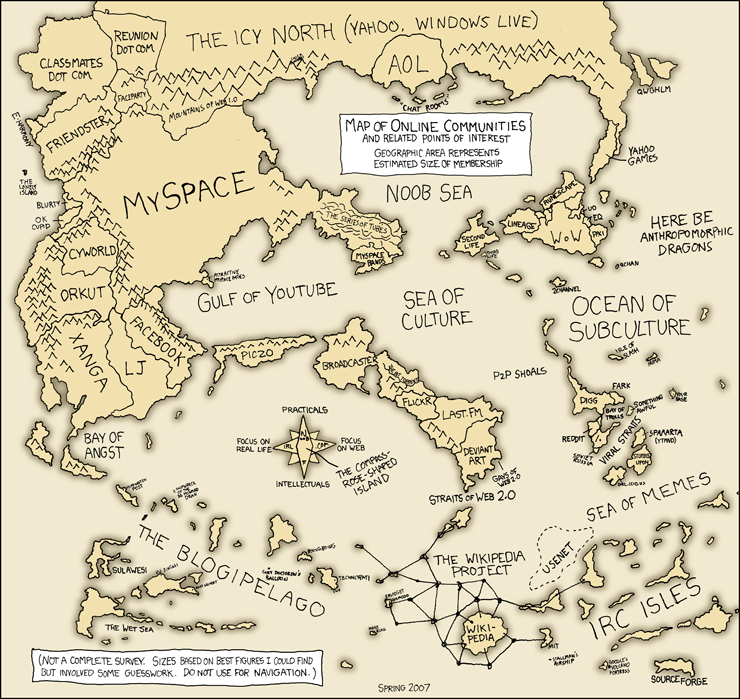
Does this mean we rush out and spend big money on social media, trusting the first person to promise a large ROI? Obviously not. We have to come to understand the social media environment and how it is changing and evolving. For example here is a social media map from 2005 courtesy of www.xkcd.com:

And here is one from 2010.

Sound research into the changing landscape will show that Myspace is not the place to break into the social media anymore. Also good research will also help you identify the demographics that you wish to reach. For instance, the fastest growing demographic on Facebook is women 55-65. Yet you are unlikely going to get that demographic on Twitter. Knowing what networks people frequent will undoubtedly shape the social media strategy that your parish and community employs.

Who you wish to reach becomes just as important as how. If you want to reach the next generation, then pull up a keyboard and jump in before it is too late.